Notes › Fundamentals of Photonics (Saleh & Teich) Concept
Spherical Lens
262 words 2 min Modified
Table of Contents
Construction
- Two spherical surfaces with radii $R_1$ and $R_2$
- Refractive index $n$
- Thickness $\Delta$
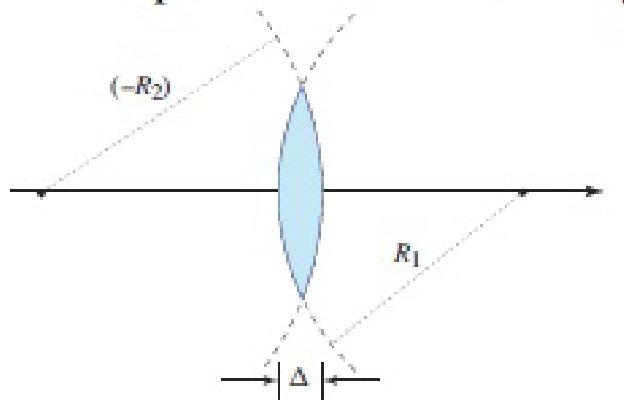
Tracing
-
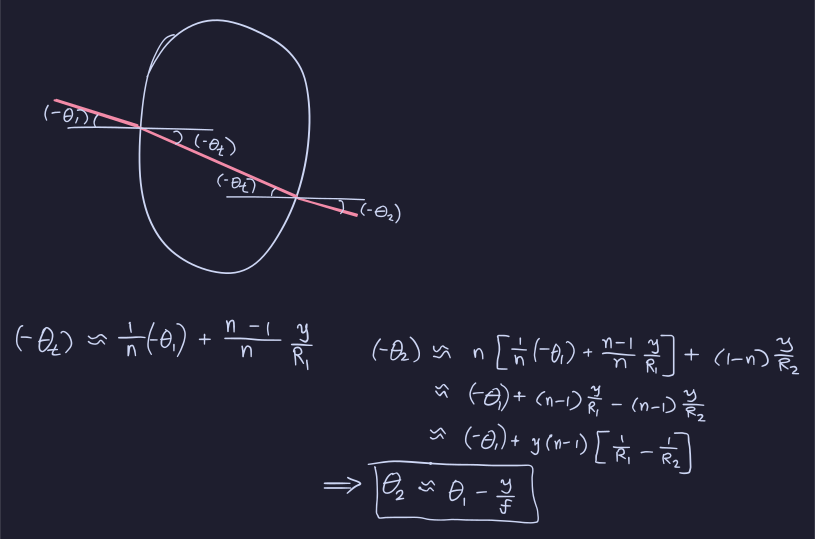
Ray crosses the first boundary at height $y$ with angle $\theta_1$
-
$\theta_2$ is obtained via
and the resulting ray is extended until the second boundary
- $\theta_2$ then becomes $\theta_1$ and the property is applied again for the exiting ray
“Thin Lens” Assumption
- If the lens is thin, we may assume the emergent ray has approximately the same $y$ as the incident ray. In addition to simplifying things (we only have to track two angles, not four), this yields the following properties:
Theorem (Angle Relationships and Focal Length).
$$
\theta_{2} = \theta_{1} - \frac{y}{f} \quad \quad \quad \frac{1}{f} = (n-1)\left( \frac{1}{R_{1}} - \frac{1}{R_{2}} \right)
$$
- Sign convention for $R$:
- Convex: $R > 0$
- Concave: $R < 0$
- For a biconvex lens, $R_1 > 0$ and $R_2 < 0$, which implies $f > 0$
Proof of Angle Relationships and Focal Length. (
EXERCISE 1.2-4[Saleh & Teich, Fundamentals of Photonics, p. 181])
Theorem (Imaging Equation and Magnification).
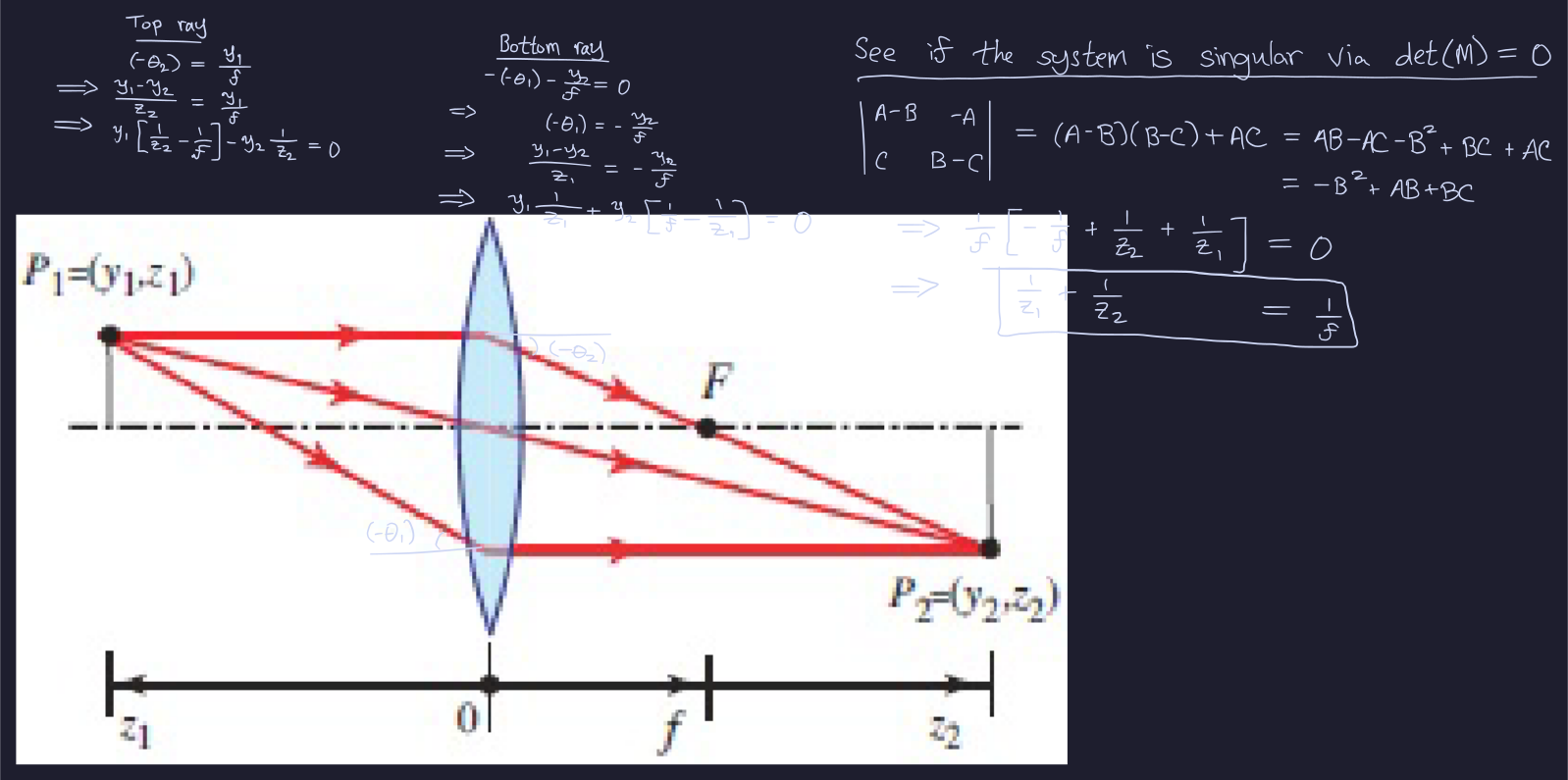
For $P_1 \coloneqq (y_1, z_1)$ and $P_2 \coloneqq (y_2, z_2)$, we have:
$$ \frac{1}{z_{1}} + \frac{1}{z_{2}} = \frac{1}{f} \quad \quad \quad y_{2} = -\frac{z_{2}}{z_{1}} y_{1} $$- These results are identical to the Spherical Mirror:
- There is a one-to-one correspondence between the conjugate planes $(z=z_1, z=z_2) \mapsto (P_1, P_2)$ with magnification factor $m=-z_2/z_1$
- $m=1 \iff z_1=z_2=2f$
Proof of Imaging Equation and Magnification. (
EXERCISE 1.2-4[Saleh & Teich, Fundamentals of Photonics, p. 181])
Sources
- Saleh & Teich, Fundamentals of Photonics