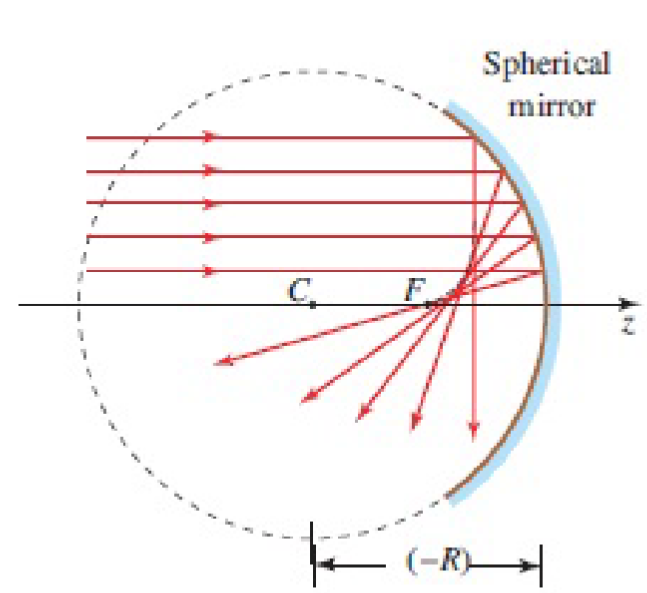
- Mirror in the shape of a sphere
- Different parallel rays focus on the axis at different points
- Rays that are close enough to the axis will approximately focus at $\frac{R}{2}$ from the center
- This is due to the small angle approximation ($\sin \theta \approx \theta$), and the rays are known as paraxial rays
- Can be concave or convex
- The radius of curvature, $R$, is negative for concave mirrors and positive for convex mirrors
- More on paraxial rays
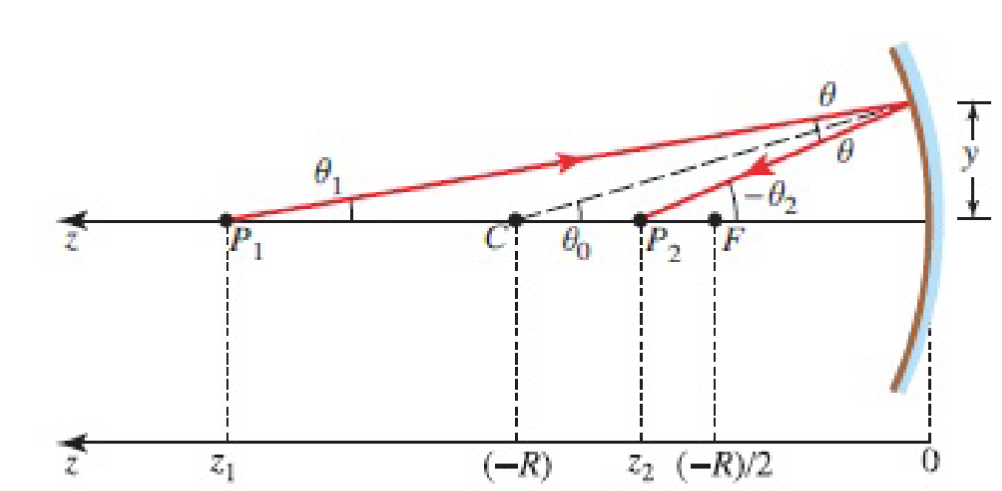
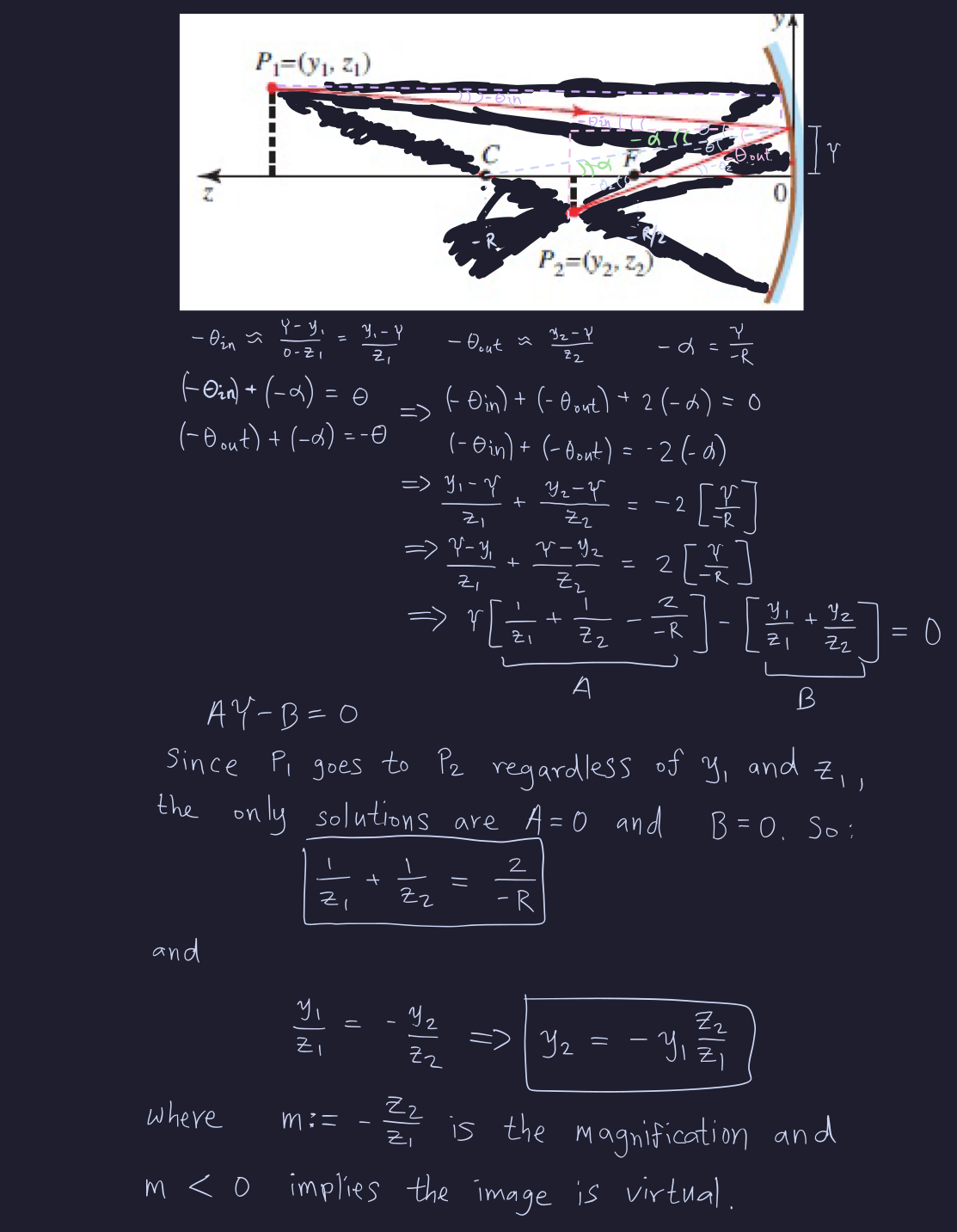
- There is a one-to-one correspondence between paraxial rays originating from points on the mirror axis and their destination (image) points, which also lie on the mirror axis
- Using angle relationships, we have $\theta_{1} = \theta_{0}-\theta \implies 2\theta_{0} = \theta_{1} + (-\theta_{2})$
- If $\theta_0$ is small enough, $\tan \theta_{0} \approx \theta_{0}$, which gives $\frac{2y}{(-R)} \approx \theta_{1} + (-\theta_{2})$
- And if $\theta_1$ and $(-\theta_2)$ are small enough, we have $\frac{2}{(-R)} \approx \frac{1}{z_{1}} + \frac{1}{z_{2}}$
- If $z_1 = \infty$, then $z_2 = \frac{(-R)}{2} = f$. This results in the imaging equation for paraxial rays: