Notes › MATH 5441: Financial Mathematics Lecture 4
Simple Interest
468 words 4 min Modified
Table of Contents
Simple Interest
-
Already covered in
Types of Interest
Definition 01.2 (Simple Interest).Simple interest occurs when interest is only calculated using the original principal; that is, interest earned from prior periods is not required for interest calculations for consecutive periods.
- It is characterized by $P$, the interest rate per measurement period $(i)$ and number of measurement periods $(t)$
- The amount value is linear in $t$
Definition 01.3 (Compound Interest).Compound interest occurs when interest is accumulated on the principal in discrete subintervals of the measurement period.
- It is characterized by $P$, the nominal interest rate $(r)$, the number of subdivisions for a single measurement period $(n)$, and the number of measurement periods $(t)$
- The amount value is exponential in $t$ (assuming $n > 1$)
The accumulated amount for one measurement period is:
$$ A(n) = P\left(1+\frac{r}{n}\right)^n. $$For multiple periods:
$$ A(n, t) = P\left(1+\frac{r}{n}\right)^{nt}. $$The effective interest rate (ER) for one measurement period is
$$ ER(n) = \left[ \left(1+\frac{r}{n}\right)^n - 1 \right] \cdot 100\%. $$For multiple periods:
$$ ER(n,t) = \left[\left(1+\frac{r}{n}\right)^{nt} - 1\right] \cdot 100\%. $$Example: If $r=0.10$ is compounded semi-annually ($n=2$), then after one year ($t=1$):
$$ A(2, 1) = P\left(1+\frac{0.10}{2}\right)^2 = 1.1025P, $$so:
$$ ER(2,1) = 1.1025 - 1 = 0.1025 = 10.25\%. $$ -
The effective interest rate $a(1) - 1$ is sometimes called the simple interest rate
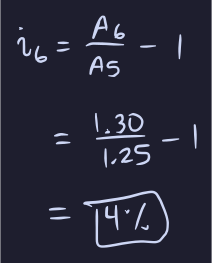
- The effective interest rate is decreasing in each consecutive period and converges to zero
-
$n$th effective interest rate
(Example 4.1
[Finan, A Basic Course in the Theory of Interest and Derivatives Markets, p. 32])
Absolute Interest Earned
- Absolute interest, $I_n=A(n)-A(n-1)$, is constant since the accumulation function is linear
$\mathbb{R}^+$ Extension of Simple Interest
- So far, we have treated simple interest as discrete unit steps, but we can make it integrable
- We can extend this definition to all positive real numbers
- The interest earned for any time period $t+s$ is the sum of the interests earned in $t$ and $s$ (assuming a principal of $1)
- Therefore, the simple interest equation holds for any nonnegative real number
- Simple interest is the only accumulation function in which the above property holds
(Example 4.2
[Finan, A Basic Course in the Theory of Interest and Derivatives Markets, p. 34])
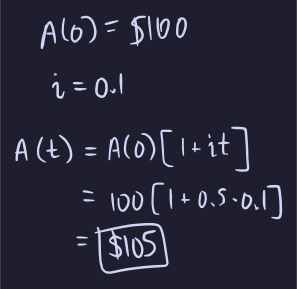
(Example 4.3
[Finan, A Basic Course in the Theory of Interest and Derivatives Markets, p. 34])

Approximating Compound Interest
- For $t \in [0, 1]$, simple interest is approximately equal to compound interest
(Example 4.4
[Finan, A Basic Course in the Theory of Interest and Derivatives Markets, p. 35])
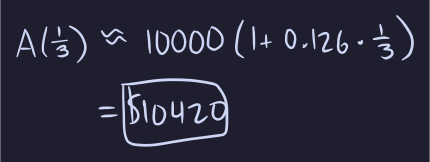
- Need to use Accumulation Factor formula if there is a deposit/withdrawal midway and add that on (
Example 4.5
[Finan, A Basic Course in the Theory of Interest and Derivatives Markets, p. 36])
Practice
Sources
- Finan, A Basic Course in the Theory of Interest and Derivatives Markets