Notes › ENGR 2341: Signals and Systems Lecture 14
Aliasing and Reconstruction
767 words 5 min Modified
Table of Contents
Aliases
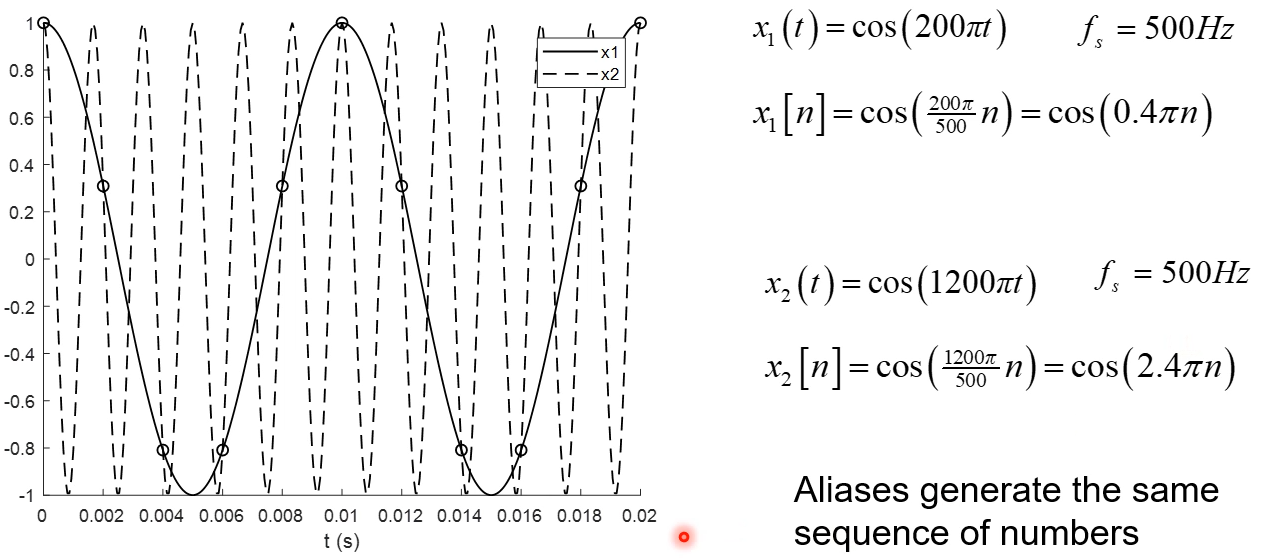
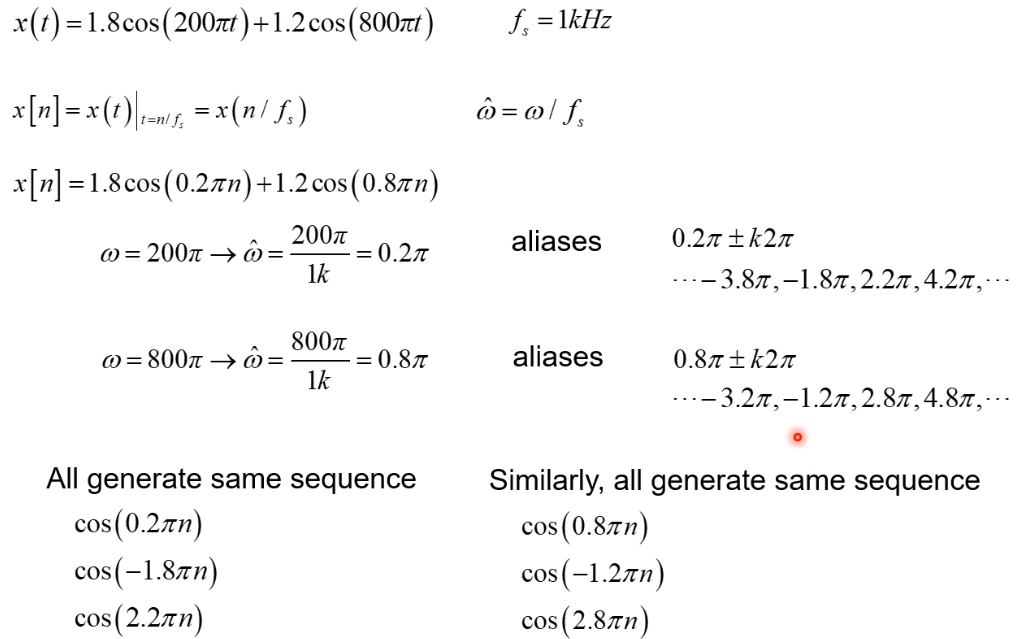
- Discrete-time frequencies differing by $2\pi k$ have equal amplitudes and are considered aliases
- Frequencies inside the Nyquist interval are called principal aliases
- There are an infinite number of aliases outside the Nyquist interval
- Sinusoids with different frequencies can produce the identical discrete sequences
- This occurs when $|f_1 - f_2| = k \cdot f_s$, which implies their principle aliases coincide
- This ambiguity can be avoided by sampling at the Nyquist rate of the sinusoid with the greatest $f_\text{max}$
Sampling in the Time Domain
- Impulse trains are used to retrieve continuous values at intervals of $T_s$
- This is possible due to the sampling property of impulse
- Therefore, $x[n] = x(nT_s)$, since the impulse train samples $x(t)$ every $T_s$
Sampling in the Frequency Domain
- Multiplying $x(t)$ by an impulse train in the time domain corresponds to convolution in the frequency domain
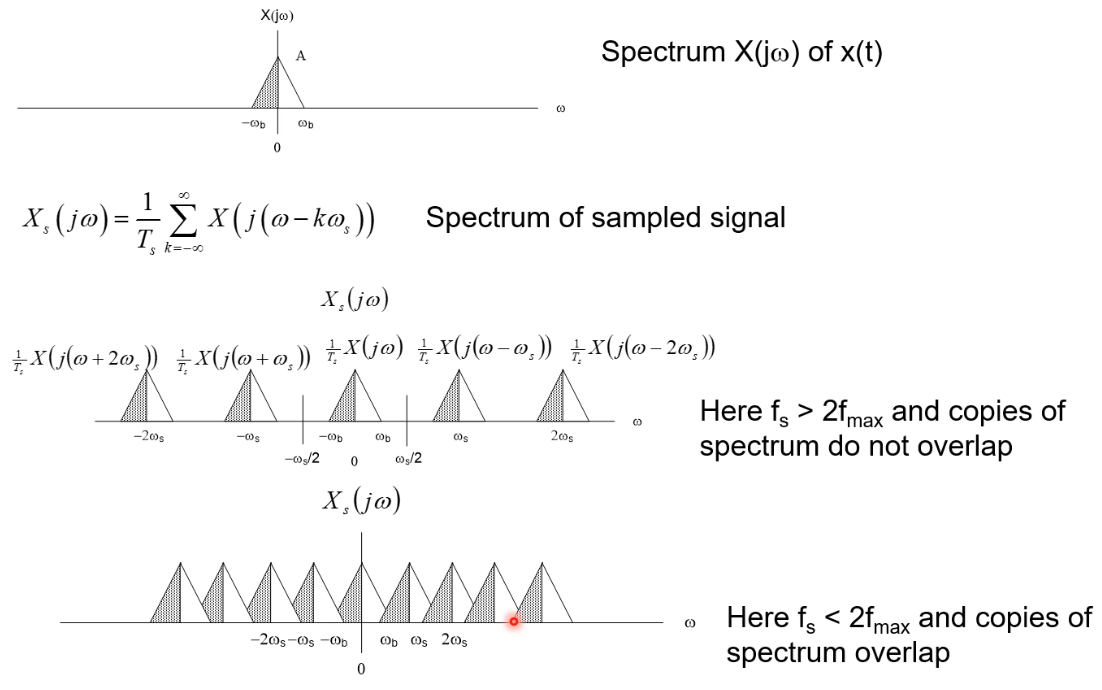
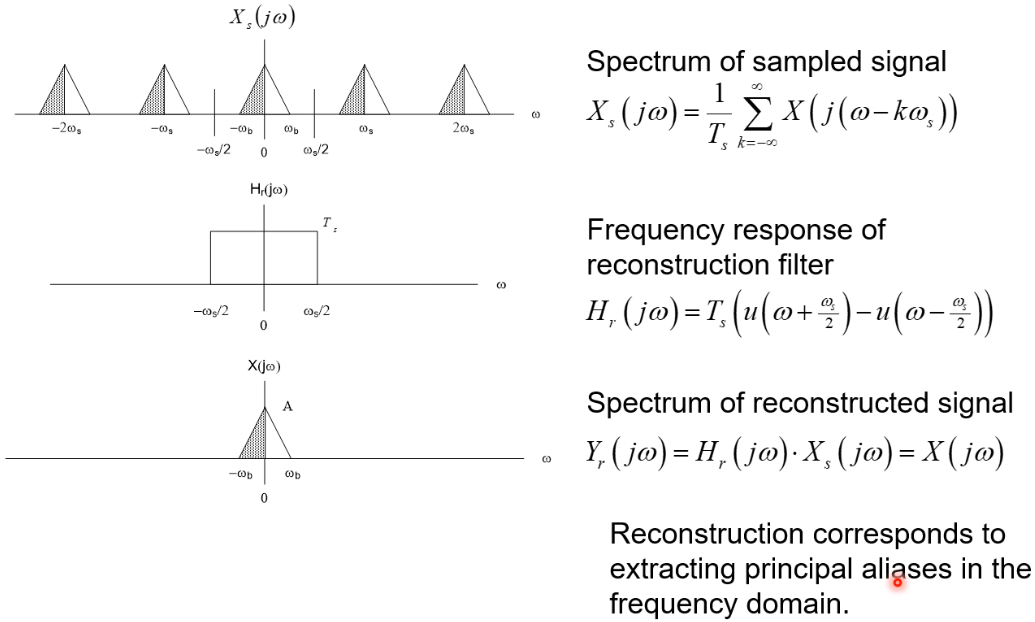
- The spectrum of a sampled signal, $X_s(j\omega)$, is obtained by convolving $X(j\omega)$ with an impulse train
- The convolution causes periodic replications of $X(j\omega)$, spaced apart by $\omega_s$
- The amplitude of each spectra is also scaled down by $\frac{1}{T_s}$
- If the sampling frequency is less than the Nyquist rate, the copies of the spectra will overlap
Reconstruction
- The process of creating analog signals from samples using a reconstruction filter that extracts only the principal aliases (only one copy of the repeated spectrum)
Time Domain
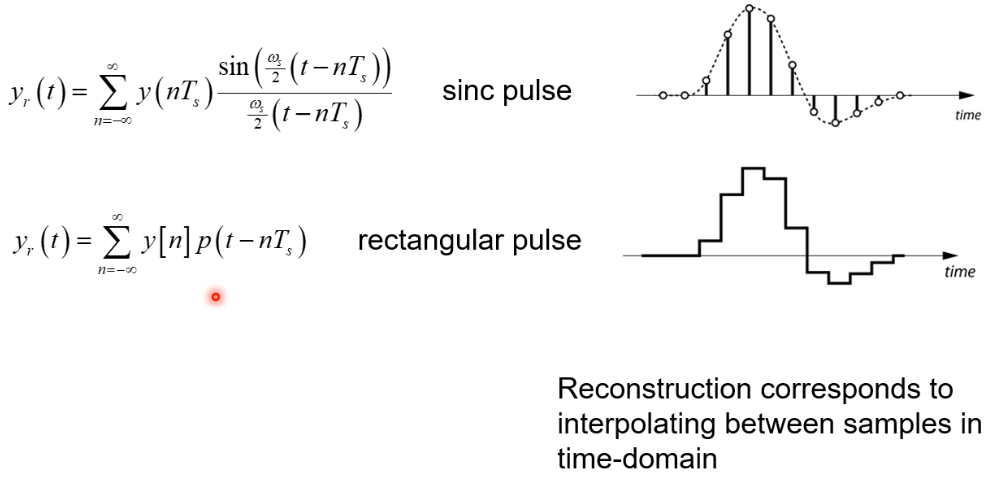
- In the time domain, this corresponds to replacing each sample with a weighted sinc pulse. When those pulses are summed together, it interpolates between the samples to reconstruct the analog signal
- This is because the sinc function has a peak at $t = 0$ and decays as $t$ moves away from zero. When these sinc pulses centered at each sample point are summed together, a smooth, continuous function is obtained
- In more practical applications, you use rectangular pulses instead of sinc
Frequency Domain
- In the frequency domain, this corresponds to using a low-pass filter to extract the spectra inside the Nyquist interval
- Passes frequencies in the range $|\omega| \leq \frac{\omega_s}{2}$
- Removes frequencies outside this range to eliminate aliasing
- In piecewise form:
Reconstruction Formulas
- The general form of reconstruction formula in the time domain is
where $y[n]$ are the sampled values of the signal and $p(t)$ is a pulse function
Sinc Pulse
- The reconstruction formula using the sinc pulse is:
- This sums over all the samples $y[n]$ and shifts each sinc pulse to the corresponding sample location $n T_s$
- The resulting signal is a continuous-time signal that approximates the original analog signal
Rectangular Pulse
- In practical applications, using an ideal sinc pulse is not feasible due to the infinite duration of the sinc function. Instead, a more commonly used approximation is a rectangular pulse, which is computationally simpler
- A rectangular pulse is defined as:
- This pulse has a finite duration of $T_s$ and is centered at each sample point. When we use this rectangular pulse to reconstruct the signal, we sum the shifted rectangular pulses weighted by the samples $y[n]$:
- This results in a piecewise constant approximation of the continuous signal, which is often used in digital-to-analog converters
Summary of both Methods
- Sinc Pulse: Ideal interpolation with infinite duration. This gives the best reconstruction, as it perfectly interpolates between samples and avoids any distortion
- Rectangular Pulse: Practical approximation with finite duration. This results in a piecewise constant reconstruction, which is easier to implement but introduces some distortion due to the abrupt transitions between samples, referred to at the Gibbs phenomenon
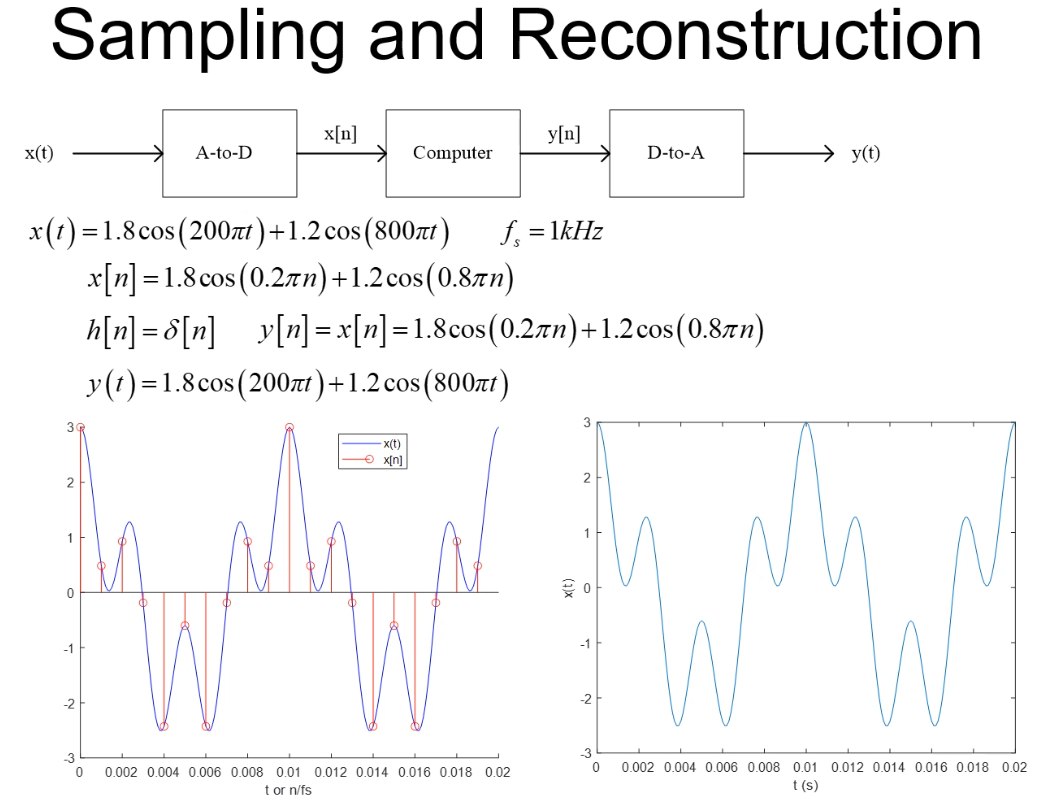
Sampling and Reconstruction Process Overview
- Sampling maps analog frequencies to discrete frequencies and replicates the discrete spectrum
- Signal bandwidth must be less than half of the Nyquist rate to avoid aliasing while sampling
- Finite duration signals are not bandlimited, so practical signals must be filtered to remove frequency components greater than $\frac{f_s}{2}$ via bandlimiting
- Reconstruction filter extracts the principal aliases to reconstruct the smoothest signal corresponding to the samples, denoted $y(t)$

References
- Aliasing and reconstruction (course handout)
- Whittaker–Shannon interpolation formula - Wikipedia]
Sources
- Aliasing and reconstruction