Notes › ENGR 2341: Signals and Systems Lecture 13
Sampling
197 words 1 min Modified
Table of Contents
Sampling
- Converts a continuous-time signal to discrete-time signal
- The signal is periodically measured over discrete intervals of time
- Each interval is called a time step
- Can be quantized over a finite number of bits to obtain a digital signal
- Bit depth is the number of bits used to represent a sample. This means that the range of the amplitude will be split into $2^n$ levels
- SQNR measures the quantization precision
- Conditions for a signal to be unambiguously represented by its samples
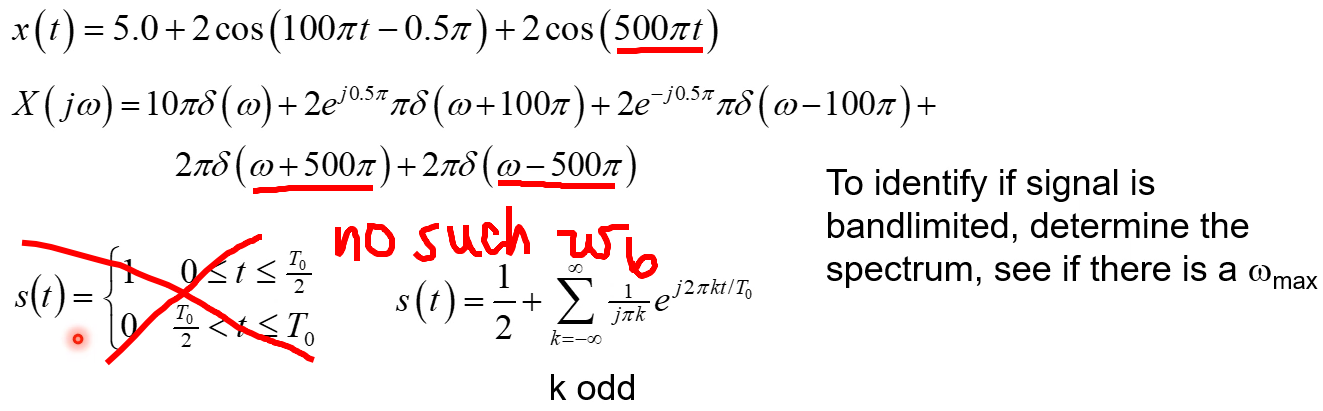
- Must be bandlimited
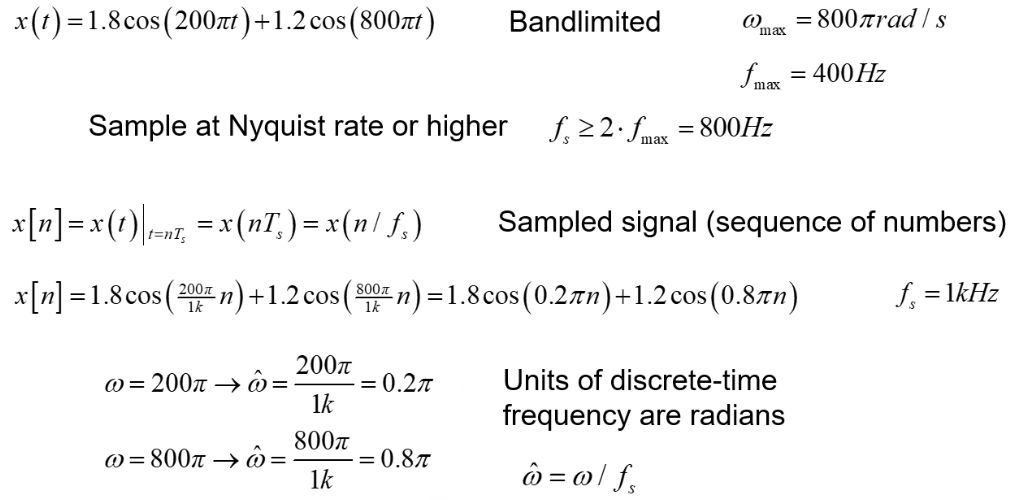
- Sampled at Nyquist rate or higher
Bandlimited Signals
- Have a finite spectrum
- There is an $f_\text{max} = \omega_{b}$ for which $X(j\omega) = 0$ for $|\omega| \gt \omega_{b}$
- Square waves are not bandlimited because they are represented by an infinite Fourier Series
Sampling and Spectrum
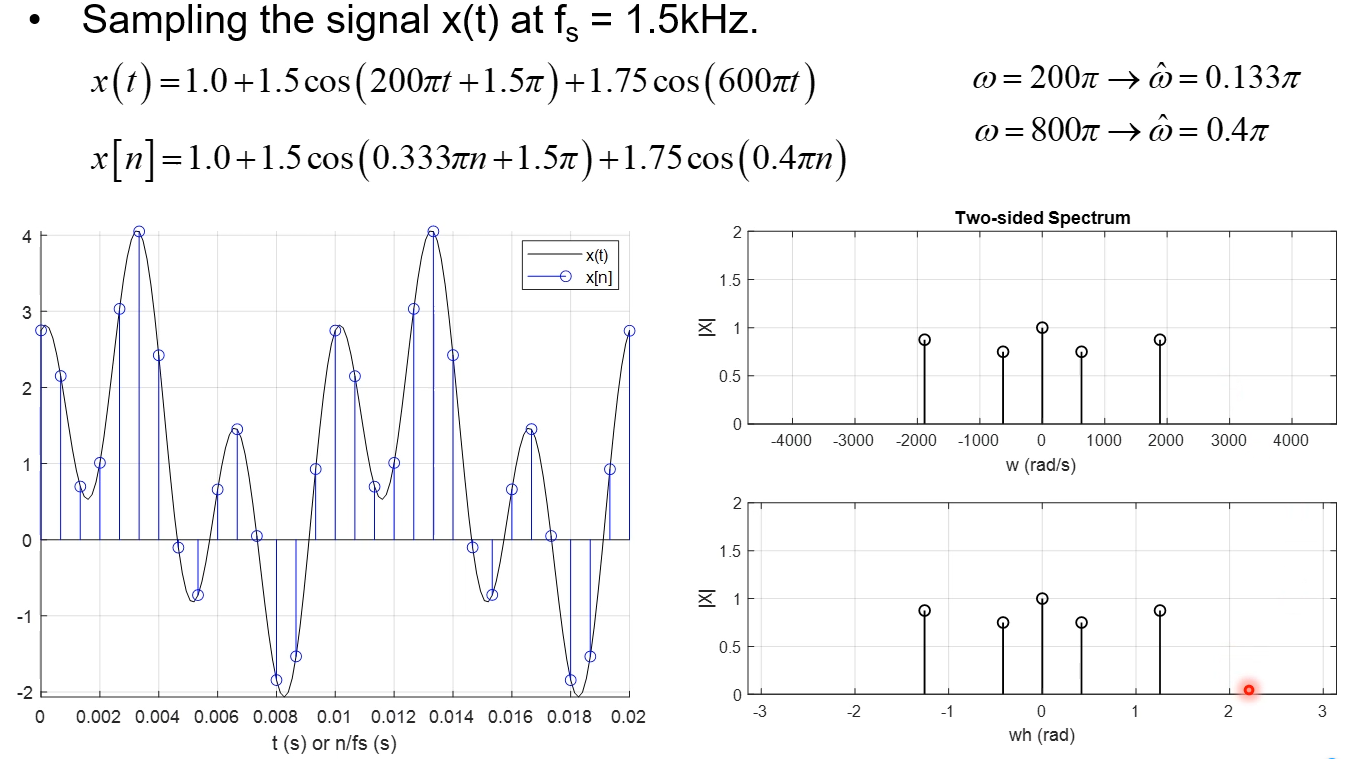
- Sampling a continuous-time signal creates a mapping between the spectra and the discrete-time domain with $\hat{\omega} = \frac{\omega}{f_s}$
- This constrains the discrete-time frequencies to the interval $[-\pi, \pi]$ (known as the Nyquist interval), with the amplitudes remaining unchanged
- $\frac{\omega_b}{\pi} = f_s$, assuming $\omega_b$ in rad/s and $f_s$ in Hz
- Basically, just remove $\pi$ to obtain the Nyquist rate from $\omega_b$
- discrete-time
References
- Sampling (course handout)
- ▶ Watch on YouTube
Sources
- Sampling