Notes › ENGR 2341: Signals and Systems Lecture 15
Discrete-time Fourier Transform
193 words 1 min Modified
Table of Contents
Types of Frequency Transforms
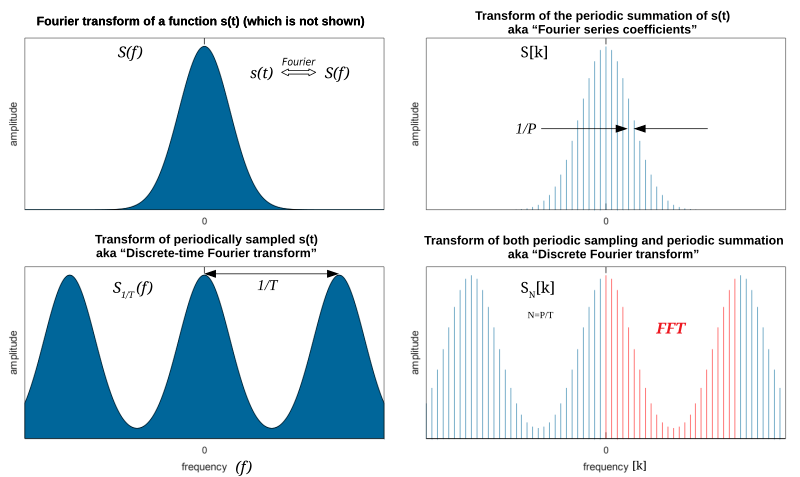
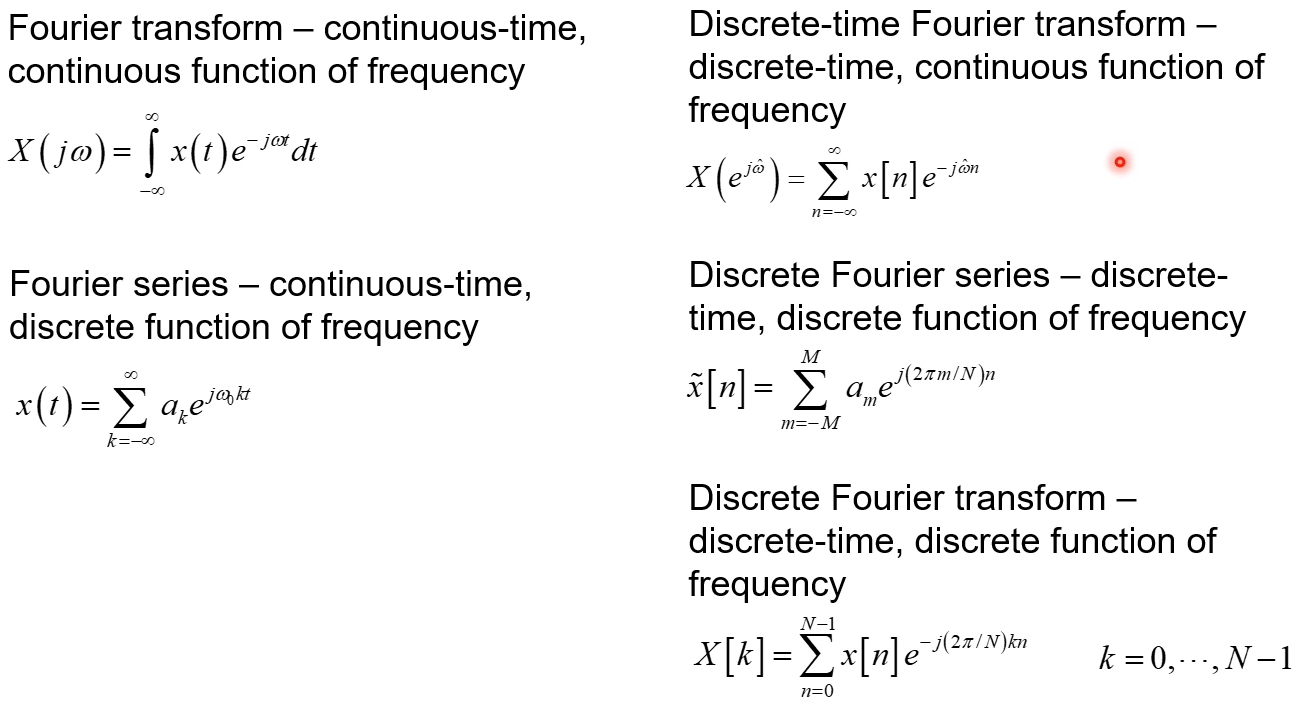
DTFT
- Transforms $x[n]$ (sequence of values) to a continuous function of frequency, $X(e^{j\hat{\omega}})$, with period $2\pi$
- Can be used to determine $X(e^{j\hat{\omega}})$, the continuous frequency spectrum of $x[n]$
- Can be used to find $H(e^{j\hat{\omega}})$, the frequency response of $x[n]$, by taking DTFT of $h[n]$, the impulse response
- Only exists for analytical purposes because it is impossible to process an infinite number of samples
- This makes it less important for computational processing, but DTFT may be used for short sequences
- Can use the Dtft table (course handout) for this purpose
- The sequence must be absolutely summable
- Finite-length sequences are always absolutely convergent
- Infinite length sequences are convergent if they are one-sided and decaying
Representation
$$X(e^{j\hat{\omega}}) = \sum_{n=-\infty}^{\infty} x[n]e^{-j \hat{\omega}n}$$Inverse DTFT
$$x[n] = \frac{1}{2\pi} \int_{-\infty}^{\infty} X(e^{j\omega})e^{j \hat{\omega}n} \ \mathrm{d}\omega$$Spectrum of Discrete-time Signals
- Practical, finite duration signals will always have a DTFT with a continuous frequency spectrum
- Cannot take the DTFT of any square wave functions, including $u(t)$, since they are not absolutely summable
- Some two-sided signals (sines/cosines and compkex exponentials) have DTFTs
References
- Dtft (course handout)
- Discrete-time Fourier transform
- Can anyone intuitively explain why the Dirac delta function contains all frequencies
Sources
- Dtft
- Dtft table (course handout)