Notes › Fundamentals of Electric Circuits (Sadiku) Lecture 5
Operational Amplifiers
670 words 7 min Modified
Table of Contents
Operational Amplifiers
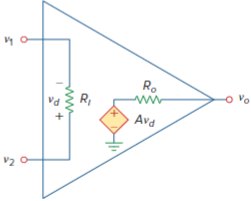
An active circuit element designed to perform mathematical operations of additional, subtraction, multiplication, division, differentiation, and integration. Consists of:
- Two inputs: inverting input $v_1$ and non-inverting input $v_2$
- Two power supplies: $V^+$ and $V^-$
- Input resistor $R_i$ with voltage drop $v_d$
- Voltage-controlled voltage source equal to $A v_d$
- Output resistor $R_o$
- Output terminal $v_0$
- Any input applied to the inverting terminal will appear inverted at the output
- The differential voltage input $v_d$ (voltage across $R_{i}$) is given by $v_{2}-v_{1}$
- Therefore, the output voltage $v_{o}$ which is equal to the voltage of the VCVS, is given by $Av_d = A(v_{2}-v_{1})$, where $A$ is the open-loop gain
- When there is feedback, the ratio $\frac{v_{o}}{v_{d}}$ is called the closed-loop gain
- Practically, $v_o \le |V_{\text{CC}}|$, which means there are three modes of operation:
- Positive saturation $(v_o = V_{\text{CC}})$
- Linear range $(-V_{\text{CC}} \le v_o = Av_{d} \le V_{\text{CC}})$
- Negative saturation $(v_{o} = -V_{\text{CC}})$
- We always assume that the op amps are linear and $v_o \in [-V_{\text{CC}}, V_{\text{CC}}]$
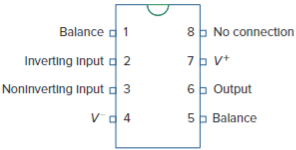
Pin Configuration
Circuit Symbol
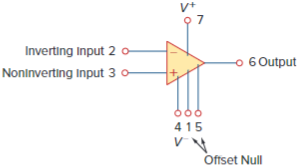
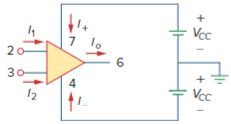
Circuit Symbol With Power
- By KCL, $i_o = i_{1} + i_{2} + i_{+} + i_{-}$
Non-Ideal Op Amp
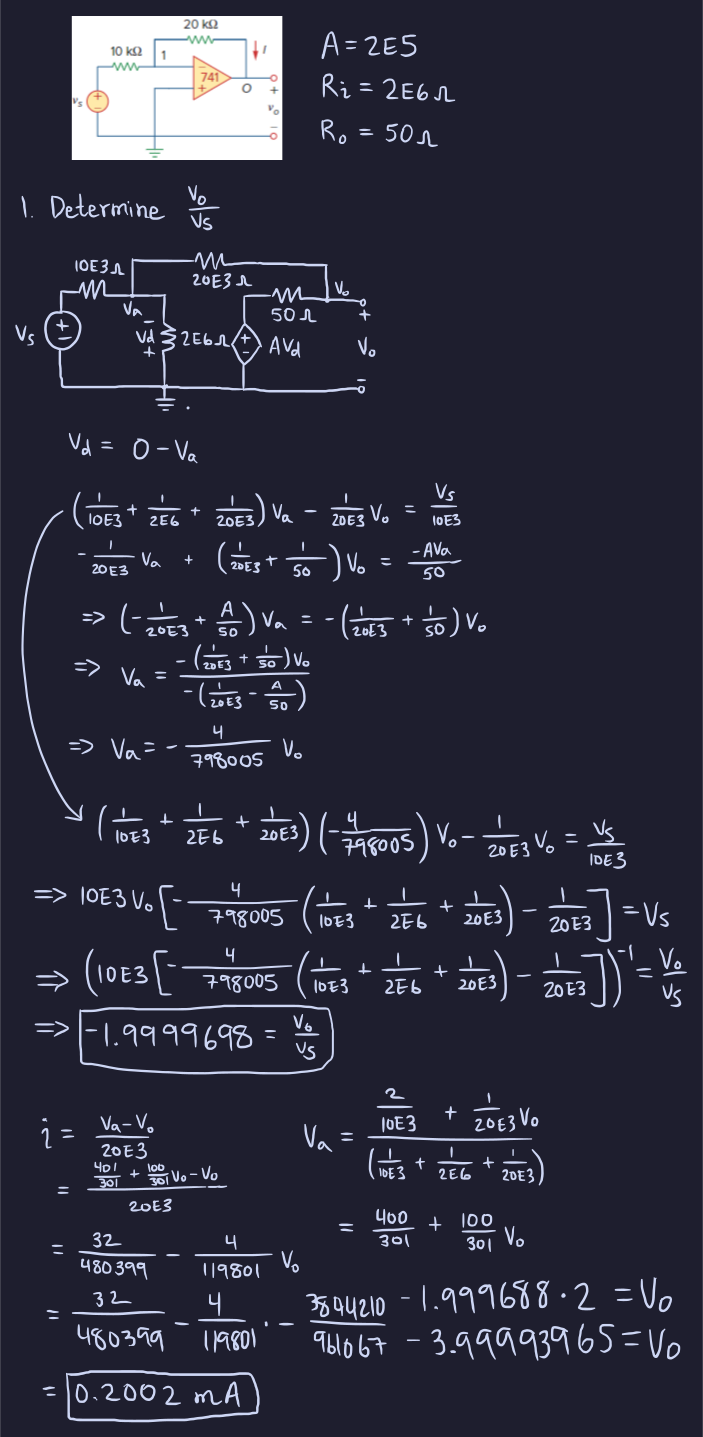
(Example 5.1
[Alexander & Sadiku, Fundamentals of Electric Circuits, 7th ed., p. 203])
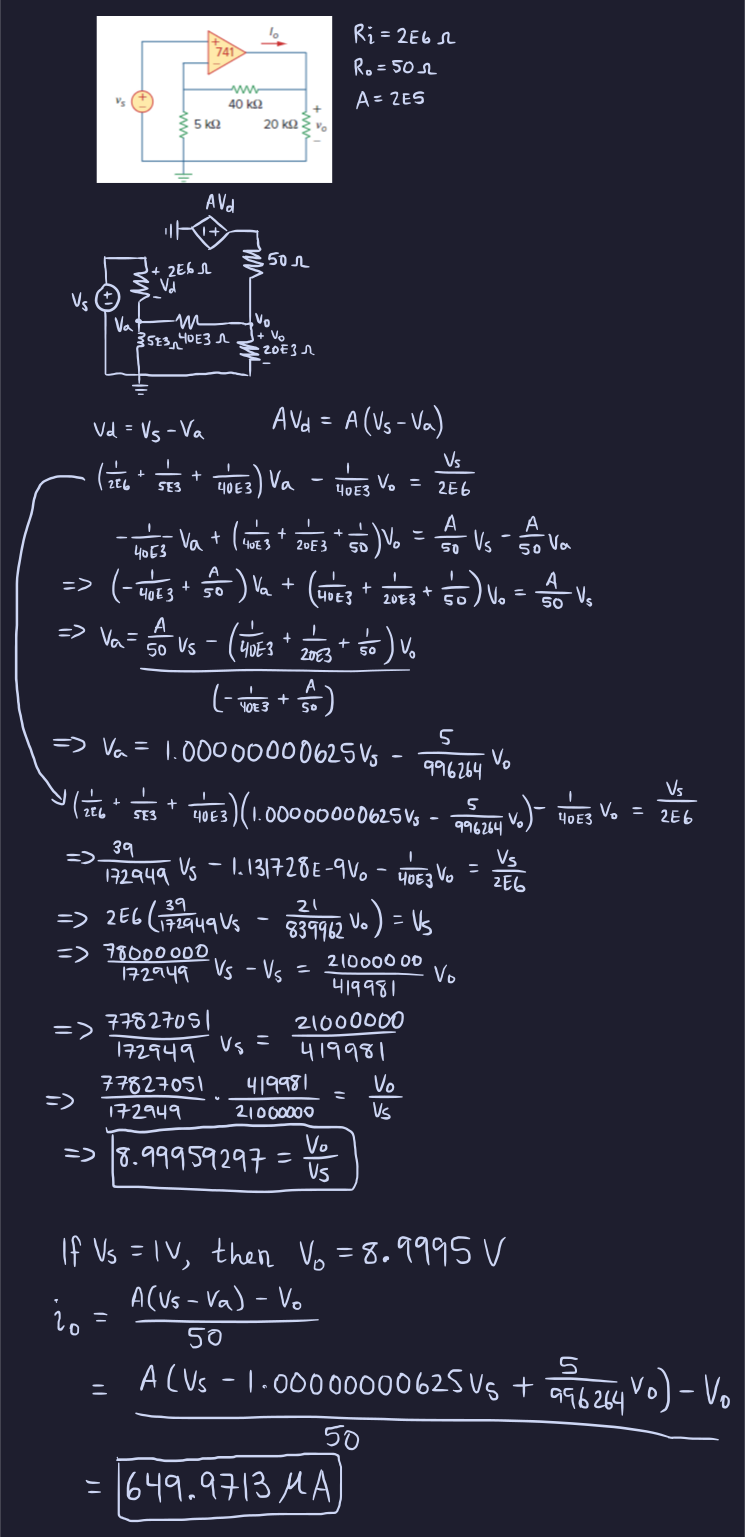
(Practice Problem 5.1
[Alexander & Sadiku, Fundamentals of Electric Circuits, 7th ed., p. 204])
Ideal Op Amp
An op amp is considered ideal if it has:
- Infinite open-loop gain
- Infinite input resistance
- Zero output resistance
- This means:
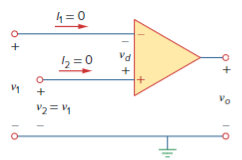
- The op amp has zero current in both input terminals (i.e., they are open circuits)
- The voltage across the terminals, $v_d$, equals 0, which means $v_1 = v_2$
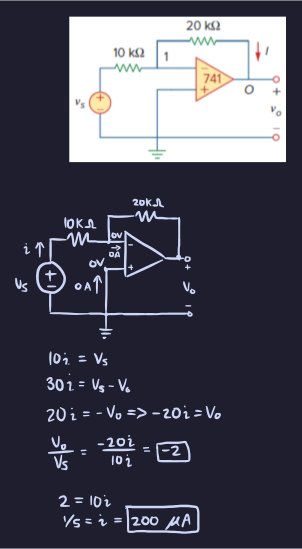
(Practice Problem 5.2
[Alexander & Sadiku, Fundamentals of Electric Circuits, 7th ed., p. 205])
Op Amp Configurations
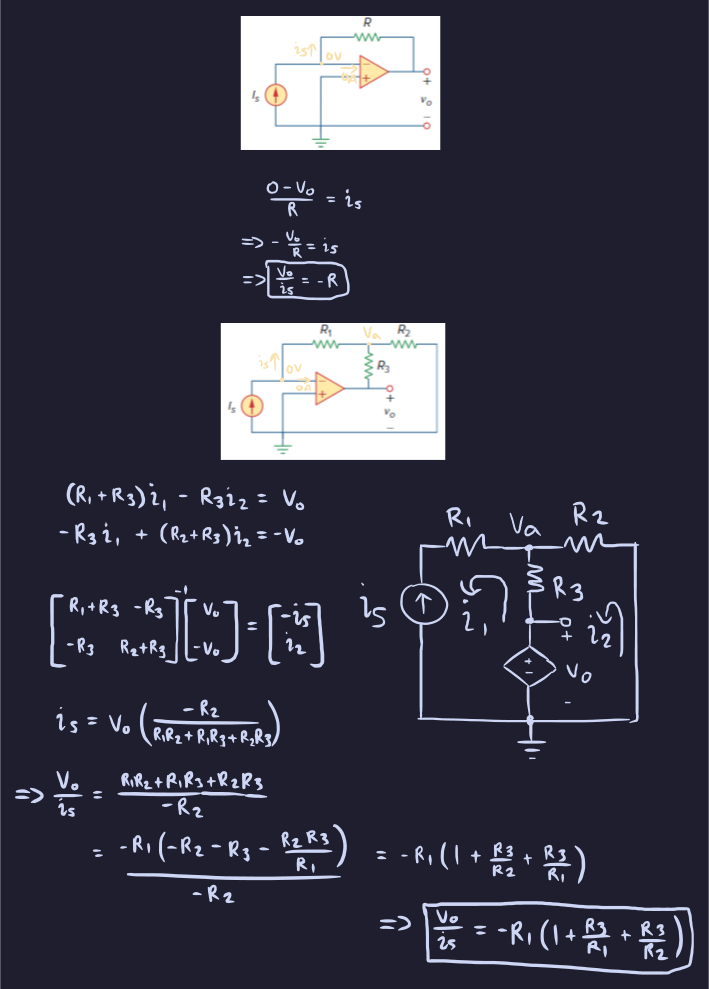
Inverting Amplifier
- Reverses the polarity of the input signal while amplifying it
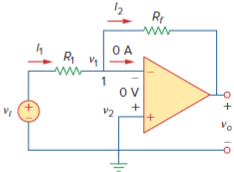
(Example 5.3
[Alexander & Sadiku, Fundamentals of Electric Circuits, 7th ed., p. 206])
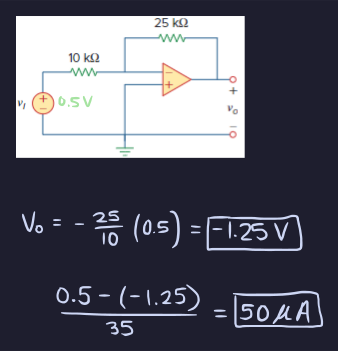
(Practice Problem 5.3
[Alexander & Sadiku, Fundamentals of Electric Circuits, 7th ed., p. 206])
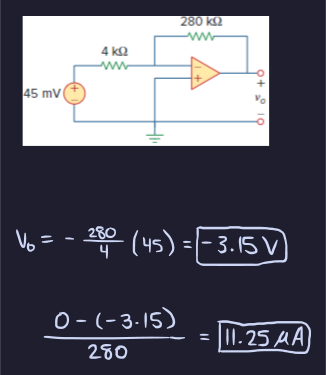
(Example 5.4
[Alexander & Sadiku, Fundamentals of Electric Circuits, 7th ed., p. 207])
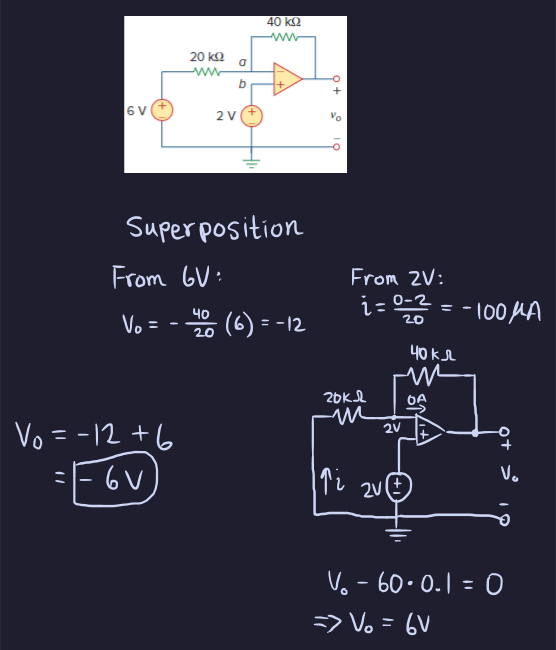
(Practice Problem 5.4
[Alexander & Sadiku, Fundamentals of Electric Circuits, 7th ed., p. 207])
Noninverting Amplifier
- Provides a positive voltage gain
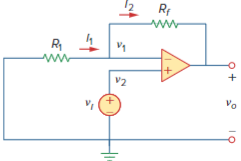
- Special case: the gain becomes 1 if $R_f = 0$ (short circuit) or $R_1 = \infty$ (open circuit) or both
- This is known as a voltage follower (or unity gain amplifier) because $v_o = v_i$
- Useful to isolate two cascading stages of a circuit
(Example 5.5
[Alexander & Sadiku, Fundamentals of Electric Circuits, 7th ed., p. 208])
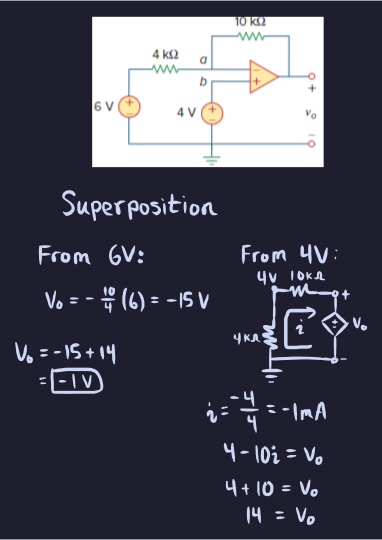
(Practice Problem 5.5
[Alexander & Sadiku, Fundamentals of Electric Circuits, 7th ed., p. 209])
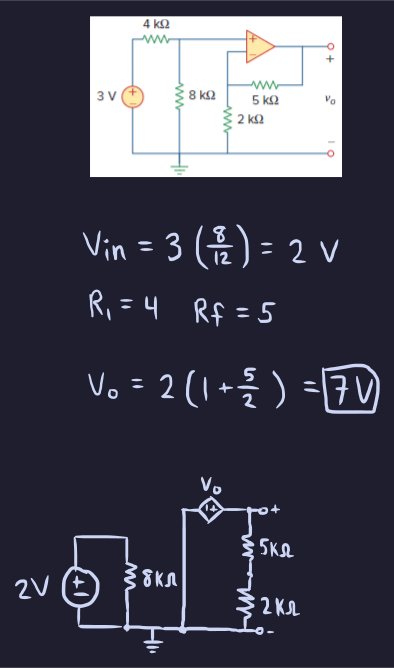
Summing Amplifier
- Variation of the inverting amplifier that outputs a weighted sum of inputs
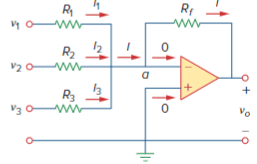
(Example 5.6
[Alexander & Sadiku, Fundamentals of Electric Circuits, 7th ed., p. 210])
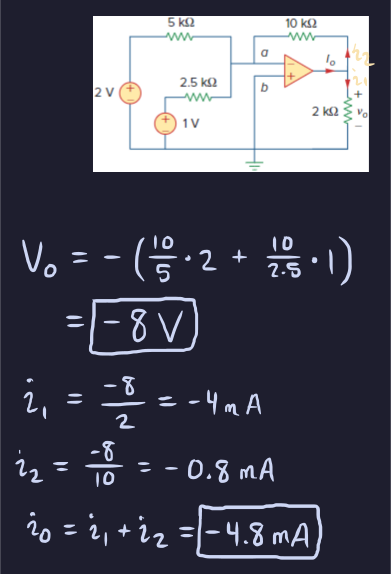
(Practice Problem 5.6
[Alexander & Sadiku, Fundamentals of Electric Circuits, 7th ed., p. 211])
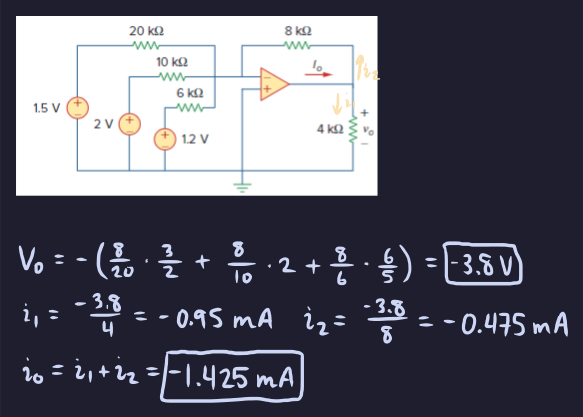
Differential Amplifier
- Amplifies the difference between two inputs
- If $\frac{R_{1}}{R_{f}} = \frac{R_{3}}{R_{4}}$:
- If $R_2 = R_1$ and $R_3 = R_4$, the gain is 1 and the output is a subtractor:
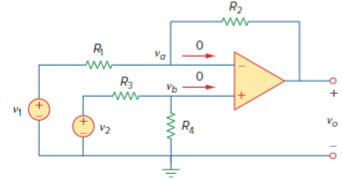
(Example 5.8
[Alexander & Sadiku, Fundamentals of Electric Circuits, 7th ed., p. 213])
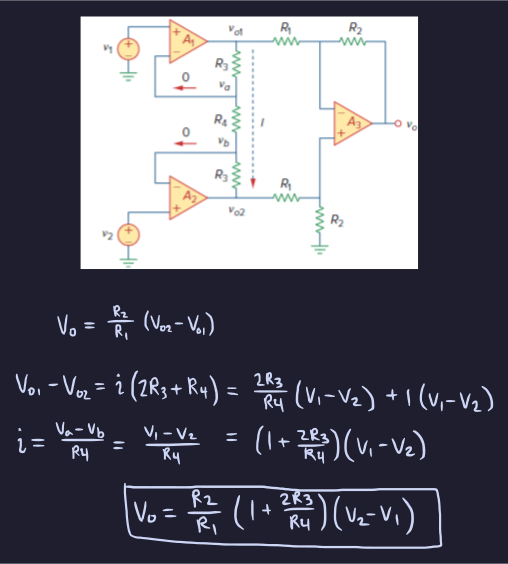
(Practice Problem 5.8
[Alexander & Sadiku, Fundamentals of Electric Circuits, 7th ed., p. 214])
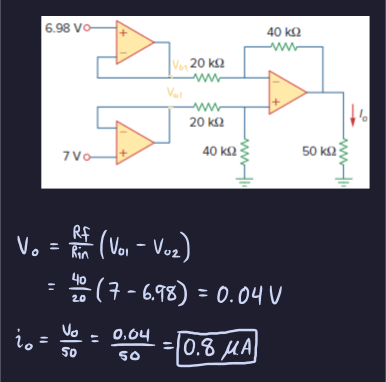
Cascaded Op Amp Circuits
- A cascade is when the output of one is the output of the next, with each connection called a stage
- The overall gain is the product of the gains of the stages
(Practice Problem 5.9
[Alexander & Sadiku, Fundamentals of Electric Circuits, 7th ed., p. 216])
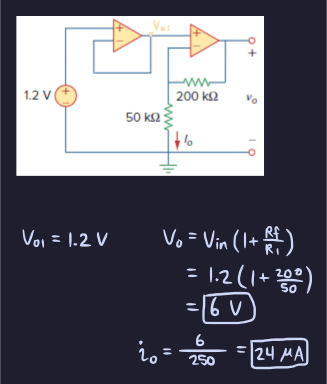
(Practice Problem 5.10
[Alexander & Sadiku, Fundamentals of Electric Circuits, 7th ed., p. 218])
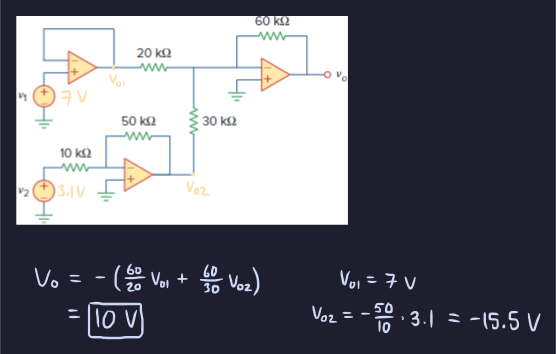
Sources
- Alexander & Sadiku, Fundamentals of Electric Circuits