Notes › Fundamentals of Electric Circuits (Sadiku) Lecture 6
Capacitors and Inductors
402 words 3 min Modified
Table of Contents
Capacitors
- Passive element that stores energy in its E-field
- Consists of two conducting plates separated by a dielectric
- When a voltage source is connected to the capacitor, each plate stores a charge $q$
The ratio of a capacitor’s plate charge to the potential difference between the plates, measured in farads (F):
$$q = Cv.$$In practice, $C$ is dependent on neither $q$ or $v$; it is dependent on capacitor’s physical dimensions (surface area, spacing, and permittivity). For a parallel plate capacitor:
$$ C = \frac{\epsilon A}{d}.$$Two important properties:
- Acts as an open circuit when the voltage is no longer changing with time; for ideal DC circuits, this occurs instantaneously.
- The voltage across the capacitor is continuous.
- Taking the derivative of both sides:
- Taking the integral of that:
- Power delivered:
- If $p > 0$, the capacitor is charging (and vice-versa)
- Energy stored:
Equivalent Capacitance
- Series:
- Share $q$ and $i$
- Parallel:
Inductors
- Passive element that stores energy in its B-field
- Consists of a coil of conducting wire
- If current passes through the inductor, the potential difference is directly proportional to the change in current
The property of an inductor to oppose the change of current through it, measured in henrys (H):
$$v = L \frac{\mathrm{d}i}{\mathrm{d}t}.$$In practice, $L$ is dependent on neither $v$ nor $i$:
$$L = \frac{N^2 \mu A}{\ell},$$where $N$ is the turns, $\ell$ is length, $A$ is cross-sectional area, and $\mu$ is permeability of the core.
Two important properties:
- Acts as a closed circuit when the current is no longer changing with time; for ideal DC circuits, this occurs instantaneously.
- The current through an inductor is continuous.
- Integrating both sides:
- Power delivered:
- Energy stored:
Equivalent Inductance
- Series
- Parallel
Integrator and Differentiator
Integrator
An op amp with $v_o \propto \int v_{i}$ by replacing $R_f$ with a capacitor in an inverting amplifier.
$$ v_{o} = -\frac{1}{RC} \int_{0}^{t} v_{i}(\tau) \, \mathrm{d}\tau$$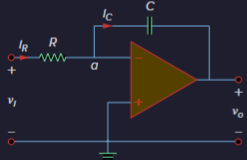
Differentiator
An op amp with $v_o \propto \frac{\mathrm{d}v_{i}}{\mathrm{d}t}$ by replacing $R_i$ with a capacitor in an inverting amplifier.
$$v_{o} = -RC \frac{\mathrm{d}v_{i}}{\mathrm{d}t}$$