Notes › Fundamentals of Electric Circuits (Sadiku) Lecture 4
Circuit Theorems
757 words 8 min Modified
Table of Contents
Linearity
- Combination of two properties: homogeneity and additivity
- Homogeneity requires that if the excitation is multiplied by a constant, the output is multiplied by the same constant
- Additivity requires that the response to a sum of excitations is the sum of the responses if each excitation was applied separately
A circuit whose output is linearly related (directly proportional) to its input. Satisfies the homogeneity and additivity properties.
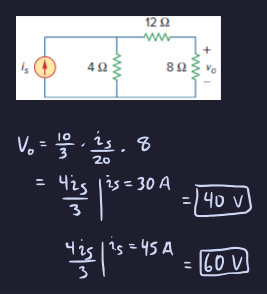
(Practice Problem 4.1
[Alexander & Sadiku, Fundamentals of Electric Circuits, 7th ed., p. 154])
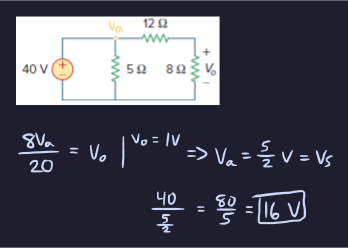
(Practice Problem 4.2
[Alexander & Sadiku, Fundamentals of Electric Circuits, 7th ed., p. 154])
Superposition
- For circuits with more than one independent source, you can determine voltage/current of an element by summing the contribution of each source to the variable
The voltage across (or current through) an element of a linear circuit is the algebraic sum of the voltages across (or currents through) that element due to each independent source acting alone. Employ the following:
- Voltage sources are 0V with a short circuit
- Current sources are 0A with an open circuit
- Dependent sources are left intact, since they are controlled by circuit variables
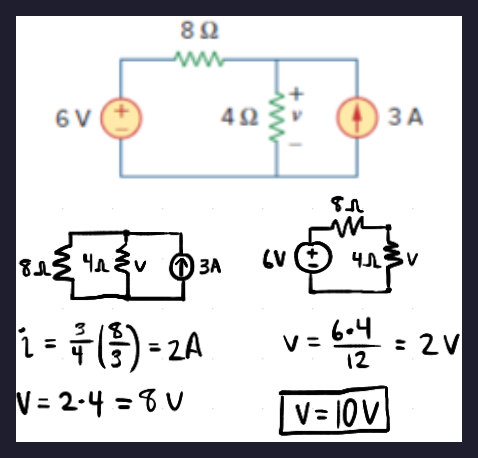
(Example 4.3
[Alexander & Sadiku, Fundamentals of Electric Circuits, 7th ed., p. 156])
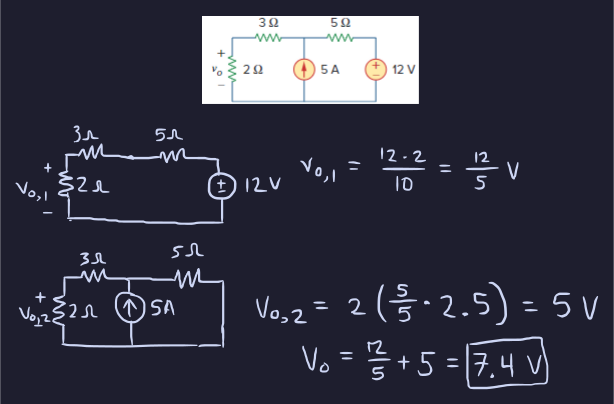
(Practice Problem 4.3
[Alexander & Sadiku, Fundamentals of Electric Circuits, 7th ed., p. 156])
(Example 4.4
[Alexander & Sadiku, Fundamentals of Electric Circuits, 7th ed., p. 156])
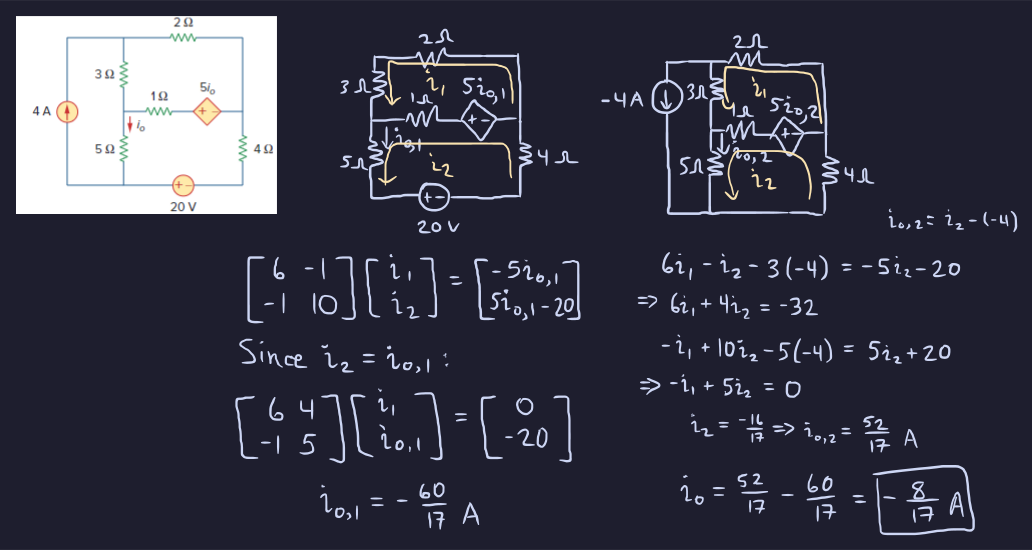
(Practice Problem 4.4
[Alexander & Sadiku, Fundamentals of Electric Circuits, 7th ed., p. 158])
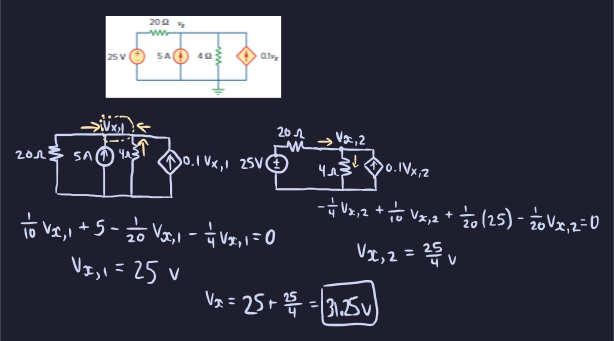
(Practice Problem 4.5
[Alexander & Sadiku, Fundamentals of Electric Circuits, 7th ed., p. 159])
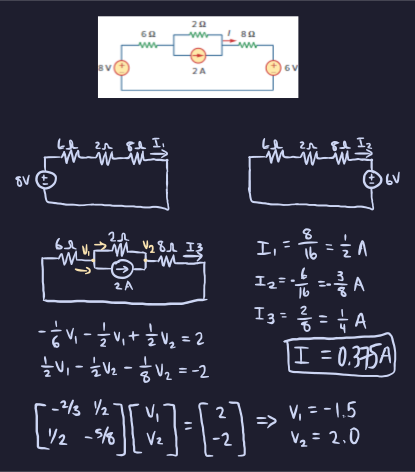
Source Transformation
- Replacing a voltage source in series with a resistor by a current source in parallel with a resistor (or vice versa)
- Can be applied to dependent sources if the equation is kept satisfied
(Example 4.6
[Alexander & Sadiku, Fundamentals of Electric Circuits, 7th ed., p. 161])
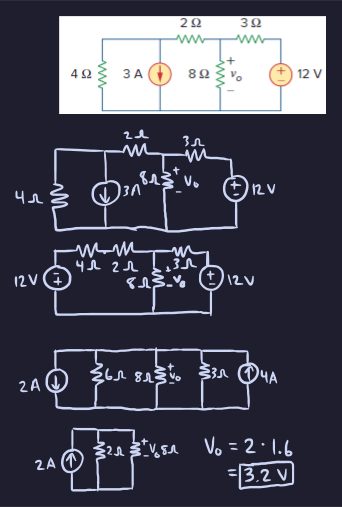
(Practice Problem 4.6
[Alexander & Sadiku, Fundamentals of Electric Circuits, 7th ed., p. 161])
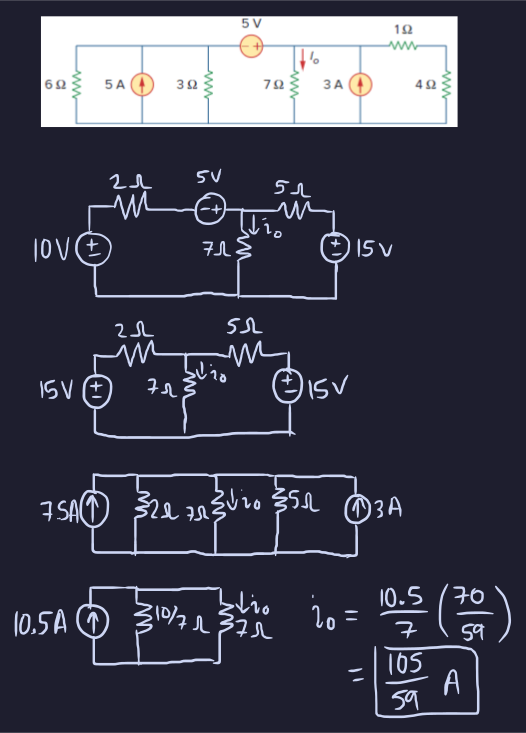
(Example 4.7
[Alexander & Sadiku, Fundamentals of Electric Circuits, 7th ed., p. 162])
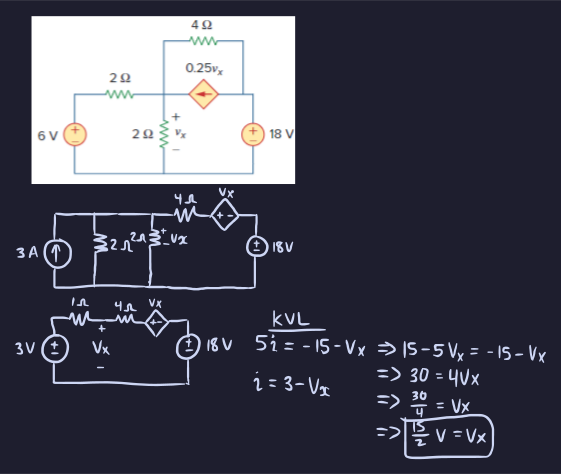
(Practice Problem 4.7
[Alexander & Sadiku, Fundamentals of Electric Circuits, 7th ed., p. 162])
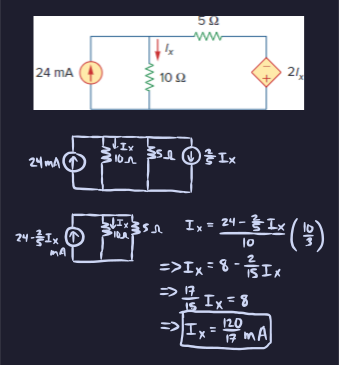
Thevenin’s Theorem
Any linear two-terminal circuit can be replaced by a voltage source $V_{\text{th}}$ in series with a resistor $R_{\text{th}}$.
- $V_{\text{th}} = V_{\text{oc}}$
- $R_{\text{th}} = R_{\text{eq}}$ with independent sources off
Finding $R_{\text{th}}$
- Two cases:
- The network has no dependent sources. Then, turn off all independent sources, and $R_{\text{th}} = R_{\text{eq}}$
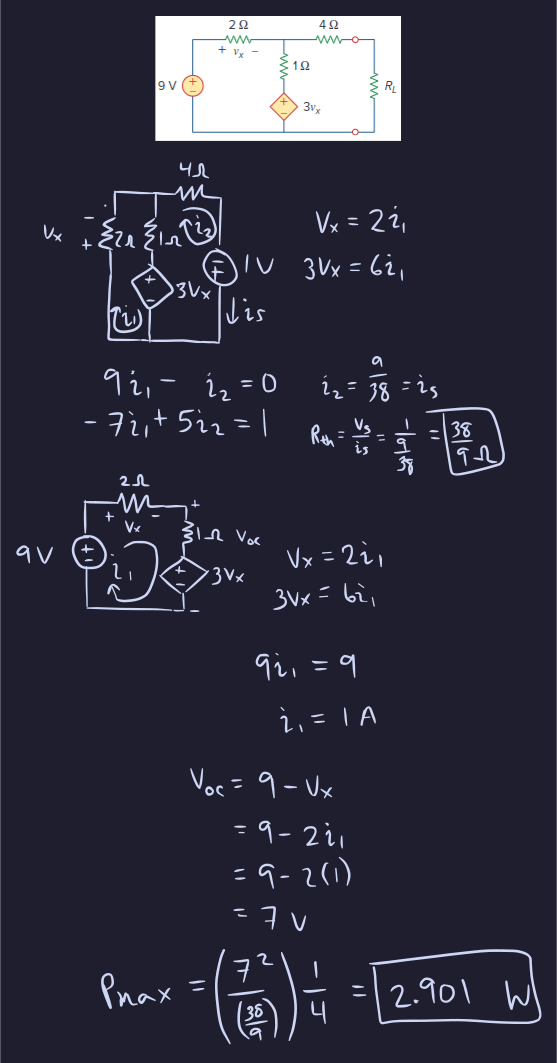
- The network has dependent sources. Then, turn off all independent sources, and apply a voltage source $v_o$ at the terminals. Determine $i_o$, and $R_{\text{th}} = \frac{v_o}{i_o}$
- Alternatively, apply a current source $i_o$ at the terminals and find the terminal voltage $v_o$
- If $R_{\text{th}} < 0$, the circuit is supplying power
(Example 4.8
[Alexander & Sadiku, Fundamentals of Electric Circuits, 7th ed., p. 164])
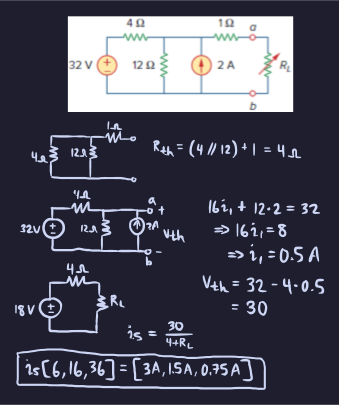
(Practice Problem 4.8
[Alexander & Sadiku, Fundamentals of Electric Circuits, 7th ed., p. 166])
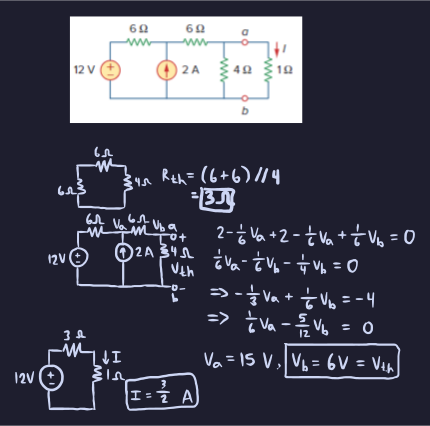
(Example 4.9
[Alexander & Sadiku, Fundamentals of Electric Circuits, 7th ed., p. 166])
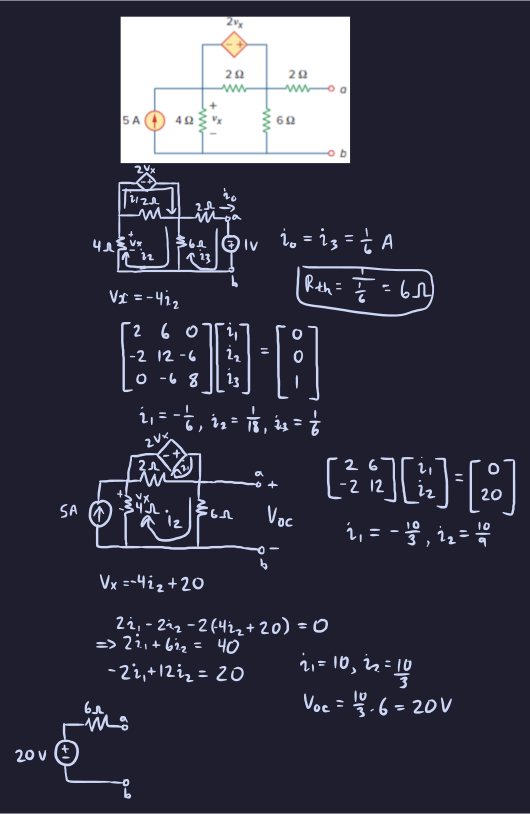
(Practice Problem 4.9
[Alexander & Sadiku, Fundamentals of Electric Circuits, 7th ed., p. 167])
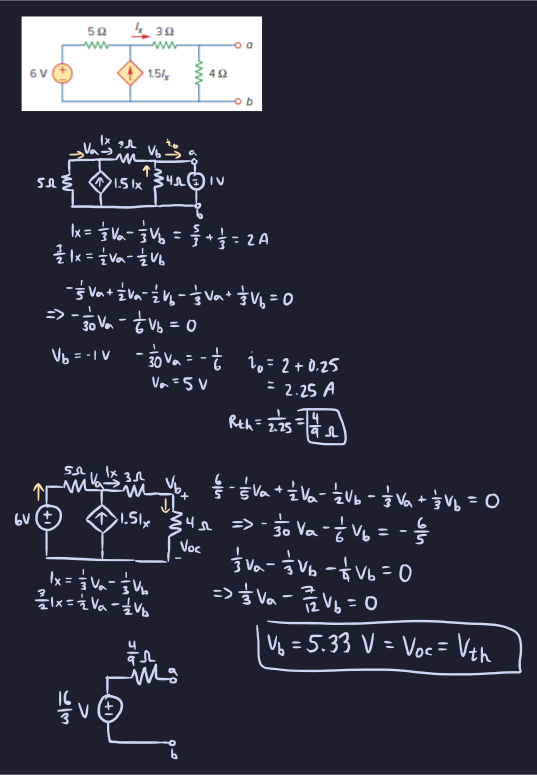
(Practice Problem 4.10
[Alexander & Sadiku, Fundamentals of Electric Circuits, 7th ed., p. 169])
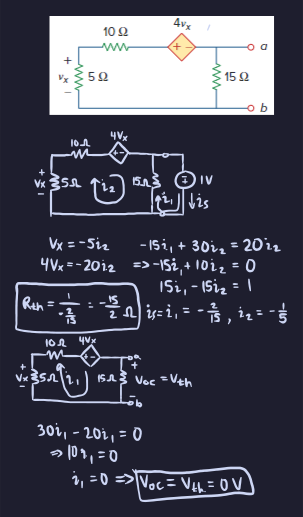
Norton’s Theorem
Any linear two-terminal circuit can be replaced by a current source $i_{N}$ in parallel with a resistor $R_{N}$.
- $i_{N} = i_{\text{sc}}$
- $R_{\text{N}} = R_{\text{eq}}$ with independent sources off
- An implication from this is $R_{N} = R_{\text{th}}$; this is true when we looked at source transformations previously
- Another implication is that Thevenin and Norton’s Theorems are related by:
(Example 4.11
[Alexander & Sadiku, Fundamentals of Electric Circuits, 7th ed., p. 170])
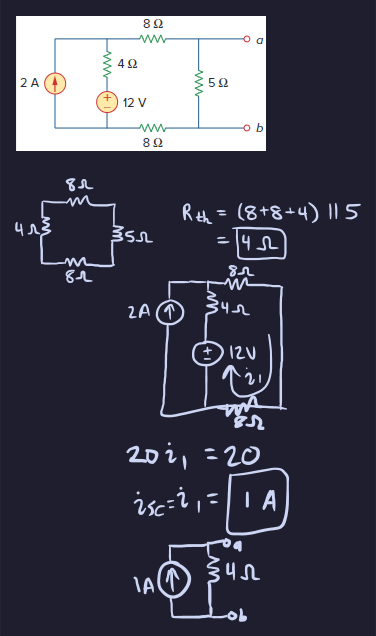
(Practice Problem 4.11
[Alexander & Sadiku, Fundamentals of Electric Circuits, 7th ed., p. 171])
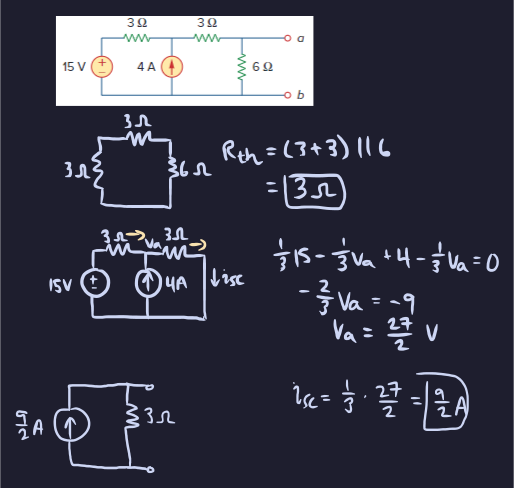
(Example 4.12
[Alexander & Sadiku, Fundamentals of Electric Circuits, 7th ed., p. 172])
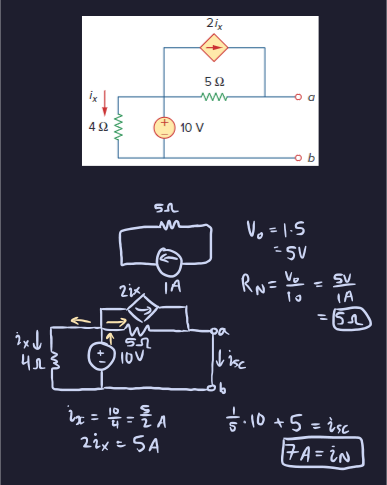
(Practice Problem 4.12
[Alexander & Sadiku, Fundamentals of Electric Circuits, 7th ed., p. 172])
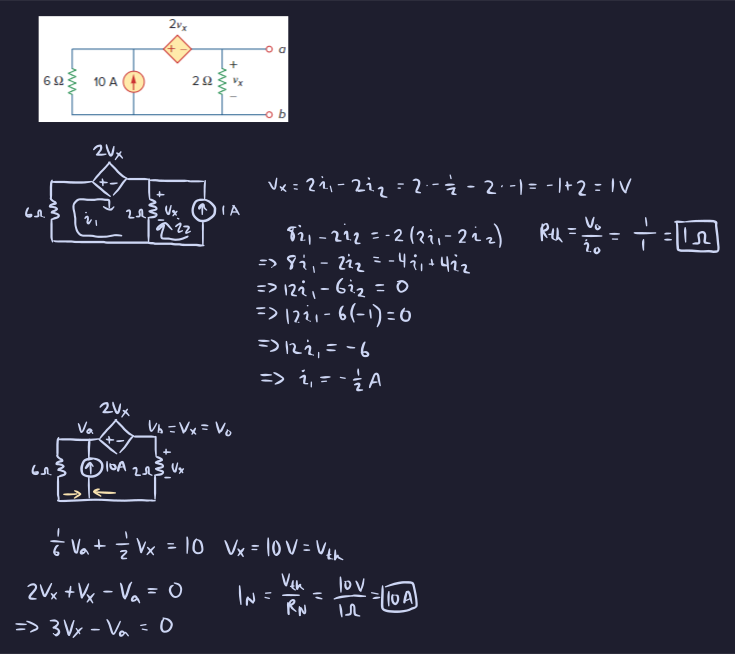
Maximum Power Transfer
Maximum power is transferred to $R_{L}$ iff ${R_{L} = R_{\text{th}}}$. In terms of $V_{\text{th}}$:
$$p_{\text{max}} = \frac{V_{\text{th}}^2}{4R_{\text{th}}}$$In terms of $I_{N}$:
$$p_{\text{max}} = \frac{I_{N}^2 R_{N}}{4}$$(Example 4.13
[Alexander & Sadiku, Fundamentals of Electric Circuits, 7th ed., p. 175])
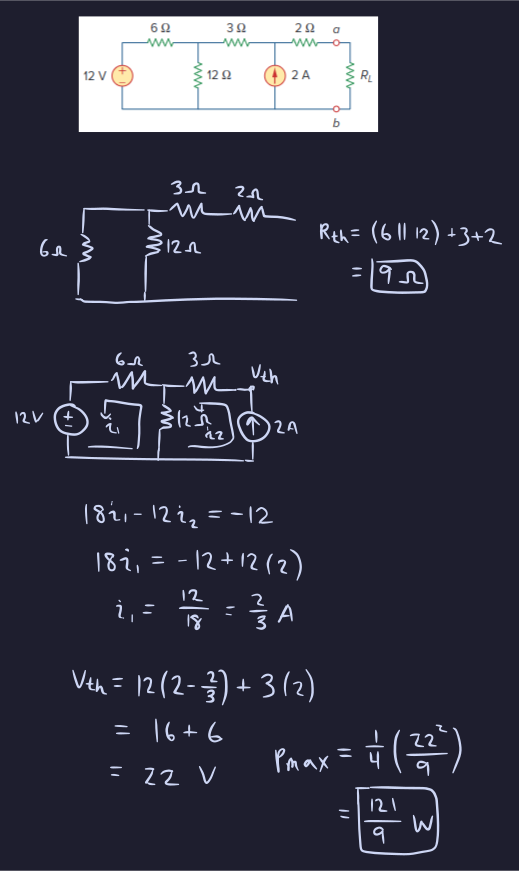
(Practice Problem 4.13
[Alexander & Sadiku, Fundamentals of Electric Circuits, 7th ed., p. 176])
Sources
- Alexander & Sadiku, Fundamentals of Electric Circuits