Notes › EENG 5342: Advanced Digital Design Lecture 3
Arithmetic for Computers
187 words 1 min Modified
Table of Contents
Binary Multiplication
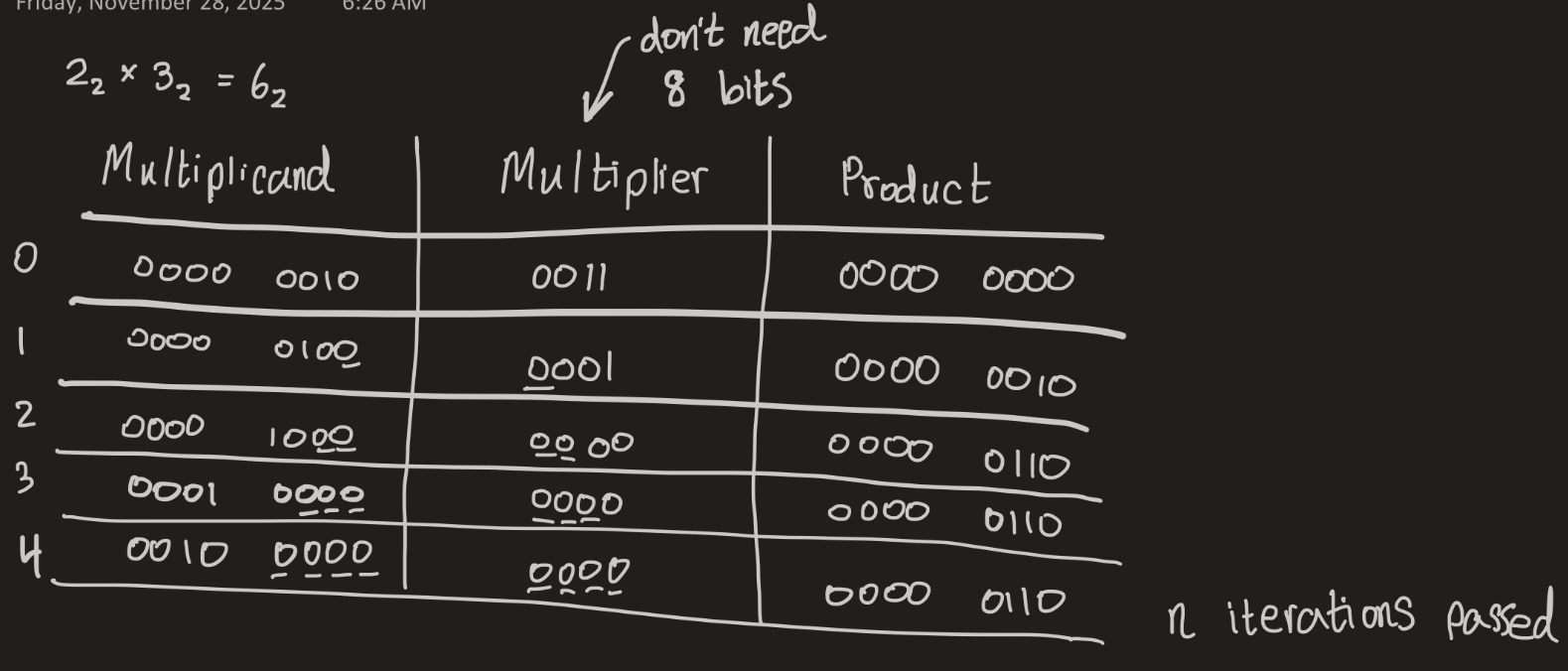
- Initial values:
- Multiplicand ($n$): given with LHS 0’s
- Multiplier ($n$): given with RHS 0’s
- Product ($2n$): 0
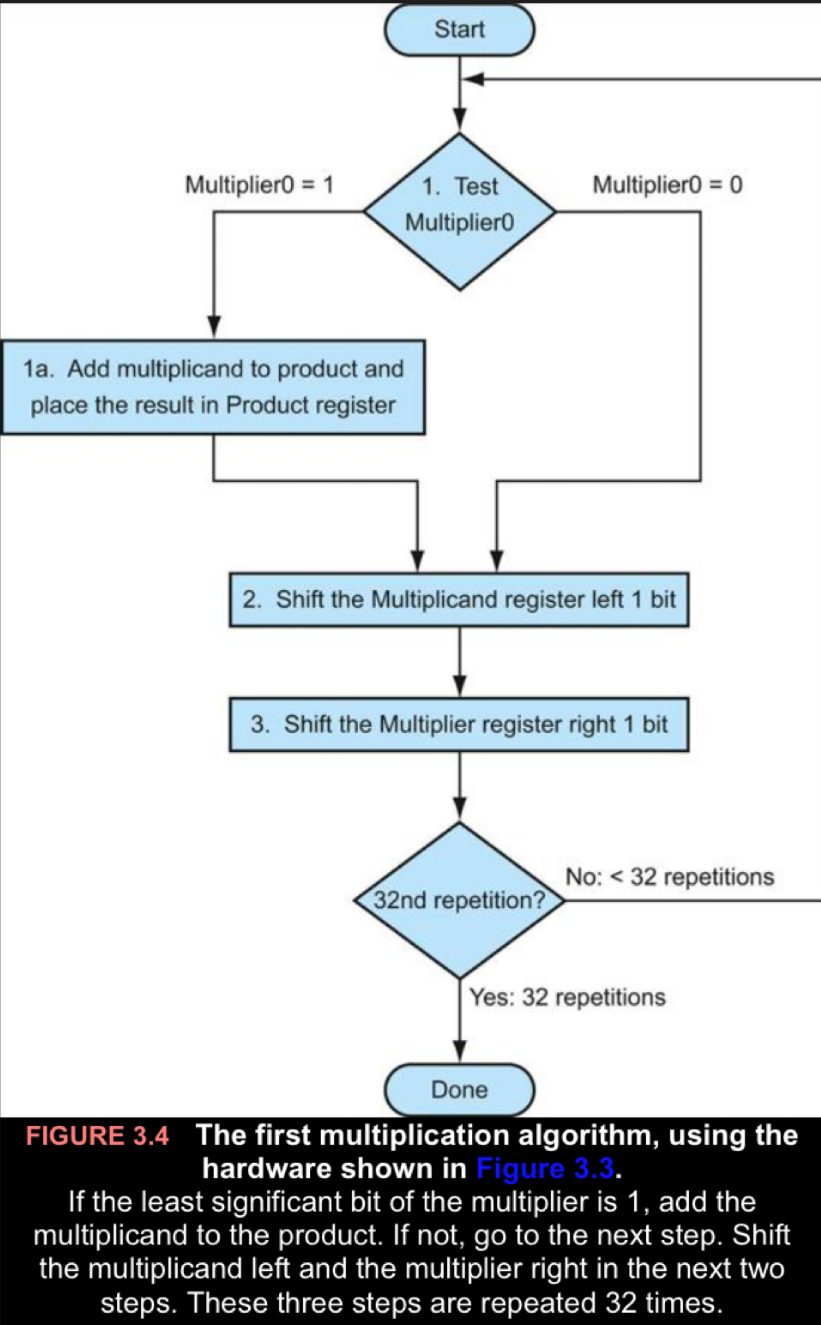
- Multiplier LSB dictates whether the multiplicand is added to product
- End after $n$ steps
Binary Division
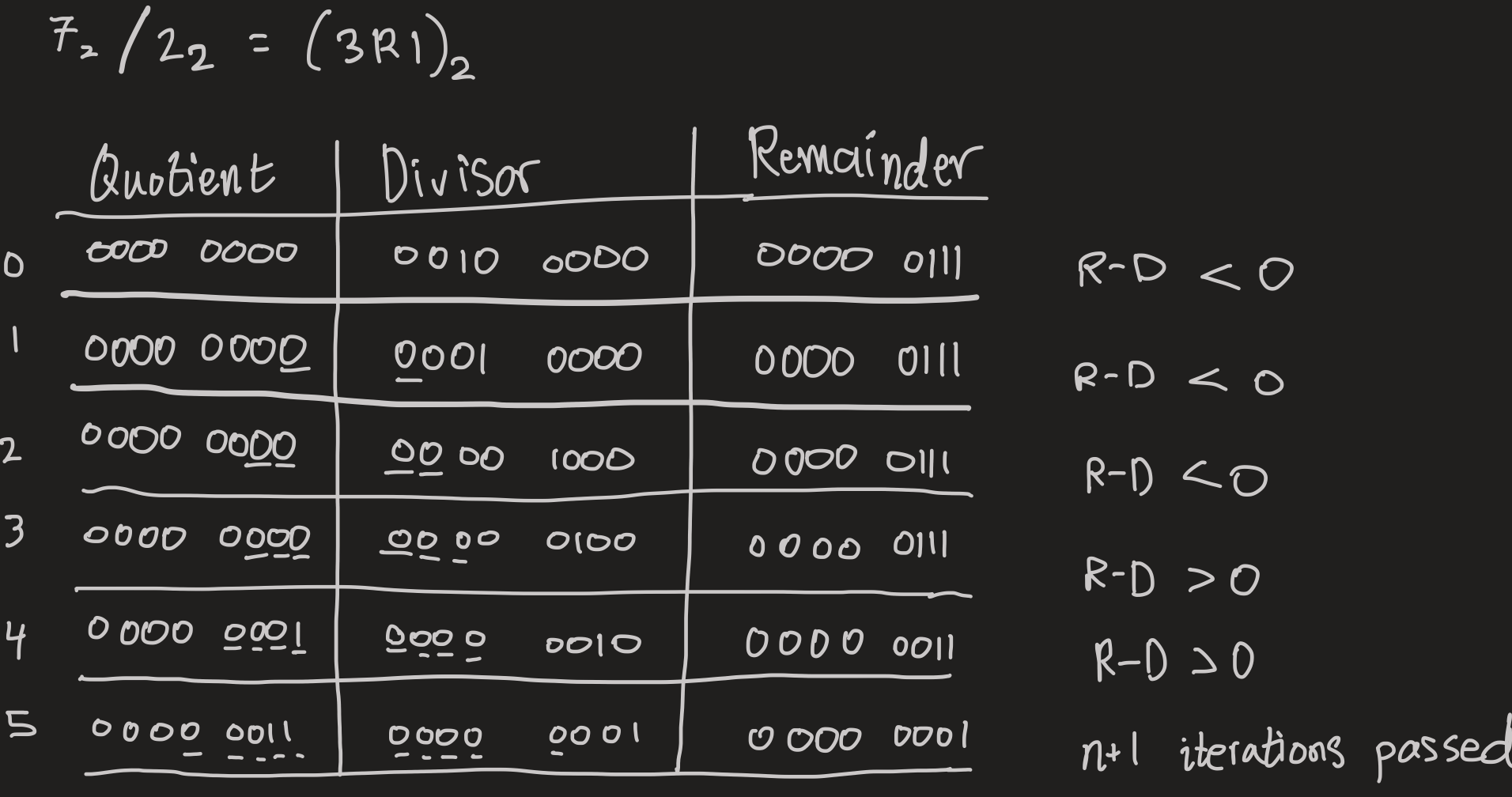
- Initial values:
- Quotient ($n$): 0
- Divisor ($n$): given with RHS 0’s
- Remainder ($2n$): dividend
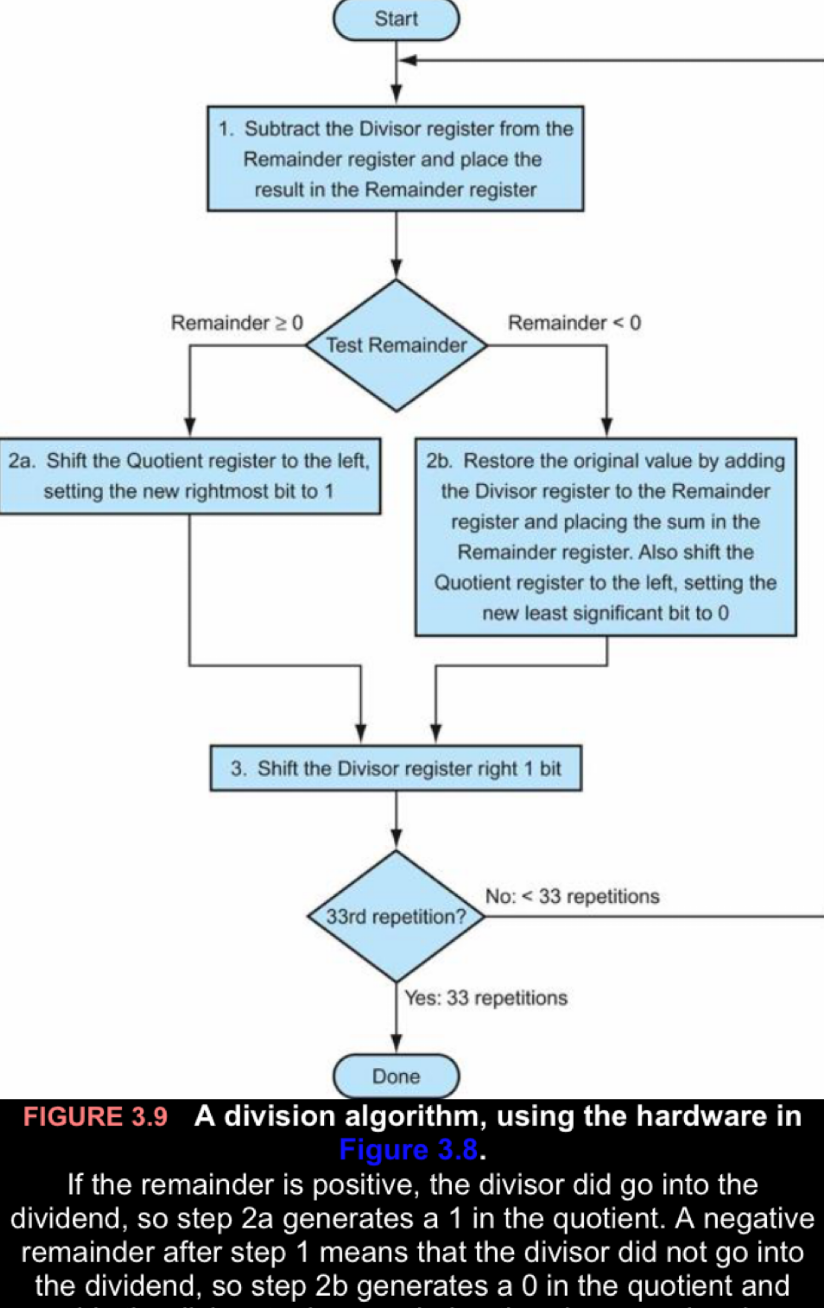
- $R-D$ determines the LSB of $Q$ with each step
- End after $n+1$ steps
IEEE 754 Standard
- Sign bit
- Significand:
- (1 + Mantissa)
- Mantissa is unsigned 24/53-bit fractional value
- Exponent:
- (Power - Bias)
- Power is unsigned 8/11-bit
- Bias is fixed at 127/1023
- Introduced so that floats could be sorted without any ambiguity with respect to the 2’s complement representation of the Power
- Steps for problem solving:
- Convert the base-10 representation to binary fractional representation
- Convert to normalized form
- Figure out mantissa and power
Special Cases
- Special cases for which the exponents zero and all ones are reserved
- If $M$ and $P$ zero, the number is zero
- If $M=0$ and $P=11111\dots$, the number is $\pm \infty$
- If $M \ne 0$ and $P=1111\dots$, the number is $\text{NaN}$
References
- Course slides, chapter 3
Sources
- Course slides, chapter 3