Notes › EENG 5342: Advanced Digital Design Lecture 2
ISA and MIPS
1125 words 7 min Modified
Table of Contents
ISA
- Instruction set architecture
- Different CPUs have different ISAs, though they share many of the same paradigms
- Using the MIPS ISA for this course
- Big Endian: MSB at the least address of a word
Register Operations
- Operations between two CPU registers that are stored in a destination register
- MIPS has a 32x32-bit register file (32 registers with 32 bits each)
- Since each register can store up to 32 bits, we designate 32 bits as the fundamental unit, or WORD, for this architecture
- Nearly all MIPS data types have sizes of one or more words
- Assembler names
$t0, $t1, ..., $t9reserved for temp values$s0, $s1, ..., $s7for saved variables
- The primitive arithmetic operations (
add/sub/mult/div) are register operations because they only use registers as operands
Memory Operations
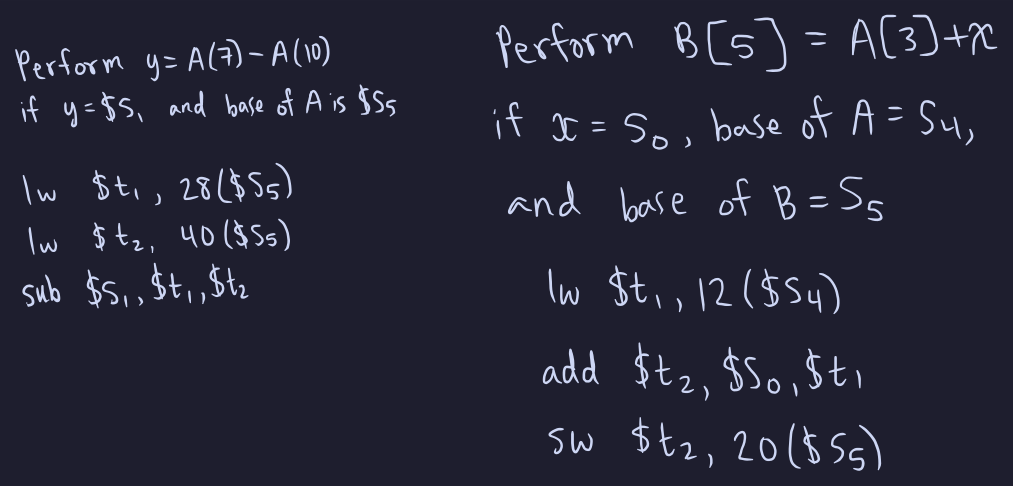
- Operations that move data between registers and memory locations
- Why RAM is needed
- Data that is not immediately needed in a program can be stored in RAM to free a register
- Data larger than a word can be stored in RAM rather than distributed across registers
- Arrays, structs, dynamic data
- Memory addresses identify a memory location corresponding to a single byte
- Word-alignment: MIPS requires that data with a size of one word (or multiples of one word) be instantiated at addresses that are multiples of 4
- The use of memory operations introduces overhead
- Registers have faster access time than RAM architecture-wise
- Require additional instructions (
lw/sw) to move data between registers and RAM - The programmer should only store values in RAM when absolutely necessary
Example 02.1.
Memory Storing/Loading into Register
Immediate Operations
- Operations between a register and 16-bit immediate (constant) value that are stored in a register
- Faster than register operations since immediate is encoded within the instruction itself
- This avoids the use of
lwto load a value from memory into a register, or even the use of a register altogether
- This avoids the use of
- The immediate is sign-extended to 32 bits so that the operation can be performed with a register
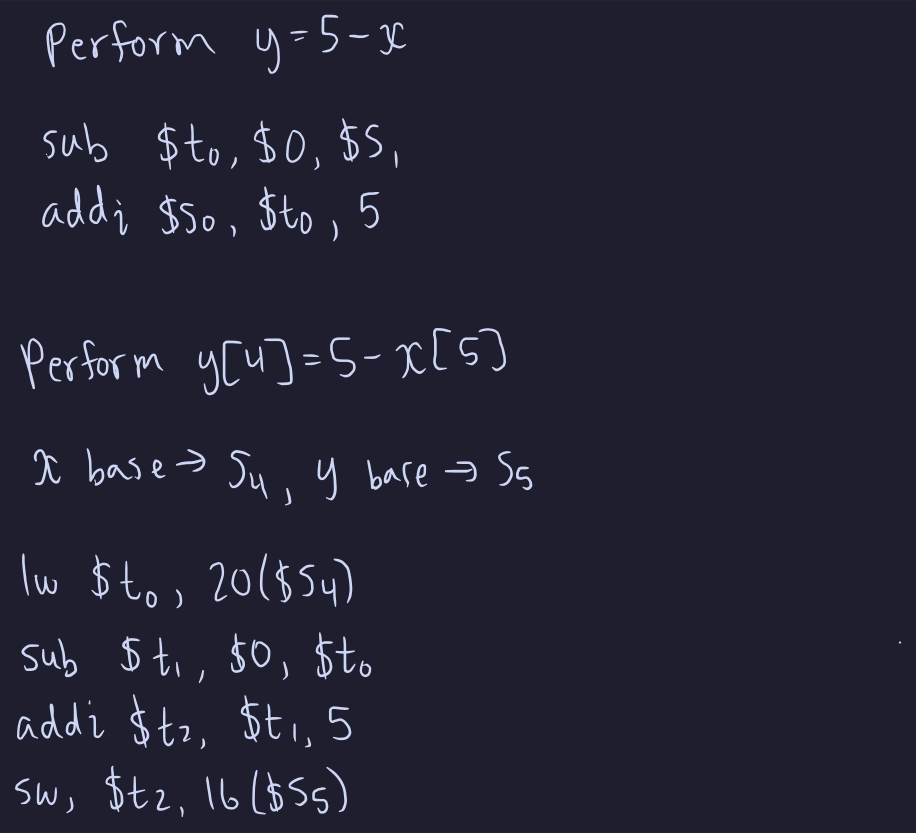
- There is no immediate
subinstruction, but you can use negative constants addiusing 0 effectively copies one register to another
Example 02.2.
Immediate Operand Subtraction
Zero Constant Register
$zero- Cannot be overwritten
- Can be used with
addto copy registers- Same efficiency as using
addiwithimm 0to copy registers - It is best to remain consistent with the method you use for enhanced program readability
- Same efficiency as using
- Can be used to load a constant:
addi $reg1, $zero, imm
Signed Integers
Two’s Complement
- Binary expansion of a number, but with the MSB negated
- If the MSB is zero, the number must be positive
- Therefore, the Two’s Complement of a positive number is equivalent to its unsigned representation
- Range is $[-2^{n-1}, 2^{n-1}-1]$
- The additive inverse of $-2^{n-1}$ is out of range, so $-(-2^{n-1})$ cannot be performed
- Identities:
- $x + \overline{x} = -1$
- $\overline{x} + 1 = -x$
- This is used to negate binary numbers
Sign Extension
- Preserves the numeric value of $x$ but with more bits
addiis the easiest way to do this, since it sign-extends any value to one word by default- Can use
lb, lhto load a byte/halfword at a memory location to a register- This effectively sign-extends the data to one word so it can be stored in the register
beqandbneinternally use sign extension to word-align 16-bit immediate offsets with the current instruction reference in the program counter (so that it can be added/subtracted)
Representing Instructions
- All instructions are binary machine code
- MIPS instructions are fixed-length words
- There are various instruction formats that encode different information depending on the use case
- Register numbers
$t0 - $t7: 8-15$t8 - $t9: 24-25$s0 - $s7: 16-23
R-Format
- Generic format used by a lot of instructions
- op: opcode
- rs: first register number
- rt: second register number
- rd: destination register number
- shamt: shift amount
- funct: function code

I-Format
- Immediate arithmetic, load/store, and branching
- rt: second/destination register number (instruction-specific)
- constant/address: an offset for a branching instruction or constant for an immediate instruction
- Question: how does the assembler know whether it’s in i-format or r-format based on shamt/funct alone?
Logical Operations
- Useful for extracting/inserting groups of bits
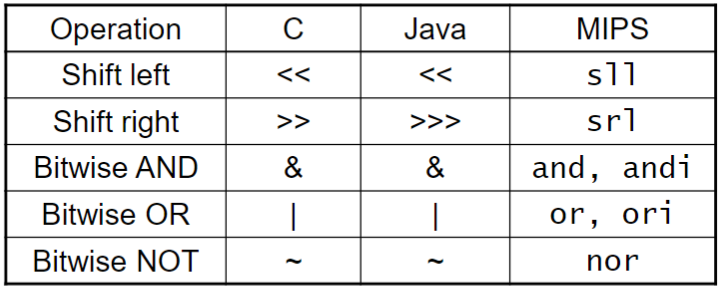
Logical Shifts
sllmultiplies by $2^n$ andsrldivides by $2^n$
AND
- Useful for bit masking
OR
- Useful for setting some bits to 1, and leaving others unchanged
NOR
- Logical NOT if one register is
$zero
Conditional Branches
- Branch to a label if a condition is true
Basic Blocks
- A sequence of instructions that:
- Contains no branches (except at the end)
- Contains no branch targets (except at the beginning)
- Compilers identify basic blocks for optimization
Conditional Operations
- Sets result to 1 if a condition is true and 0 otherwise
- There are signed and unsigned comparisons
Procedure Calling
- Place parameters in registers
- Transfer control to procedure
- Acquire storage for proceduer
- Perform procedure operations
- Place result in register for caller
- Return to call location
Register Convention
$a0 - $a3: arguments (4-7)$v0, $v1: results (2-3)$t0-$t9: temporary registers to be overwritten by the procedure call$s0-$s7: must be saved and restored before and after procedure- This means the procedure must save all the values in the
sregisters on the stack, and restore them after finishing!
- This means the procedure must save all the values in the
$gp: global pointer for static data (28)$sp: stack pointer (29)$fp: frame pointer (30)$ra: return address (31)
Calling a Procedure
- Jump and link
jal ProcedureLabel- Address of the following instruction is put into
$ra - Jumps to the address in
ProcedureLabel
- Address of the following instruction is put into
- Procedure return:
jr $ra- Copies
$rato program counter - Can also be used for switch cases or computed jumps
- Copies
Branch Addressing
- Branch instructions use i-format
- Need to specify opcode, 2 registers, and target address
- PC-relative addressing
- Target address = PC + 4 * offset
- The reason why the offset is multiplied by 4 is a very interesting optimization by the MIPS assembler that allows for a range of $2^{18}-1$ instead of $2^{16} - 1$ addresses. Essentially, since memory addresses are word-aligned, you know those addresses are divisible by 4, which means their values must end in 00 in their binary representation. This means that you only have to enter the first 16 bits of the address, even if your final address ends up being 18 bits
Jump Addressing
- Jump targets can be anywhere in the text section
- The full address is encoded in the instruction because the first 4 bits of the next instruction address plus the extra 2-bit optimization equals 32 bits
- Therefore, you only have to enter bits 5-30 in the address
- Technically, this means you can only select from $2^{28}-1$ addresses surrounding the instruction pointer since you’re hardcoding the first four bits, but this is equivalent to ~256 MiB, which is greater than the size of text section in the address space
- The full address is encoded in the instruction because the first 4 bits of the next instruction address plus the extra 2-bit optimization equals 32 bits

References
- Course slides, chapter 2
- Course handout, MIPS reference sheet
Sources
- Course handout, MIPS reference sheet
- Course slides, chapter 2