Notes › EENG 5342: Advanced Digital Design Lecture 4
The Processor
614 words 4 min Modified
Table of Contents
Instruction Execution
- All instructions are stored in the memory
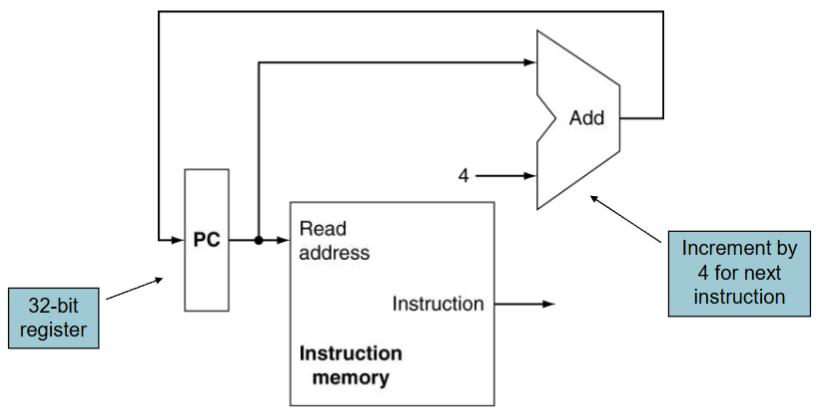
- The program counter points to instruction memory; it fetches an instruction, which is 4 bytes of machine code, and increments by 4
- The memory bus has three ports: address line (input), data line (input), and data line (output)
- There is a select for Read (which is basically a load) at the top and a select for Write at the bottom (which is basically a store)
- All of the register numbers point to a register file, or the read registers
- Depending on the instruction format
- Use ALU to calculate arithmetic result, memory address of load/store, or branch target address
- Necessary loads and stores are performed to access data memory
- PC is set to the target address or incremented by 4
Datapath
- Elements that process data and addresses in the CPU
- Consists of registers, ALUs, multiplexers, memory
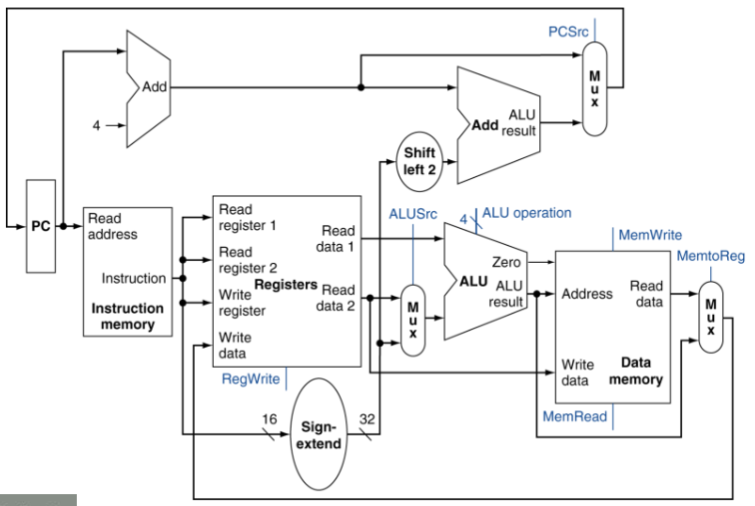
Instruction Fetch
R-Formatting
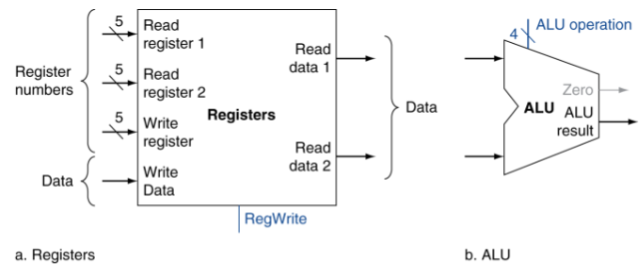
- Read from two registers
- Perform an arithmetic/logical operation
- Write the result
Load/Store
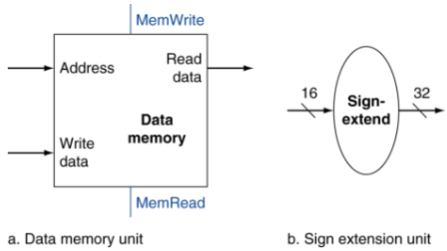
- Read from register
- Calculate address with 16-bit offset
- Uses ALU and sign-extends to 32-bits
- Load: Reads memory and updates register
- Store: Write register value to memory
Branching Instructions
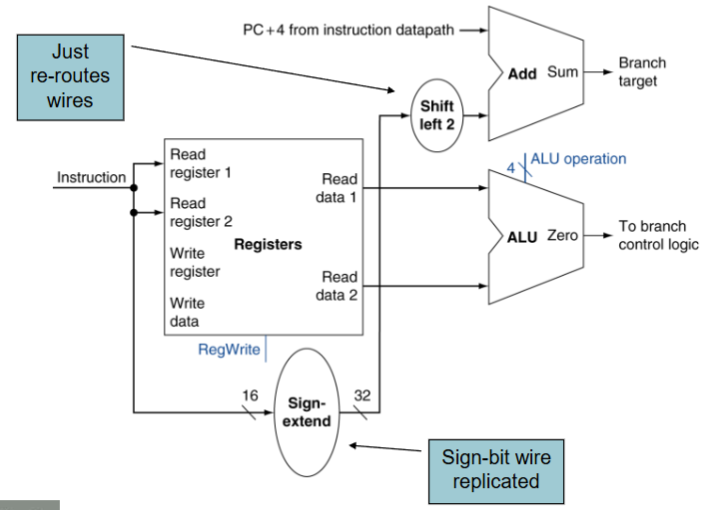
- Read from registers
- Subtract operands using ALU and check Zero flag
- Calculate target address
- Sign-extend displacement
- Shleft 2 (word alignment)
- Add to PC + 4
- Should’ve already been calculated by intruction fetcher
Composing Elements of Datapath
- First-cut datapath performs each instruction in one clock cycle
- Each datapath element can only perform one function at a time
- Therefore, need to separate instruction and data memory
- Use muxes where alternate data sources can be used for different instructions
R-Type/Load/Store Datapath
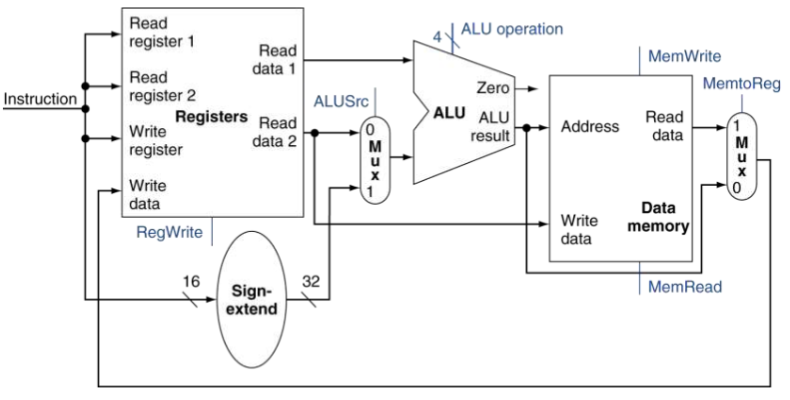
Full Datapath
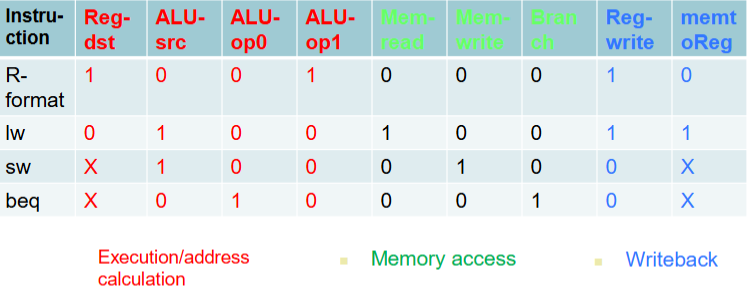
Controlling the ALU
- ALU is used for
- Load/Store: Function = add
- Branch: Function = subtract
- R-type: Function depends on funct field
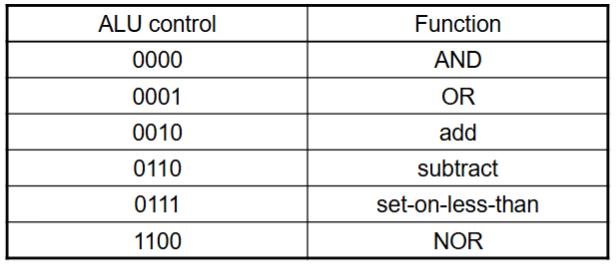
- There is a 2-bit ALUop that is derived from the opcode
- This is achieved with combinational logic
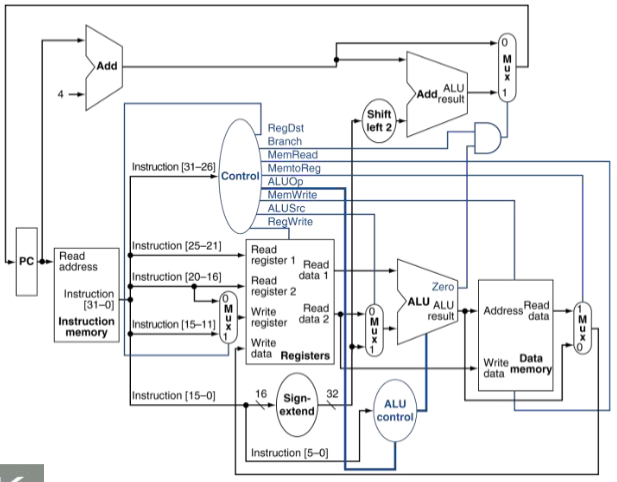
Main Control Unit
- The control signals are derived from the instruction
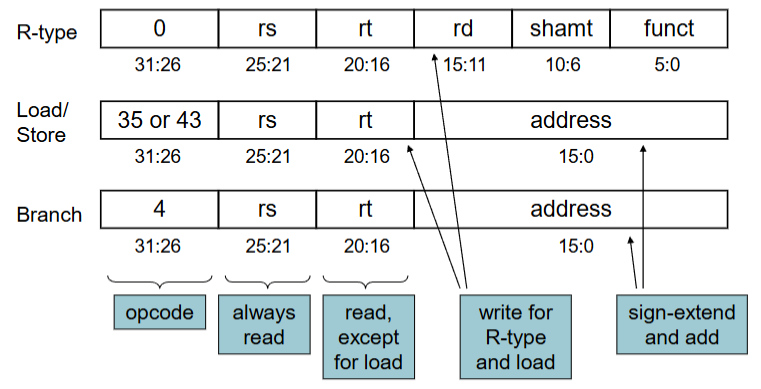
Datapath With Control
Control Lines
Problems With Current Approach
- Problem: the longest instruction in the datapath determines the clock period
- The critical path for the overall datapath is
lw- IM -> REG -> ALU -> DM -> MUX -> REG
- The critical path for the overall datapath is
- It’s not feasible to vary the period for different instructions
- We want the common case to be fast
- We can incorporate a design that expedites the execution time of the processor via pipelining
Pipelining Analogy
- Pipelined laundry: overlap the executions
- Parallelism improves the overall performance
- Shouldn’t introduce any conflicts, as long as each roommate is in different stages!
Pipelining in MIPS
- Five stages:
- Instruction fetch
- Instruction decode and register read
- Execute operation/calculate address
- Access memory operand
- Write back to register
Hazards
- Situations that prevent starting the next instructions in the next cycle
- Types
- Structure
- When a required resource is busy
- More than one instruction is trying to use the same component
- Q: This shouldn’t be the case for a pipeline, though… so isn’t this a contradiction since we assume mutual exclusivity?
- A: Unfortunately, it can still occur, even with distinct components. You could have a memory conflict in the IM/DM if the read/write bits are set at the same time
- Ex: You shouldn’t have an instruction writing to the IM/DM while there’s another instruction fetching a memory instruction
- This isn’t really a huge issue on modern architectures, since modern systems do guarantee mutual exclusivity of r/w to instruction and data memory
- Data (most common)
- An instruction depends on the completion of data access by a previous instruction
- Can be eliminated entirely if you have a good enough data path or architecture
- Control hazard
- Deciding on control action depending on previous instruction
- Solution: something to do with half-cycles? Not really sure wasn’t paying attention
- Structure
References
- Course slides, chapter 4
Sources
- Course slides, chapter 4