Notes › EENG 3345: AC Circuit Analysis Lecture 10
Two-Port and Three-Port Networks
378 words 3 min Modified
Table of Contents
Wye-Delta Transformations
- Resistive networks that aren’t in series or parallel may be simplified to a three-terminal equivalent network
- Either the Wye/Tee network or the Delta/Pi network
Delta-Wye Conversion
- Superimpose Y onto $\Delta$ by adding an extra node $n$. Each resistor in Y is the product of the resistors in the two adjacent $\Delta$ branches divided by the sum of the three $\Delta$ resistors
- For the network below:
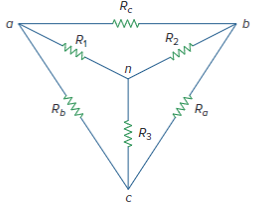
Wye-Delta Conversion
- Each resistor in the $\Delta$ network is the sum of all products of Y resistors divided by the opposite Y resistor
- For the superimposed network:
Balanced Condition
- If all the Y resistances are equal AND all the $\Delta$ resistances are equal, then:
(Practice Problem 2.14
[Alexander & Sadiku, Fundamentals of Electric Circuits, 7th ed., p. 80])
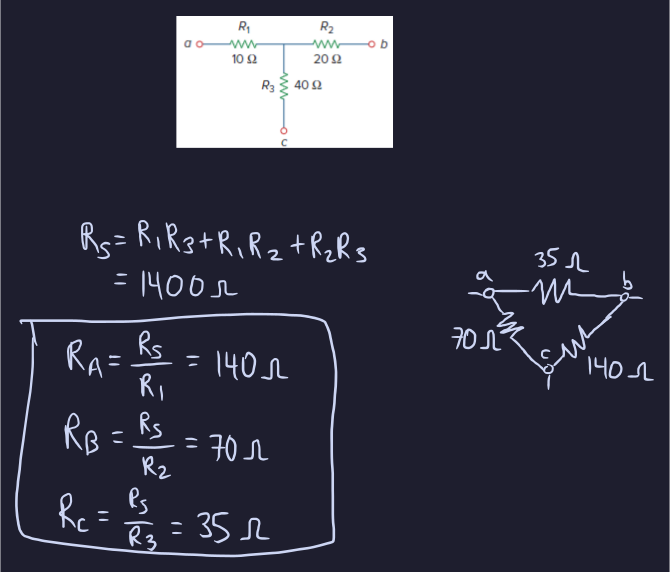
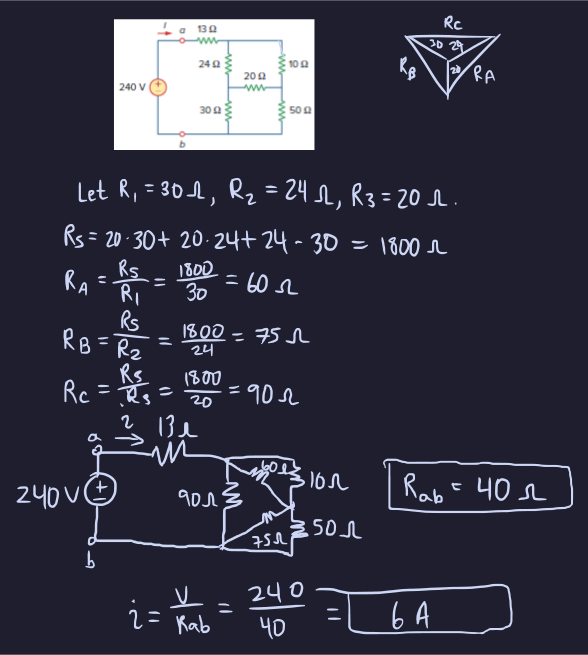
(Practice Problem 2.15
[Alexander & Sadiku, Fundamentals of Electric Circuits, 7th ed., p. 83])
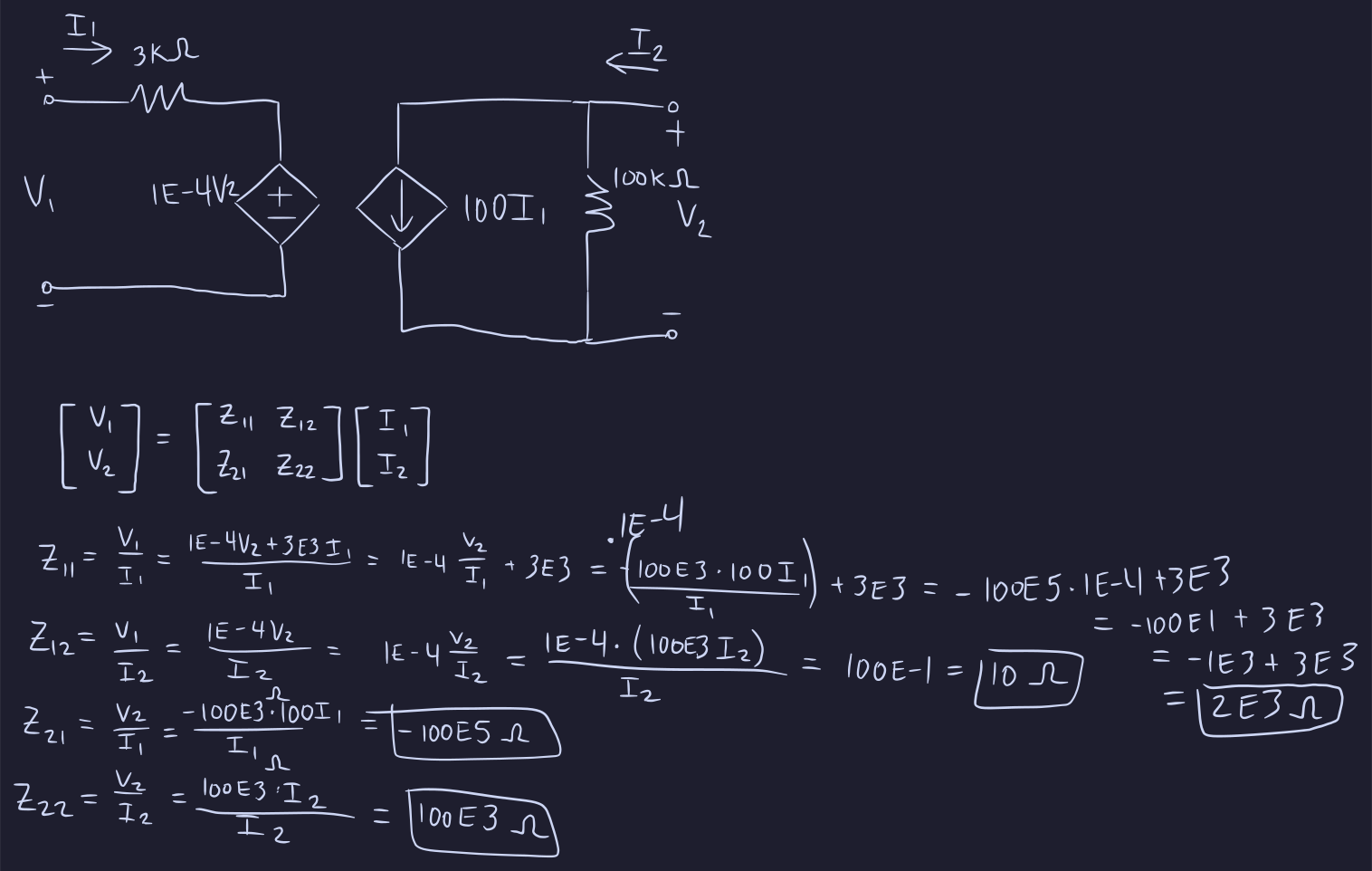
Two-Port Networks
Overview
- Define a matrix model for the system using the network type
- Selectively zero out each parameter
- Use methods of analysis to rewrite the output equations in terms of the input variables
- Solve the output equations
Network Parameters
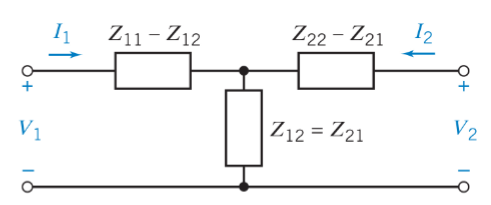
Impedance
$$
\begin{bmatrix}
V_1 \
V_2
\end{bmatrix}
=
\begin{bmatrix}
Z_{11} & Z_{12} \
Z_{21} & Z_{22}
\end{bmatrix}
\begin{bmatrix}
I_1 \
I_2
\end{bmatrix}
$$
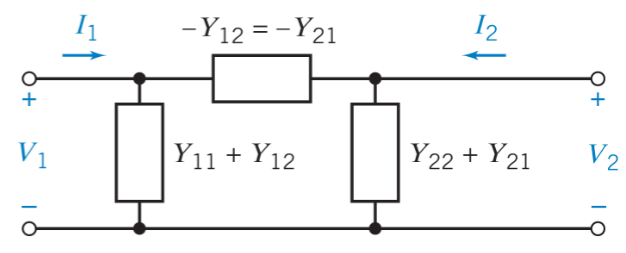
Admittance
$$
\begin{bmatrix}
I_1 \
I_2
\end{bmatrix}
=
\begin{bmatrix}
Y_{11} & Y_{12} \
Y_{21} & Y_{22}
\end{bmatrix}
\begin{bmatrix}
V_1 \
V_2
\end{bmatrix}
$$
Hybrid
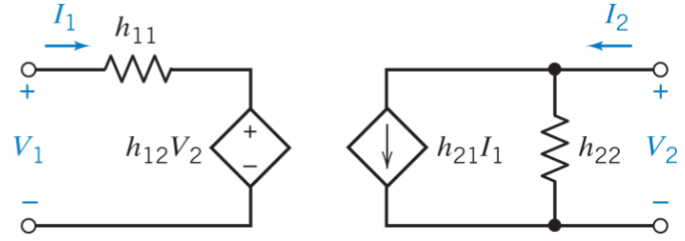
$$
\begin{bmatrix}
V_1 \
I_2
\end{bmatrix}
=
\begin{bmatrix}
h_{11} & h_{12} \
h_{21} & h_{22}
\end{bmatrix}
\begin{bmatrix}
I_1 \
V_2
\end{bmatrix}
$$
Inverse Hybrid
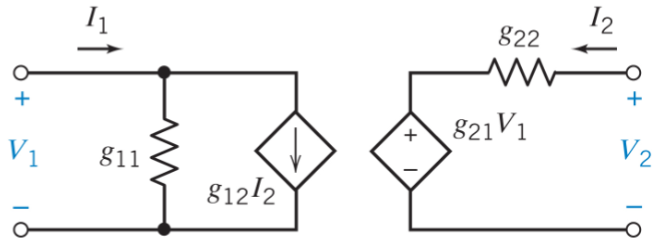
$$
\begin{bmatrix}
I_1 \
V_2
\end{bmatrix}
=
\begin{bmatrix}
g_{11} & g_{12} \
g_{21} & g_{22}
\end{bmatrix}
\begin{bmatrix}
V_1 \
I_2
\end{bmatrix}
$$
Transmission
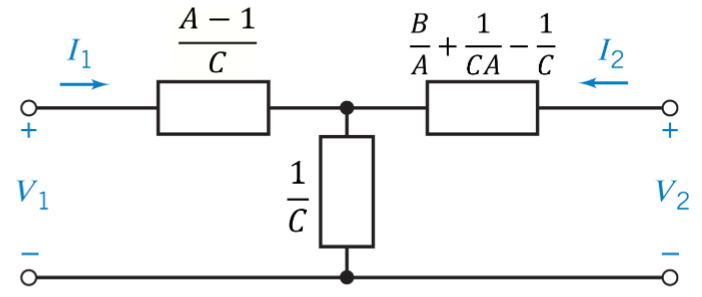
$$
\begin{bmatrix}
V_1 \
I_1
\end{bmatrix}
=
\begin{bmatrix}
A & B \
C & D
\end{bmatrix}
\begin{bmatrix}
V_2 \
- I_2
\end{bmatrix}
$$
References
- Two-Port and Three-Port Networks (course handout)
Sources
- Alexander & Sadiku, Fundamentals of Electric Circuits
- Two-Port and Three-Port Networks