Notes › EENG 3345: AC Circuit Analysis Lecture 6
Three-Phase Circuits
398 words 3 min Modified
Table of Contents
Three-Phase Circuits
Definition 06.1 (Three-Phase Voltages).
Consists of three sinusoidal voltages of equal magnitude but phase-shifted by $120^{\circ}$. Advantage: constant power transmission.
- Balanced condition: $V_{aa^{'}} + V_{bb^{'}} + V_{cc^{'}} = 0$
- This also implies the resistive loads in each branch are the same, since the potential at each point is identical
- For notational simplicity: $V_{aa^{'}} = V_a$ and so forth
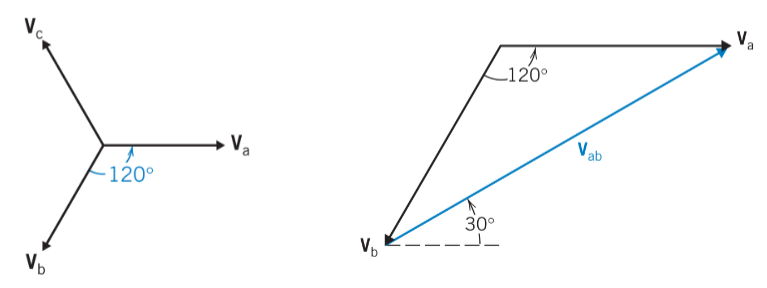
- For any balanced bridge circuit, the phase voltages should be the same
Current Relationships
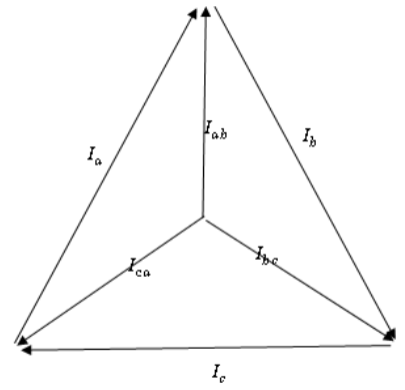
- Line currents: $I_a, I_b, I_c$
- Phase currents: $I_{ab}, I_{bc}, I_{ca}$
- Phase to line current: $I_{m}\sqrt{3} \angle -30^{\circ}$
- For Delta Configuration:
Voltage Relationships
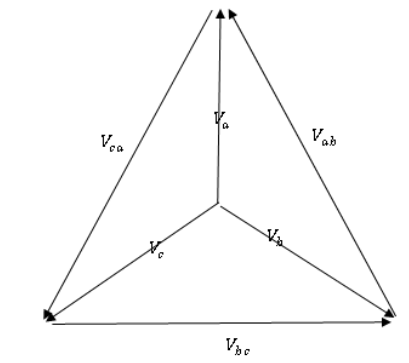
- Line voltages: $V_{ab}, V_{bc}, V_{ca}$
- Phase voltages: $V_a, V_b, V_c$
- Phase to line voltage: $V_{m} \sqrt{3} \angle 30^{\circ}$
Line voltages:
$$\begin{align} V_{aa^{'}} &= V_{m}\cos \omega t \\ &= Vm \angle 0^{\circ}\\ V_{bb^{'}} &= V_{m}\cos(\omega t - 120^{\circ}) \\ &= Vm \angle -120^{\circ}\\ V_{cc^{'}} &= V_{m}\cos(\omega t - 240^{\circ}) \\ &= Vm \angle 120^{\circ}\\ \end{align}$$- For Delta Configuration:
Bridge Circuits
Y-to-Y Circuit
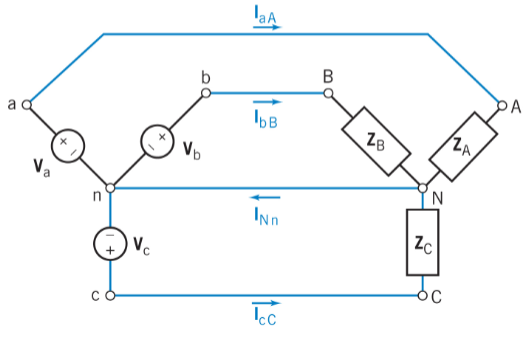
- Three voltage sources connected in a Y configuration to three impedances in a Y configuration
- Assuming the voltage sources are three-phase and the impedances match, then the neutral current in the middle $i_N$ is zero
- Otherwise, use nodal analysis to determine the currents
- Phase currents equal line currents
D-to-D Circuit
- Three voltage sources connected in a D configuration to three impedances in a D configuration
- The current through each impedance is the corresponding voltage source times the admittance
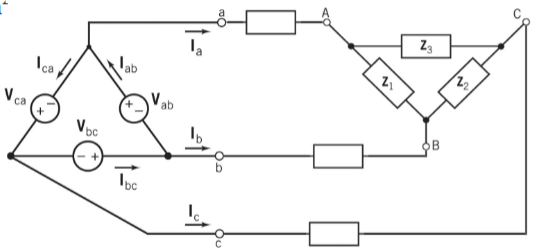
Y-to-D Circuit
- Use KCL and KVL
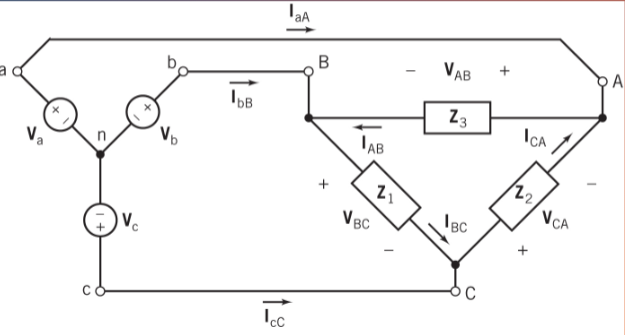
Power
- Total real power (balanced load)
- Apparent power:
- Reactive power:
Examples
Example 06.2.
In a purely resistive circuit, the voltage and current are:
$$v(t) = 230\cos(\omega t), i(t) = 10\cos(\omega t)$$- Calculate the real power consumed by the circuit
- Determine the apparent power
- What is the power factor?
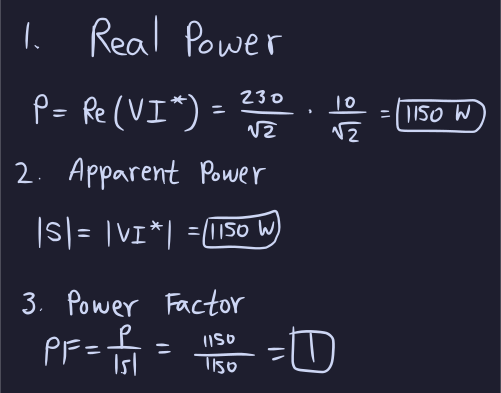
Example 06.3.
A balanced Y-Y system has a phase voltage $V_{ph} = 120V$ and resistive load $Z = 10\Omega$. Find the line current and the total power consumed.
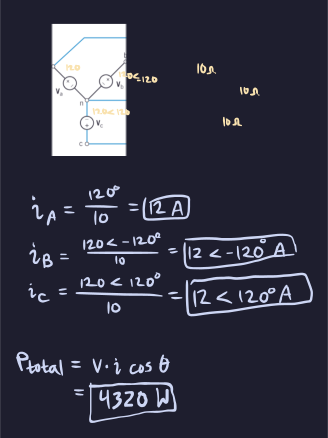
References
- Three-Phase Circuits (course handout)
Sources
- Three-Phase Circuits