> anishgoyal


NotesA First Course in Analysis (Pedrick) Lecture 1

Number Systems

calendar_today   article 4410 words   access_time 30 min   replay Modified

Table of Contents

Ways to Count

Counting

Definition 01.1 (Successor Properties).

a. Every object has a unique successor b. Different objects have different successors c. There is an object that is not the successor of any object (the “first” object)

The Abstract Number System

Definition 01.2 (Complete Matching).

Identify the “first” elements of both sets, then their successors with each other, then identify the successors of any pair that is already identified. This is a complete matching of the two sets.

Definition 01.3 (Extended Successor Property).

A subset of $\mathbb{N}$ is all of $\mathbb{N}$ if it includes the initial element and the successor of each element of $\mathbb{N}$.

Peano Axioms

Axiom (Peano Axiom 1).

Every $n \in \mathbb{N}$ has a unique successor $n^{*} \in \mathbb{N}$.

Axiom (Peano Axiom 2).

$n \ne m \implies n^{*} \ne m^{*}$

Axiom (Peano Axiom 3).

There exists an element (denoted 1), in $\mathbb{N}$ such that $1 \ne n^{*} \ \forall \ n \in \mathbb{N}$.

Axiom (Peano Axiom 4 (Induction Axiom)).

If $S \subset \mathbb{N}$ satisfies $1 \in S \quad \text{(One-Case)}$ and $n \in S \Rightarrow n^{*} \in S \quad \text{(Inductive Step)},$ then $S = \mathbb{N}$.

Addition

Definition 01.4 (Addition).
$$ \begin{align} m + 1 &= m^{*}, \\ m + n^{*} &= (m + n)^{*} \end{align} $$
Theorem 01.5 (Associativity of Addition).
$$(m + n) + k = m + (n + k)$$
Theorem 01.6 (Commutativity of Addition).
$$m + n = n + m$$

Proof of Associativity of Addition. One-Case $(k = 1)$:

$$(m + n)^* = m + n^* $$

RHS

$$m + n^{*}$$

LHS

$$(m + n)^* = m + n^{*}$$

Since LHS = RHS, the One-Case is complete.

Inductive Step $(k = k^{*})$:

$$ \begin{align} (m + n) + k^* &= [(m + n) + k]^* && \text{by the one-case} \\ &= [m + (n + k)]^* && \text{by the induction hypothesis} \\ &= m + (n + k)^* && \text{by the one-case} \\ &= m + (n + k^*) && \text{by the one-case} \end{align} $$

We have shown that $(m + n) + k^{*} = m + (n + k^{*})$; thus, the Inductive Step is complete and so is the proof.

Proof of Commutativity of Addition.(Exercises 8 and 9 [Pedrick, A First Course in Analysis, p. 22]) One-Case $(n = 1)$:

$$1 + 1 = 1 + 1$$

This is trivially true.

Inductive Step $(n = n^{*})$:

$$1 + n^{*} = n^{*} + 1$$

RHS:

$$\begin{align} n^* + 1 &= (n + 1) + 1 \\ &= (n + 1)^{*} \end{align}$$

LHS:

$$\begin{align} 1 + n^* &= (1 + n)^* &&\\ &= (n + 1)^* && \text{by the inductive hypothesis} \end{align}$$

Since, RHS = LHS, the Inductive Step is complete and so concludes the proof.

Multiplication

Definition 01.7 (Multiplication).
$$ \begin{align} 1 \cdot m &= m, \\ m \cdot n^* &= m \cdot n + m \end{align} $$
Theorem 01.8 (Left Distributive Law).
$$m \cdot (n + k) = m \cdot n + m \cdot k$$
Theorem 01.9 (Right Distributive Law).
$$(n + k) \cdot m = n \cdot m + k \cdot m$$
Proposition 01.10.
$$1 \cdot n = n \ \forall \ n \in \mathbb{N}$$
Theorem 01.11 (Associativity of Multiplication).
$$m \cdot (n \cdot k) = (m \cdot n) \cdot k$$
Theorem 01.12 (Commutativity of Multiplication).
$$m \cdot n = n \cdot m$$

Proof of Proposition 01.10.(Exercise 10 [Pedrick, A First Course in Analysis, p. 23]) One-Case $(m = 1)$:

$$1 \cdot 1 = 1$$

Trivially true.

Inductive Step $(m = m^{*})$:

$$1 \cdot m^{*} = m^{*}$$

RHS:

$$n^{*} = n+1$$

LHS:

$$\begin{align} 1 \cdot (n+1) &= 1 \cdot n + 1 \end{align}$$

Since RHS = LHS, the Inductive Step is complete, and so is the proof.

This shows commutativity holds for the first part of the definition of multiplication. 1 is a neutral element under multiplication since $1 \cdot m = m \cdot 1 = m \ \forall \ m \in \mathbb{N}$

Proof of Left Distributive Law. One-Case $(k = 1)$:

$$m \cdot (n + 1) = m + n + m \cdot 1$$

RHS:

$$m \cdot n + m \cdot 1 = m \cdot n + m$$

LHS:

$$\begin{align} m \cdot (n + 1) &= m \cdot n^* \\ &= m \cdot n + m \end{align}$$

Since RHS = LHS, the One-Case is complete.

Inductive Step $(k = k^*)$:

$$m \cdot (n + k^*) = m \cdot n + m \cdot k^*$$

RHS:

$$m \cdot n + m \cdot k^*$$

LHS:

$$\begin{align} m \cdot (n + k^*) &= m \cdot (n+k)^* \\ &= m \cdot (n + k) + m \\ &= m \cdot n + m \cdot k + m \\ &= m \cdot n + m \cdot k^* \\ \end{align}$$

Since RHS = LHS, the Inductive Step is complete and so is the proof.

Proof of Right Distributive Law.(Exercise 11 [Pedrick, A First Course in Analysis, p. 23]) One-Case $(m = 1)$:

$$(n + k) \cdot 1 = n \cdot 1 + k \cdot 1$$

RHS:

$$n \cdot 1 + k \cdot 1 = n + k$$

LHS:

$$(n + k) \cdot 1 = n + k$$

Since RHS = LHS, the One-Case is complete.

Inductive Step $(m = m^*)$:

$$(n + k) \cdot m^* = n \cdot m^* + k \cdot m^*$$

RHS:

$$\begin{align} n \cdot m^* + k \cdot m^* &= n \cdot m + n + k \cdot m + k \\ &= n \cdot m + k \cdot m + n + k \end{align}$$

LHS:

$$\begin{align} (n + k) \cdot m^* &= (n + k) \cdot m + (n + k) \\ &= n \cdot m + k \cdot m + n + k \end{align}$$

Since the RHS = LHS, the Inductive Step is complete, and so is the proof.

Proof of Associativity of Multiplication.(Exercise 12 [Pedrick, A First Course in Analysis, p. 23]) One-Case $(k = 1)$:

$$m \cdot (n \cdot 1) = (m \cdot n) \cdot 1$$

RHS:

$$(m \cdot n) \cdot 1 = m \cdot n$$

LHS:

$$m \cdot (n \cdot 1) = m \cdot n$$

Since RHS = LHS, the One-Case holds.

Inductive Step $(k = k^*)$:

$$m \cdot (n \cdot k^*) = (m \cdot n) \cdot k^*$$

RHS:

$$(m \cdot n) \cdot k^* = m \cdot n \cdot k + m \cdot n$$

LHS:

$$\begin{align} m \cdot (n \cdot k^*) &= m \cdot (n \cdot k + n) \\ &= m \cdot n \cdot k + m \cdot n \end{align}$$

Since RHS = LHS, the Inductive Step is complete and so is the proof.

Proof of Commutativity of Multiplication.(Exercise 12 [Pedrick, A First Course in Analysis, p. 23]) One-Case $(n = 1)$: Already proven in Proof of Proposition 01.10.

Inductive Step $(n = n^*)$:

$$m \cdot n^* = n^* \cdot m$$

RHS:

$$\begin{align} n^* \cdot m &= (n + 1) \cdot m \\ &= n \cdot m + 1 \cdot m \\ &= n \cdot m + m \end{align}$$

LHS:

$$\begin{align} m \cdot n^* &= m \cdot n + m \\ &= n \cdot m + m \end{align}$$

Since RHS = LHS, the Inductive Step is complete and so is the proof.

Ordering

Theorem 01.13 (Transitive Law).

$l < m \land m < n \Rightarrow l < n$

Theorem 01.14 (Trichotomy Property).

$m = n \lor m < n \lor n < m \ \forall \ (m, n) \in \mathbb{N}$

Proof of Trichotomy Property.(EXERCISE 13 [Pedrick, A First Course in Analysis, p. 24]) The Peano Axioms imply that $\mathbb{N}$ can be decomposed into three distinct sets:

  • $\{m \in \mathbb{N}: m < n\}$
  • $\{n\}$
  • $\{m \in \mathbb{N}: n < m\}$

Fix $n \in \mathbb{N}$. Define $T = \{ m \in \mathbb{N} : m = n \lor m < n \lor n < m \}$.

One-Case: $1 \in T$

  • If $n = 1$, then $1 = n$.
  • If $n \ne 1$, then $1 < n$.

So $1 \in T$.

Inductive Step: Assume $m \in T$. Then one of the following holds:

  • If $m = n$, then $m^* = n^*$, so $n < m^*$, hence $m^* \in T$.
  • If $m < n$, then $\exists k \in \mathbb{N}$ such that $m + k = n$.

Then $m^* + k = (m + 1) + k = m + (1 + k) = m + k + 1 = n + 1 = n^*$, so $m^* < n^*$, hence $m^* < n \lor m^* = n \lor n < m^*$, thus $m^* \in T$.

  • If $n < m$, then $\exists k \in \mathbb{N}$ such that $n + k = m$. Then $n + k + 1 = m^*$, so $n < m^*$, hence $m^* \in T$.

By induction, $T = \mathbb{N}$. Therefore, $m = n \lor m < n \lor n < m$ for all $m, n \in \mathbb{N}$.

Proposition 01.15 (Addition preserves order).
$$m < n \implies m + k < n + k$$
Proposition 01.16 (Multiplication preserves order).
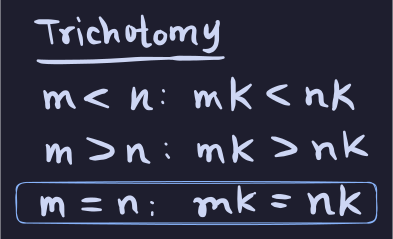
$$m < n \implies m \cdot k < n \cdot k$$

Proof of Addition preserves order.(EXERCISE 14 [Pedrick, A First Course in Analysis, p. 24]) $m < n \implies \exists \ b \in \mathbb{N}: n = m + b$

$k \in \mathbb{N} \implies m + k = n - b + k$

$n - b + k$ is trivially less than $n + k$, so the proof is complete.

Proof of Multiplication preserves order.(EXERCISE 14 [Pedrick, A First Course in Analysis, p. 24]) $m < n \implies \exists \ b \in \mathbb{N}: n = m + b$

$k \in \mathbb{N} \implies m \cdot k = (n - b) \cdot k$

$(n-b) \cdot k$ is trivially less than $n \cdot k$, so the proof is complete.

Remark on Induction

Exponentiation

Definition 01.17 (Exponentiation).

(EXERCISE 15 [Pedrick, A First Course in Analysis, p. 24])

$$\begin{align} m ^ 1 &= m \\ m^{n^*} &=m^n \cdot m \end{align}$$
Theorem 01.18 (Exponent Addition Law).
$$m^n \cdot m^k = m^{n + k}$$
Theorem 01.19 (Exponent Distributive Law).
$$(m \cdot n)^k = m^k \cdot n^k$$
Theorem 01.20 (Exponent Multiplication Law).
$$\left(m^n\right)^k = m^{n \cdot k}$$

Proof of Exponent Addition Law.(EXERCISE 16 [Pedrick, A First Course in Analysis, p. 24]) One-Case $(k = 1)$:

$$m^n \cdot m^1 = m^{n + 1}$$

RHS:

$$m^{n+1} = m^{n^*}$$

LHS:

$$\begin{align} m^{n} \cdot m^1 &= m^n \cdot m \\ &= m^{n^*} \end{align}$$

Since RHS = LHS, the One-Case holds.

Inductive Step $(k = k^{*})$:

$$m^{n} \cdot m^{k^*} = m^{n + k^*}$$

RHS:

$$m^{n + k^*}$$

LHS:

$$\begin{align}

m^n \cdot m^{k^} &= m^n \cdot m^k \cdot m \ &= (m^n \cdot m^k) \cdot m \ &= m^{n+k} \cdot m \ &= m^{(n + k)^} \ &= m^{n + k^*} \end{align}$$

Since RHS = LHS, the Inductive Step is complete and so is the proof.

Proof of Exponent Distributive Law.(EXERCISE 16 [Pedrick, A First Course in Analysis, p. 24]) One-Case $(k = 1)$:

$$(m \cdot n)^1 = m^1 \cdot n^1$$

RHS:

$$m^1 \cdot n^1 = m \cdot n$$

LHS:

$$(m \cdot n)^1 = m \cdot n$$

Since RHS = LHS, the One-Case holds.

Inductive Step $(k = k^*)$:

$$(m \cdot n)^{k^*} = m^{k^*} \cdot n^{k^*}$$

RHS:

$$\begin{align} m^{k^*} \cdot n^{k^*} &= (m^k \cdot m) \cdot (n^k \cdot n) \\ &= (m^k \cdot n^k) \cdot (m \cdot n) \end{align}$$

LHS:

$$\begin{align} (m \cdot n)^{k^*} &= (m \cdot n)^k \cdot (m \cdot n) \\ &= (m^k \cdot n^k) \cdot (m \cdot n) \\ &= (m^k \cdot n^k) \cdot (m \cdot n) \end{align}$$

Since RHS = LHS, the Inductive Step is complete and so is the proof.

Proof of Exponent Multiplication Law.(EXERCISE 16 [Pedrick, A First Course in Analysis, p. 24]) One-Case $(k=1)$:

$$(m^n)^1 = m^{n \cdot 1}$$

RHS:

$$m^{n \cdot 1} = m^{n}$$

LHS:

$$(m^n)^1 = m^n$$

Since RHS = LHS, the One-Case holds.

Inductive Step $(k = k^*)$:

$$(m^n)^{k^*} = m^{n \cdot k^*}$$

RHS:

$$\begin{align} m^{n \cdot k^*} &= m^{n \cdot k + n} \\ &= m^{n \cdot k} \cdot m^n \end{align}$$

LHS:

$$\begin{align} (m^n)^{k^*} &= (m^n)^k \cdot m^n \\ &= m^{n \cdot k} \cdot m^n \end{align}$$

Since RHS = LHS, the Inductive Step is complete and so is the proof.

Miscellaneous Proofs with Induction

Proof.(EXERCISE 17 [Pedrick, A First Course in Analysis, p. 26]) One-Case $(n = 1)$:

$$(1 + x)^1 \ge 1 + 1 \cdot x$$

RHS:

$$1 + 1 \cdot x = 1 + x$$

LHS:

$$(1 + x)^1 = 1 + x$$

Since RHS = LHS, $\ge$ can be refined to =, and the One-Case holds. This also implies all choices of $x$ work when $n=1$.

Inductive Step $(n = n^*)$:

$$(1 + x)^{n^*} \ge 1 + n^* \cdot x$$

RHS:

$$1 + n^* \cdot x = 1 + n \cdot x + x$$

LHS:

$$\begin{align} (1 + x)^{n^*} &= (1+x)^n(1+x) \\ &\ge (1+ n \cdot x)(1+x) \\ &= 1 + n \cdot x + x + n \cdot x^2 \end{align}$$

Since LHS contains an extra $n \cdot x^2$ than the RHS, which is guaranteed to be positive for $x \ge -1$, the Inductive Step is complete and so is the proof. The inequality does not hold for $x < -1$ because $(1 + x)$ would be negative, reversing the inequality.

Proof.EXERCISE 18 [Pedrick, A First Course in Analysis, p. 26] One-Case $(n=1)$:

$$1^2 = \frac{1 (1+1)(2\cdot 1 + 1)}{6}$$

RHS:

$$\begin{align} \frac{1 (1+1)(2\cdot 1 + 1)}{6} &=\frac{1 \cdot 2 \cdot 3}{6} \\ &= \frac{6}{6} \\ &=1 \end{align}$$

LHS:

$$1^2 = 1$$

Since RHS = LHS, the One-Case holds.

Inductive Step $(n=n^*)$:

$$1^2 + 2^2 + \dots + n^2 + (n^*)^2 = \frac{n^*(n^* + 1)(2n^* + 1)}{6}$$

RHS:

$$\frac{n^*(n^* + 1)(2n^* + 1)}{6}$$

LHS:

$$\begin{align} 1^2 + 2^2 + \dots + n^2 + (n^*)^2 &= (1^2 + 2^2 + \dots + n^2) + (n^*)^2 \\ &= \frac{n(n+1)(2n+1)}{6} + (n^*)^2 \\ &= \frac{n(n^*)(2n + 1)}{6} +(n^*)^2 \\ &= \frac{n^*}{6}\left(n(2n+1) + 6n^*\right) \\ &= \frac{n^*}{6}\left((n^*-1)(2n^*-1)+6n^*\right) \\ &= \frac{n^*}{6}\left(2(n^*)^2 + 3n^* + 1\right) \\ &= \frac{n^*}{6}\left((2n^*+1)(n^*+1)\right) \\ &= \frac{n^*(2n^*+1)(n^*+1)}{6} \\ &=\frac{n^*(n^*+1)(2n^*+1)}{6} \end{align}$$

Since RHS = LHS, the Inductive Step is complete and so is the proof.

Proof.EXERCISE 19 [Pedrick, A First Course in Analysis, p. 26] One-Case $(n = 1)$:

$$2 \cdot 1 - 1 = 1^2$$

RHS:

$$1^2 = 1$$

LHS:

$$\begin{align} 2 \cdot 1 - 1 &= 2 - 1 \\ &= 1 \end{align}$$

Since RHS = LHS, the One-Case holds.

Inductive Step $(n = n^*)$:

$$1 + 3 + 5 + \dots + (2n - 1) + (2n^* - 1) = (n^*)^2$$

RHS:

$$\begin{align} (n^*)^2 &= (n+1)^2 \\ &= n^2 + 2n + 1 \\ &= n^2 + (2n + 1) \\ &=n^2 + (2n^* - 1) \end{align}$$

LHS:

$$\begin{align} 1 + 3 + 5 + \dots + (2n - 1) + (2n^* - 1) &= (1 + 3 + 5 + \dots + (2n - 1)) + (2n^* - 1) \\ &= n^2 + (2n^* - 1) \end{align}$$

Since RHS = LHS, the Inductive Step is complete and so is the proof.

Proposition 01.21 (Summation up to $n$).
$$1 + 2 + \dots + n = \frac{n(n+1)}{2} =\frac{n^2 + n}{2}$$

Proven in This example [Pedrick, A First Course in Analysis, p. 25]

Proof.EXERCISE 20 [Pedrick, A First Course in Analysis, p. 26] One-Case $(n = 1)$:

$$1^3 = 1^2$$

Trivially true.

Inductive Step $(n = n^*)$:

$$1^3 + 2^3 + \dots + n^3 + (n^*)^3 = (1 + 2 + \dots + n + n^*)^2$$

RHS:

$$\begin{align} (1 + 2 + \dots + n + n^*)^2 &= \left(\frac{(n^*)^2 + n^*}{2}\right)^2 \\ &= \frac{(n^*)^4 + 2(n^*)^3 + (n^*)^2}{4} \\ \\ &= \frac{(n+1)^4 + 2(n+1)^3 + (n+1)^2}{4} \end{align}$$

By the Binomial Theorem (which is covered later, but just as a shortcut):

$$ \begin{align} (n+1)^4 &= \binom{4}{0}n^4 + \binom{4}{1}n^3 + \binom{4}{2}n^2 + \binom{4}{3}n + \binom{4}{4} \\ &= n^4 + 4n^3 + 6n^2 + 4n + 1\\ (n+1)^3 &= \binom{3}{0}n^3 + \binom{3}{1}n^2 + \binom{3}{2}n + \binom{3}{3} \\ &= n^3 + 3n^2 + 3n + 1 \end{align} $$

Therefore:

$$\begin{align} \frac{(n+1)^4 + 2(n+1)^3 + (n+1)^2}{4} &= \frac{(n^4 + 4n^3 + 6n^2 + 4n + 1)}{4} \\ \\ &+ \frac{2(n^3 + 3n^2 + 3n + 1) + (n^2 + 2n + 1)}{4} \\ &= \frac{n^4 + 6n^3 + 13n^2 + 12n + 4}{4} \end{align}$$

LHS:

$$\begin{align} 1^3 + 2^3 + \dots + n^3 + (n^*)^3 &= (1^3 + 2^3 + \dots + n^3) + (n^*)^3 \\ &= \left(\frac{n^2 + n}{2}\right)^2 + (n^*)^3 \\ &= \frac{n^4 + 2n^3 + n^2}{4} + n^3 + 3n^2 + 3n + 1 \\ &= \frac{n^4 + 2n^3 + n^2}{4} + \frac{4n^3 + 12n^2 + 12n + 4}{4} \\ &= \frac{n^4 + 6n^3 + 13n^2 + 12n + 4}{4} \end{align}$$

Since RHS = LHS, the Inductive Step is complete and so is the proof.

Exercise 01.22.

(EXERCISE 21 [Pedrick, A First Course in Analysis, p. 26]) Inductive Step $(n = n^*)$:

$$(n^*)^2 + 3n^* + 1 \equiv 0 \pmod 2$$

RHS:

$$0\pmod 2$$

LHS:

$$\begin{align} (n^*)^2 + 3n^* + 1 &= (n+1)^2 + 3(n+1) + 1 \\ &= n^2 + 2n + 1 + 3n + 3 + 1 \\ &= (n^2 + 3n + 1) + 2n + 4 \end{align}$$

Taking everything mod 2:

$$\begin{align} (n^2 + 3n + 1) + 2n + 4 &\equiv 2n + 4 \pmod 2 \\ &\equiv 2(n+4) \pmod 2 \\ &= 0 \pmod 2 \end{align}$$

Since RHS = LHS, the Inductive Step is complete. However, the One-Case fails for any arbitrary $n$. This is why the One-Case should never be overlooked in an inductive proof.

Exercise 01.23.

(EXERCISE 22 [Pedrick, A First Course in Analysis, p. 26]) One-Case $(n = 1)$:

$$2^{1} > 1$$

This is trivially true.

Inductive Step $(n = n^*)$:

$$2^{n^*} > n^*$$

RHS:

$$n^* = n+1$$

LHS:

$$\begin{align} 2^{n^*} &= 2^n \cdot 2 \\ &> 2n \\ \end{align}$$

By transitivity, we obtain $2n \ge n +1$, which holds $\forall n \in \mathbb{N}$. Thus, the Inductive Step is complete and so is the proof.

Exercise 01.24.

(EXERCISE 23 [Pedrick, A First Course in Analysis, p. 26]) One-Case $(n=1)$:

$$11^1 - 4^1 \equiv 0 \pmod 7$$

This is trivially true.

Inductive Step $(n = n^*)$:

$$11^{n^*} - 4^{n^*} \equiv 0 \pmod 7$$

RHS:

$$0 \pmod 7$$

LHS:

$$11^{n^*} - 4^{n^*} = 11^n \cdot 11 - 4^n \cdot 4$$

Taking everything mod 7:

$$\begin{align} 11^n \cdot 11 - 4^n \cdot 4 &= 4^n \cdot 11 - 4^n \cdot 4 \pmod 7\\ &= 4^n (11-4) \pmod 7 \\ &= 0 \pmod 7 \end{align}$$

Since RHS = LHS, the Inductive Step is complete and so is the proof.

Exercise 01.25.

(EXERCISE 24 [Pedrick, A First Course in Analysis, p. 26]) Since we are proving this for $n \ge 4$, we will make the One-Case at $n=4$.

One-Case $(n=4)$:

$$4! > 2^4$$

RHS:

$$2^4 = 16$$

LHS:

$$4! = 24$$

Since $24 > 16$, the One-Case holds.

Inductive Step $(n = n^*)$:

$$n^*! > 2^{n^*}$$

RHS:

$$2^{n^*} = 2^n \cdot 2$$

LHS:

$$\begin{align} n^*! &= n^* \cdot n! \\ &> n^* \cdot 2^n \end{align}$$

We obtain $n^* \cdot 2^n \ge 2^n \cdot 2$. This simplifies to

$$n^* \ge 2$$

which is true $\forall n \in \mathbb{N}$. Therefore, the Inductive Step is complete and so is the proof.

Reduction Formulas

Exercise 01.26.

(EXERCISE 26 [Pedrick, A First Course in Analysis, p. 26]) One-Case $(n = 0)$:

$$\int x^0 e^x \ \mathrm{d}x = x^0 e^x - 0\int x^{n-1}e^x \ \mathrm{d}x$$

RHS:

$$\begin{align} x^0 e^x - 0\int x^{n-1}e^x \ \mathrm{d}x &= 1 \cdot e^x \\ &= e^x \end{align}$$

LHS:

$$\begin{align} \int x^0 e^x \ \mathrm{dx} &= \int 1 \cdot e^x \ \mathrm{d}x \\ &= \int e^x \ \mathrm{d}x \\ &= e^x \end{align}$$

Since RHS = LHS, the One-Case holds.

Inductive Step $(n=n^*)$:

$$\int x^{n^*} e^x \ \mathrm{d}x = x^{n^*} e^x - n^*\int x^{n^* - 1}e^x \ \mathrm{d}x$$

RHS:

$$ x^{n^*} e^x - n^*\int x^{n^* - 1}e^x \ \mathrm{d}x = x^{n^*} e^x - n^*\int x^{n}e^x \ \mathrm{d}x $$

LHS:

$$ \begin{align} \int x^{n^*} e^x \ \mathrm{d}x &= \int x^{n+1} e^x \ \mathrm{d}x &&\\ &= x^{n+1}e^x - \int e^x \cdot (n+1)x^n \ \mathrm{d}x &&\text{IBP}\\ &= x^{n+1}e^x - (n+1)\int x^ne^x \ \mathrm{d}x \\ &= x^{n^*}e^x - n^* \int x^n e^x \ \mathrm{d}x \end{align} $$

Since RHS = LHS, the Inductive Step is complete and so is the proof. Using this reduction formula, we can write the general formula:

$$\int x^n e^x \ \mathrm{d}x = e^x \left[\sum_{i=0}^n (-1)^i \frac{n!}{(n-i)!}x^{n-i}\right].$$

Complete Induction

Definition 01.27 (Complete (Strong) Induction).

$S \subset \mathbb{N}$ is all of $\mathbb{N}$ if $1 \in S$ and $\{1, 2, \dots , k\} \subset S$ implies $k+1 \in S$ This is a type of induction that uses all numbers up to and including $n$ to imply $n^*$ rather than just $n$

Proposition 01.28.

Every nonempty set of natural numbers has a first member. Proof [Pedrick, A First Course in Analysis, p. 27]

Sequence

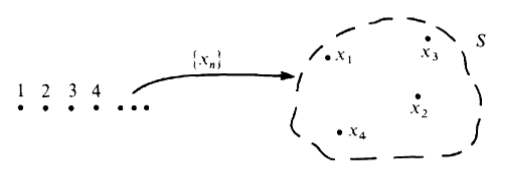
sequence diagram example

Exercise 01.29.

(EXERCISE 28 [Pedrick, A First Course in Analysis, p. 28])

Part I:

One-Case $(n = 1)$:

$$a ^ 1 - b ^ 1 = k_{1}(a - b)$$

This is trivially true with $k_{1} =1 \in \mathbb{N}$ Inductive Step $(n = n^*)$:

$$a^{n^*} - b^{n^*} = k_{n^*}(a - b)$$

RHS:

$$\begin{align} k_{n^*}(a-b) &= (k_{n^*} + 1)(a-b) &&\text{add $a-b$} \end{align}$$

LHS:

$$\begin{align} a^{n^*} - b^{n^*} &= a \cdot a^n - b \cdot b^n \\ &= (a \cdot a^n + a) - (b \cdot b^n + b) &&\text{add $a - b$} \\ &= a(k_{n}(a-b) + b^n) + a - b \cdot b^n - b \\ &= a \cdot k_{n}(a-b) + a \cdot b^n + a - b \cdot b^n - b \\ &= ak_{n}(a-b) + ab^n - bb^n + a - b \\ &= ak_{n}(a-b)+b_{n}(a-b) + 1(a - b) \\ &= (ak_{n} + b^n + 1)(a-b) \end{align}$$

Dividing RHS and LHS by $(a-b)$:

$$ak_{n} + b^n + 1 = k_{n^*} + 1 \implies ak_{n} + b^n = k_{n^*}$$

Since $k_{n^*} \in \mathbb{N}$, the Inductive Hypothesis is complete and so is the proof.

Part II:

Important note: I changed the LHS of this identity to

$$(a-b)\sum_{i=0}^{n-1}a^ib^{n-1-i}$$

One-Case $(n = 1)$:

$$a^1 - b^1 = (a-b)\sum_{i=0}^{0}a^ib^{0-i}$$

From this, we have $a-b$ on both sides, so the One-Case holds.

Inductive Step $(n = n^*)$:

$$a^{n^*} - b^{n^*} = (a-b)\sum_{i=0}^{n} a^i b^{n-i}$$

RHS:

$$\begin{align} (a-b)\sum_{i=0}^{n} a^i b^{n-i} &= (a-b)\left( a\sum_{i=0}^{n-1}a^ib^{n-1} + b^n \right) \\ &= a(a-b)\sum_{i=0}^{n-1}a^ib^{n-1} + b^n(a-b) \\ &=aa^n - ab^n +ab^n - bb^n \\ &= aa^n - bb^n \\ &= a^{n^*} - b^{n^*} \end{align}$$

LHS:

$$a^{n^*} - b^{n^*}$$

Since RHS = LHS, the Inductive Step is complete, and so is the proof.

More on Sequences

Definition 01.30.

Every infinite subset, $\mathbf{K}$, of $\mathbb{N}$ is injective over $\mathbb{N}$, starting with $n_1 =$ the first element of $\mathbf{K}$. The notation is $\{x_{n_k}\}$, where $n_k$ is the first unmatched integer.

Proof.(EXERCISE 29 [Pedrick, A First Course in Analysis, p. 29]) Consider any finite list of prime numbers $p_1, p_2, \ldots, p_n$. It will be shown that there exists at least one additional prime number not included in this list.

Let $P$ be the product of all the prime numbers in the list:

$$ P = p_1 p_2 \cdots p_n. $$

Let $q = P + 1$. Then $q$ is either prime or not:

  • If $q$ is prime, then there is at least one more prime that is not in the list, namely, $q$ itself.
  • If $q$ is not prime, then some prime factor $p$ divides $q$. If this factor $p$ were in our list, then it would also divide $P$ (since $P$ is the product of every number in the list). If $p$ divides both $P$ and $q$, then $p$ must also divide the difference of the two numbers: $$ q - P = (P + 1) - P = 1. $$ Since no prime number divides 1, $p$ cannot be in the list. This means that at least one more prime number exists that is not in the list.

Extending $\mathbb{N}$ to $\mathbb{Z}$

$\mathbb{N} \cup \{0\}$

Adjoining 0 to $\mathbb{N}$ gives us the solution for the equations $n + x = n$, for any $n$ in this new set of numbers. $\forall \ n \in \mathbb{N} \cup 0$:

Creating $\mathbb{Z}$

Exercise 01.31.

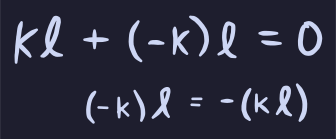
(EXERCISE 30 [Pedrick, A First Course in Analysis, p. 30]) Using the definition of additive inverse:

01 Number Systems 2025-06-03 15.00.54

Therefore, $(-k) \cdot l = -(k \cdot l)$

Exercise 01.32.

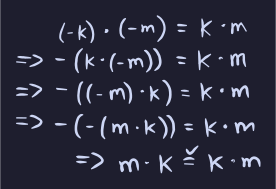
(EXERCISE 31 [Pedrick, A First Course in Analysis, p. 30])

01 Number Systems 2025-06-03 15.27.35
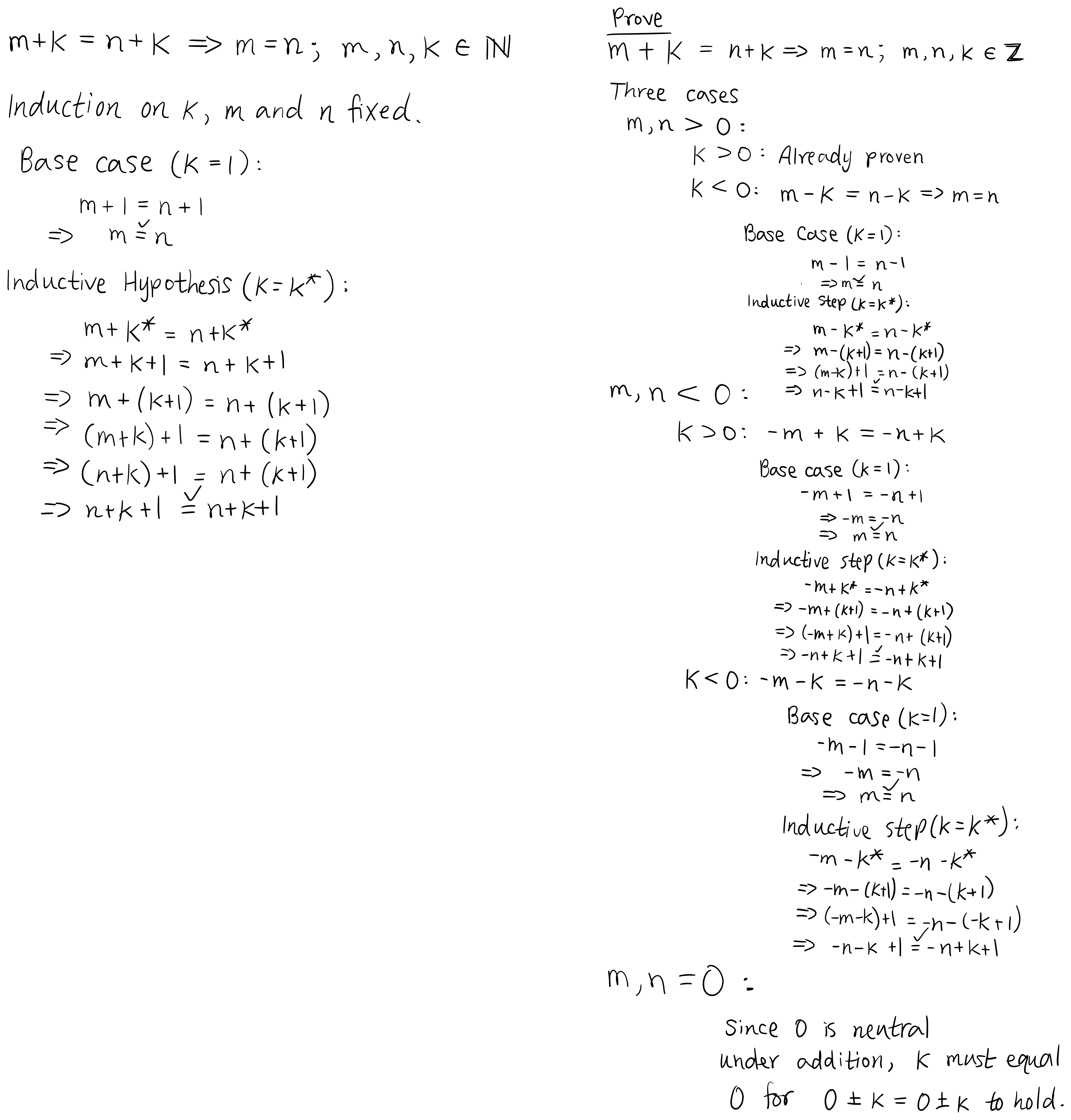
Definition 01.33 (Cancellation Law for Addition).
$$m + k = n + k \implies m = n$$

Proof.(EXERCISE 32 [Pedrick, A First Course in Analysis, p. 30]) exercise 32 cancellation law

Definition 01.34 (Cancellation Law for Multiplication).
$$m \cdot k = n \cdot k \implies m = n; k \ne 0$$

Proof.(EXERCISE 33 [Pedrick, A First Course in Analysis, p. 30])

01 Number Systems 2025-06-03 16.29.49

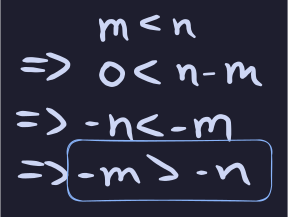
Definition 01.35 (Inequality Reversing).
$$m < n \implies -m > -n$$

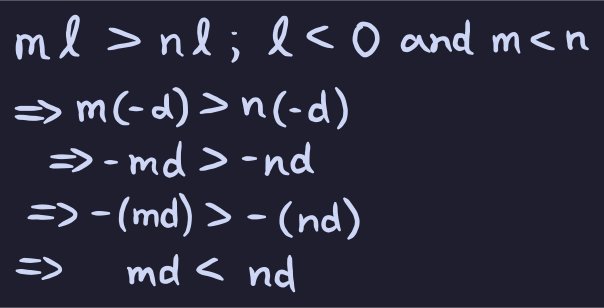
Proof.(EXERCISE 34 [Pedrick, A First Course in Analysis, p. 30])

01 Number Systems 2025-06-03 16.47.29
01 Number Systems 2025-06-03 16.56.22

Binomial

Definition 01.36 (Binomial Coefficients).

Define $0! = 1$ and

$${n\choose k} = \frac{n!}{k!(n-k)!}$$
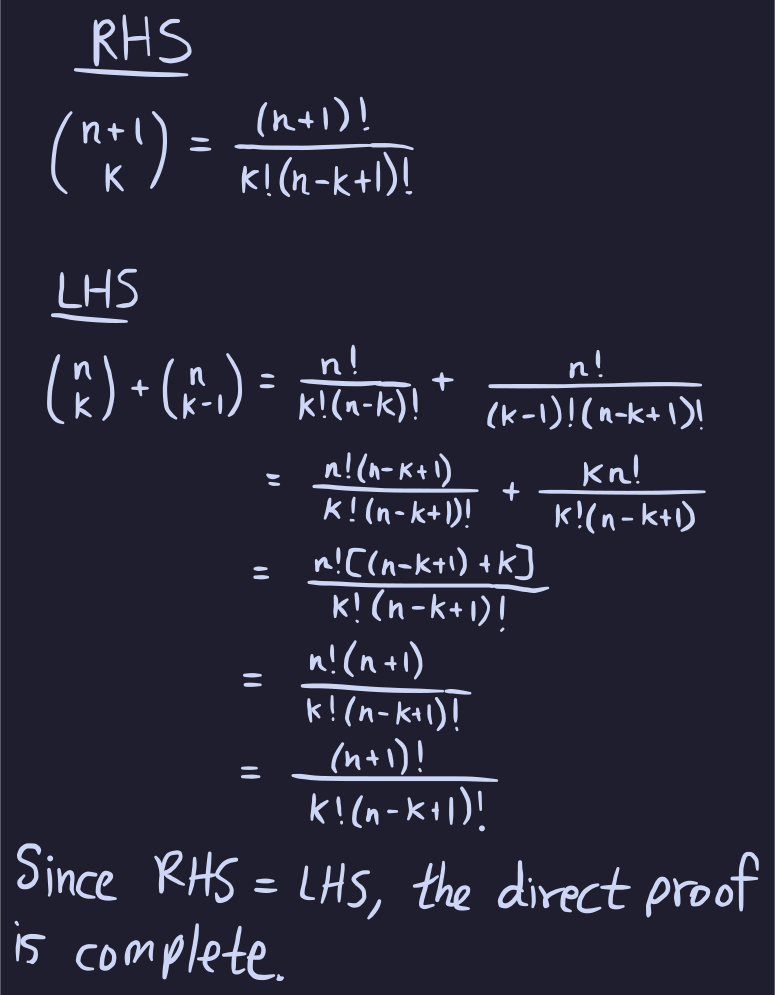
Proposition 01.37 (Addition of Binomial Coefficients).
$${n \choose k} + {n \choose k-1} = {n+1 \choose k}$$

Proof of Addition of Binomial Coefficients.(EXERCISE 35. [Pedrick, A First Course in Analysis, p. 31])

01 Number Systems 2025-06-03 17.14.48

Theorem 01.38 (Binomial Theorem).
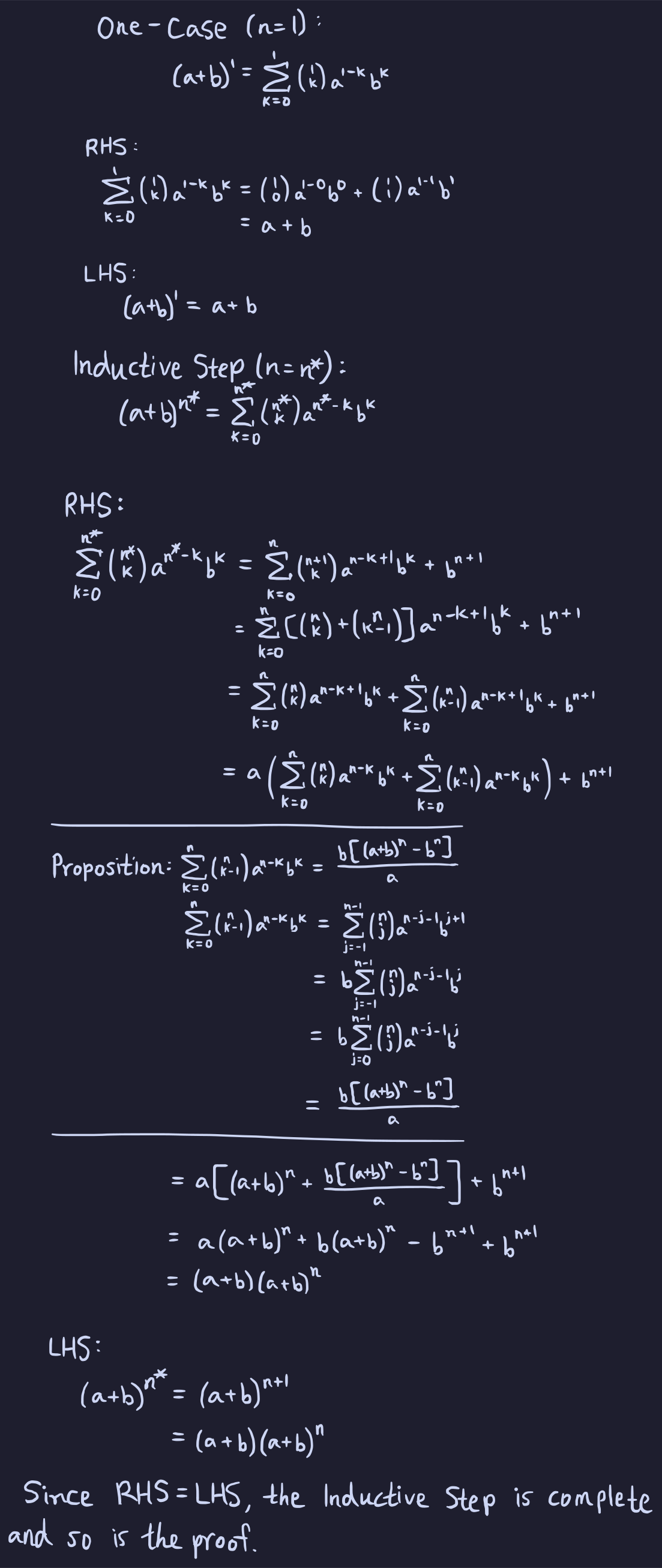
$$(a+b)^n = \sum_{k=0}^n {n \choose k} a^{n-k} b^k$$

Proof of Binomial Theorem.(EXERCISE 36 [Pedrick, A First Course in Analysis, p. 31])

01 Number Systems 2025-06-07 18.42.34

Exercise 01.39.

(EXERCISE 38 [Pedrick, A First Course in Analysis, p. 31])

01 Number Systems 2025-06-07 21.05.59

Sources

Graph