Notes › A First Course in Analysis (Pedrick) Lecture 2
Measurement and the Rationals
1156 words 17 min Modified
Table of Contents
Measurement Theory
- Any given amount is really a chosen unit amount a certain “number” of times
- Two amounts are commensurable if they share a unit amount (e.g. $mu$ and $nu$ for $m, n \in \mathbb{Z}$)
Directed Segments
- A single point is a segment of length 0 for all units
- For segments with more than one point, they exist in pairs called directed segments
- Expressed as arrows, one going to the left and the other going to the right
- Left-directed segments have negatives of their lengths as measures
- All directed segments lie on a single line with initial endpoint at the origin $\mathcal{o}$

Need for Division
- If $\alpha$ and $\beta$ are mutually commensurable points with shared unit $u$, then we need to define a number $x$ such that $\beta$ may be expressed in terms of $\alpha$
- Since $\alpha = nu$ and $\beta = mu$, then $\beta = x\alpha$ and $mu = x \cdot nu \implies m = xn$
- We need to create a number system in which $m = nx$ always has a unique solution
- Exception: division by zero, so $n \ne 0$
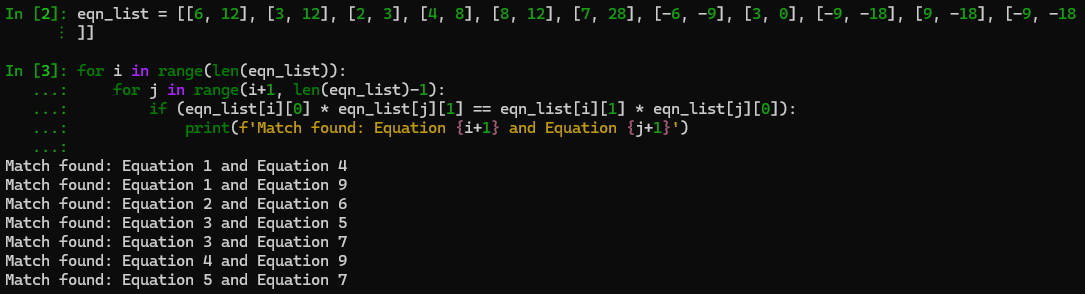
The equations $nx = m$ and $qx = p$ $(n, q \ne 0)$ in $\mathbb{Z}$ are equivalent if $mq = pn$. Alternatively, it means $\frac{m}{n} = \frac{p}{q}$.
EXERCISE 1
[Pedrick, A First Course in Analysis, p. 33]
EXERCISE 2
[Pedrick, A First Course in Analysis, p. 34]
All numbers can be expressed as products of primes. For a fully simplified fraction, $\frac{a}{b}$, $\gcd(a, b) = 1$, since $a$ and $b$ do not share any factors.
Defining $\mathbb{Q}$
- The set of fully simplified fractions forms $\mathbb{Q}$
(EXERCISE 3
[Pedrick, A First Course in Analysis, p. 34])
(EXERCISE 4
[Pedrick, A First Course in Analysis, p. 34])
(EXERCISE 5
[Pedrick, A First Course in Analysis, p. 35])
EXERCISE 6.
[Pedrick, A First Course in Analysis, p. 35]
EXERCISE 7.
[Pedrick, A First Course in Analysis, p. 35]
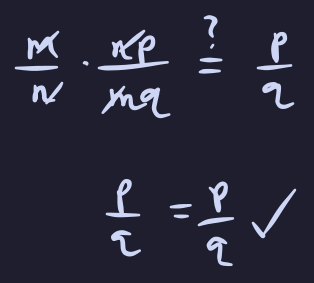
Any equation in $\mathbb{Q}$ of the form
$$\frac{m}{n} \cdot x = \frac{p}{q}, m \ne 0$$has the unique solution $\frac{np}{mq}$.
(EXERCISE 8.
[Pedrick, A First Course in Analysis, p. 35])
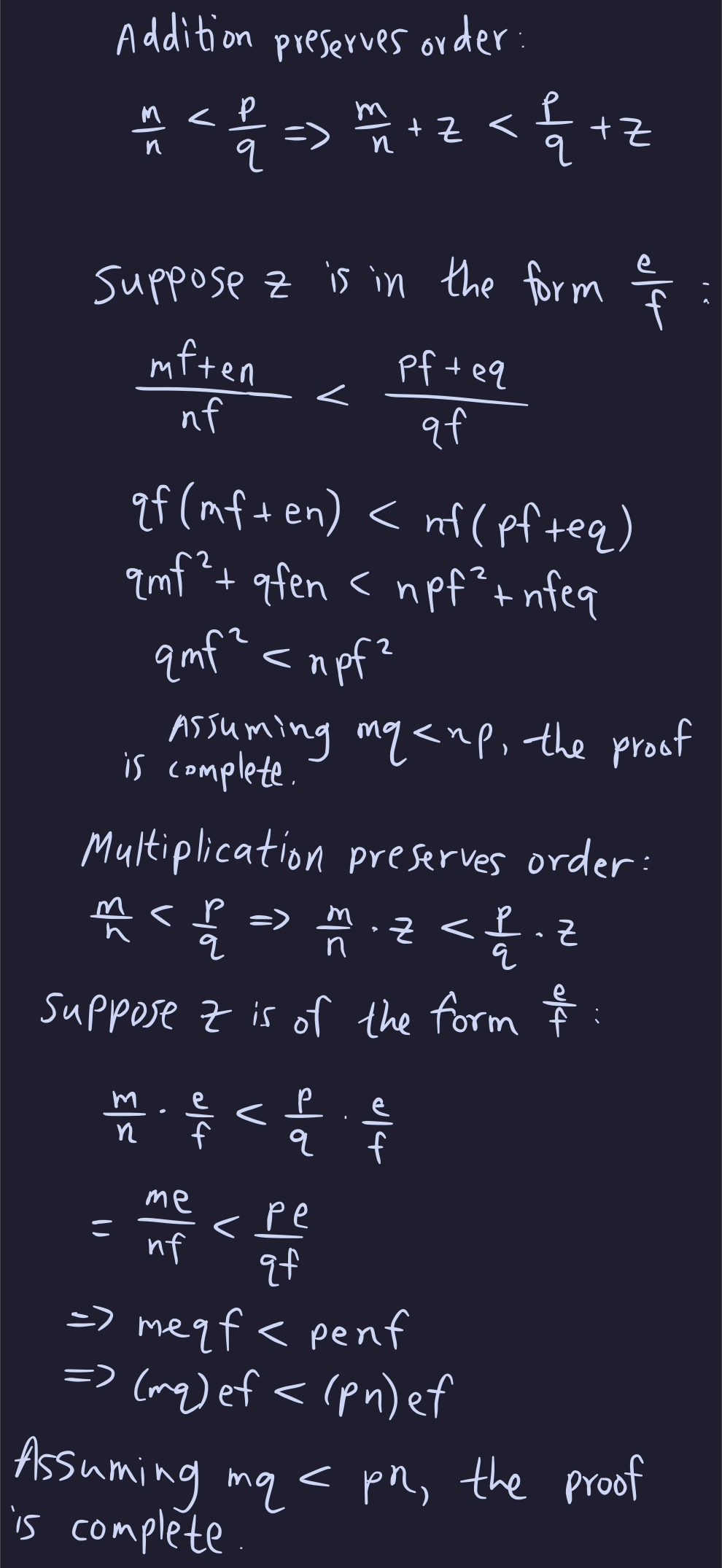
The order between fractions is given by
$$\frac{m}{n} < \frac{p}{q} \implies mq < np$$if $n, q > 0$.
(EXERCISE 9.
[Pedrick, A First Course in Analysis, p. 35])
(EXERCISE 10
[Pedrick, A First Course in Analysis, p. 35])
(EXERCISE 11
[Pedrick, A First Course in Analysis, p. 35])
(EXERCISE 12
[Pedrick, A First Course in Analysis, p. 35])
Measurement of Directed Segments
- If $\alpha$ and $\beta$ are commensurable, and $\beta$ is not a point ($\alpha = mu, \beta = nu, n \ne 0$), you may express $\alpha$ in terms of $\beta$ using $\mathbb{Q}$ and determine the unit $u$
- Only commensurable lengths can be expressed in terms of each other using $\mathbb{Q}$
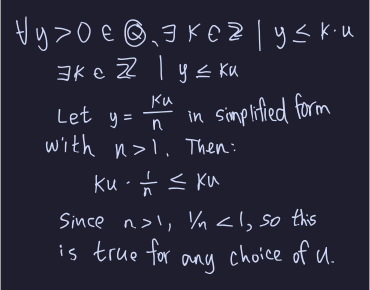
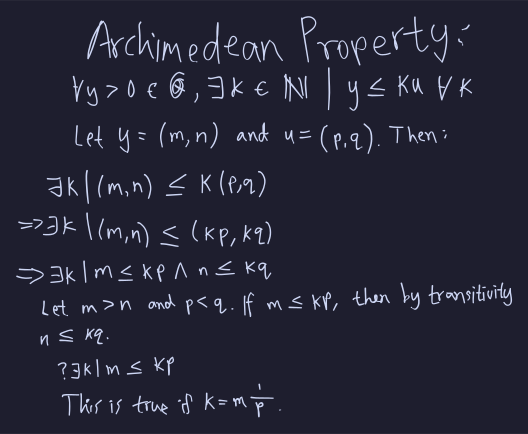
$\forall y > 0 \in \mathbb{Q}, \exists m \in \mathbb{N} | y \le m$. Alternative definitions with directed segments: $\forall y > 0 \in \mathbb{Q} \exists k \in \mathbb{N} | y \le k \cdot u$. “There are arbitrarily large natural numbers.”
$\forall x > 0 \in \mathbb{Q}, \exists n \in \mathbb{N} | \frac{1}{n} < x$. “The reciprocals of the natural numbers can be arbitrarily small.”
(EXERCISE 14
[Pedrick, A First Course in Analysis, p. 37])
Axioms of Ordered Fields
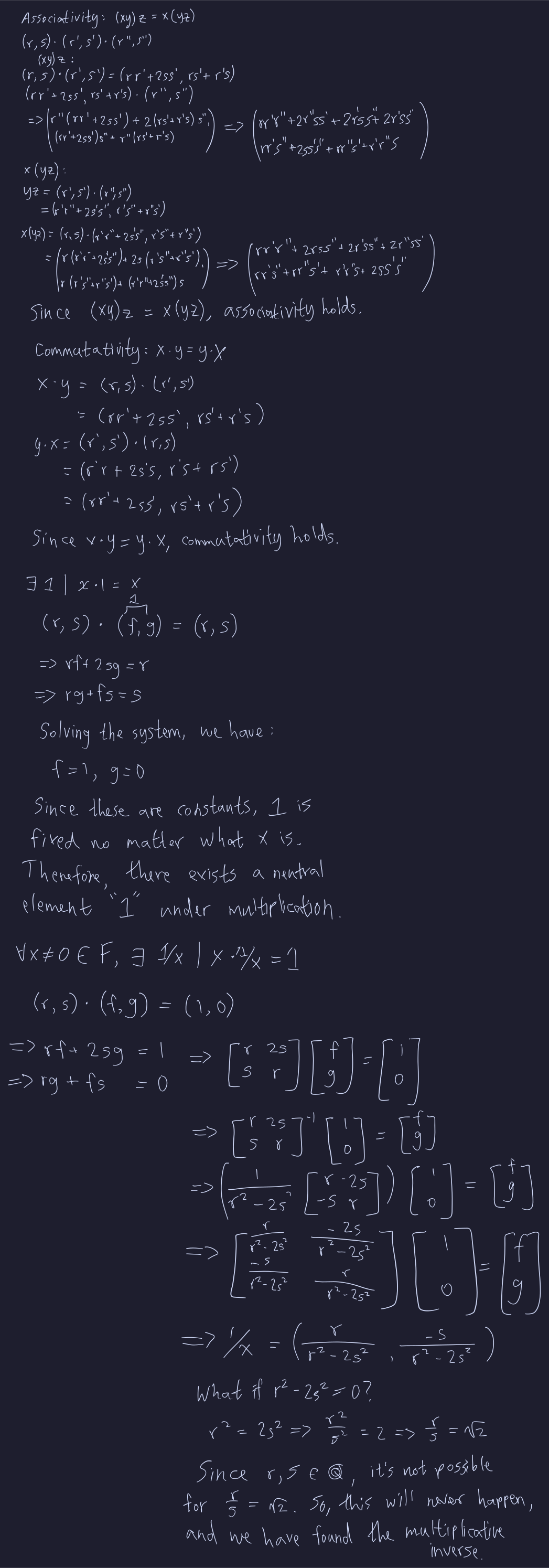
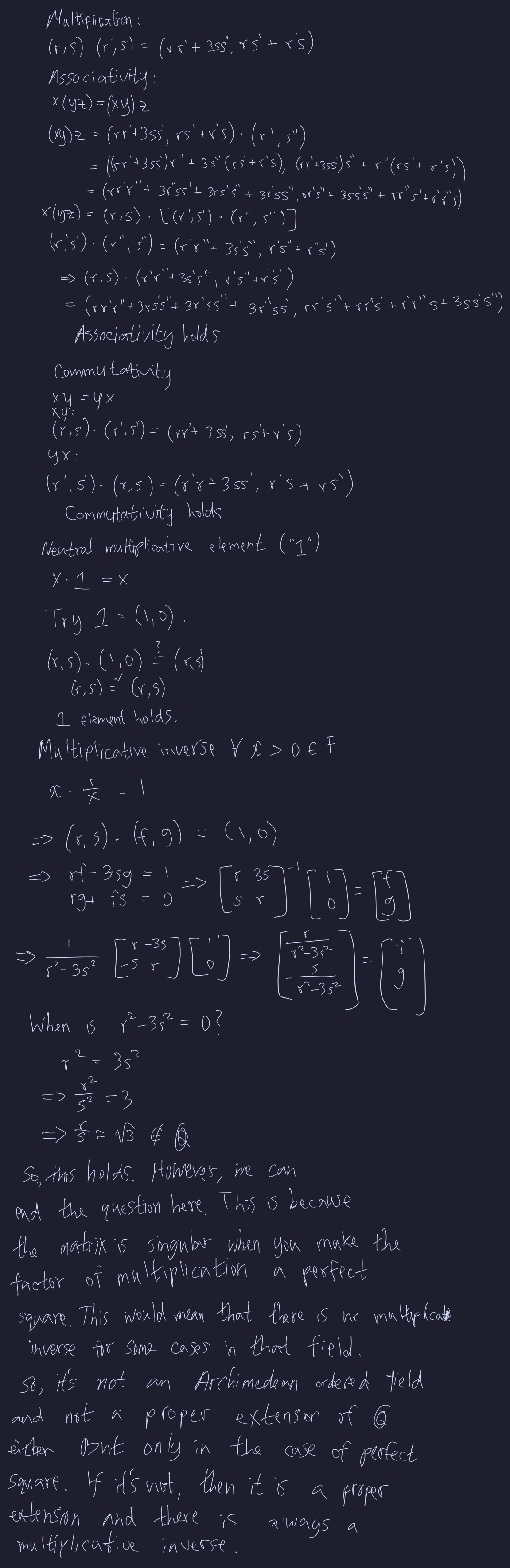
- Any number system that satisfies the below properties is called an ordered field
- Number systems that are ordered fields and satisfy the Archimedean property are called Archimedean ordered fields
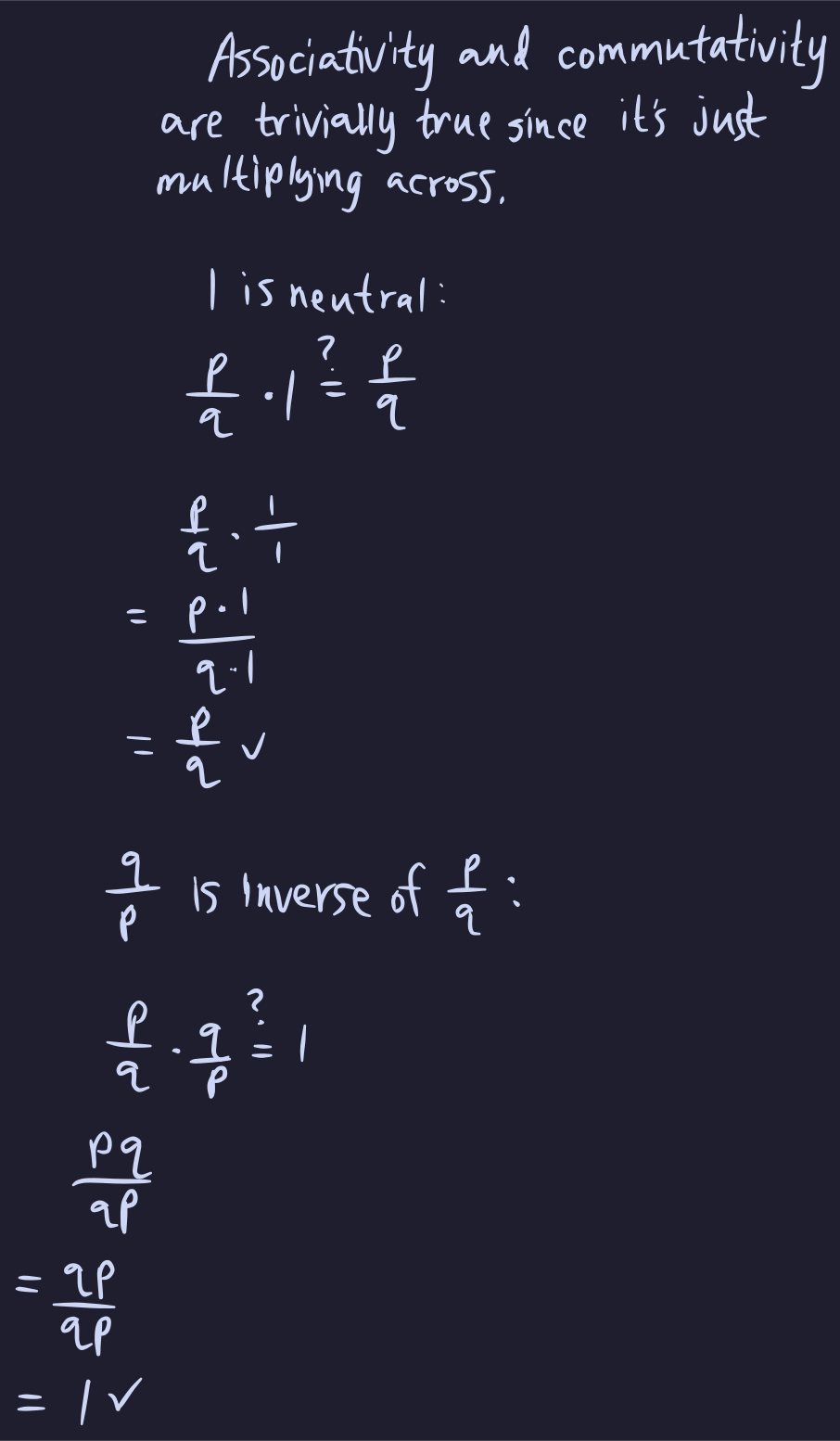
- Associative and Commutative
- $\exists 0 \in F$ that is neutral under addition.
- $\exists$ additive inverse “negative $x$” $\forall x \in F$.
- Associative and Commutative
- $\exists 1 \in F$ that is neutral under multiplication.
- $\exists$ multiplicative inverse $1/x$ $\forall x \in F, x \ne 0$.
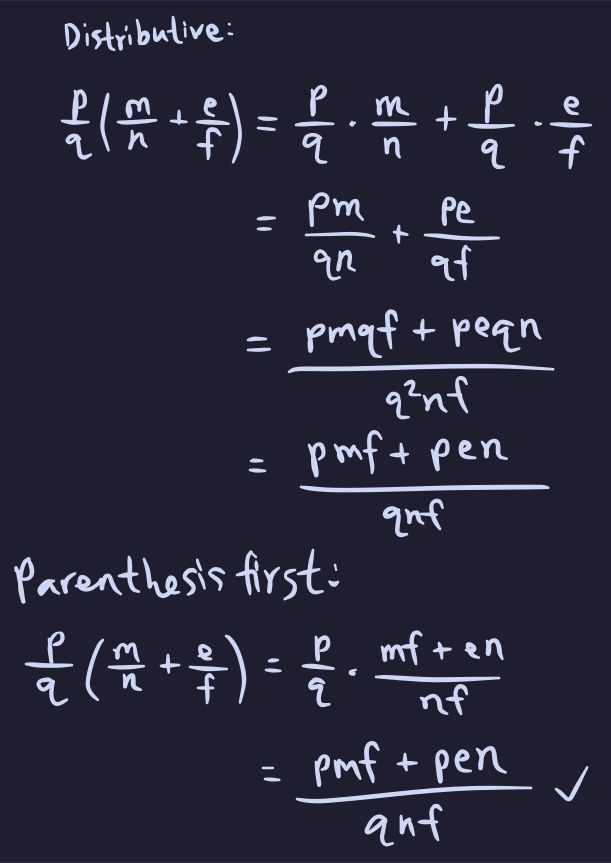
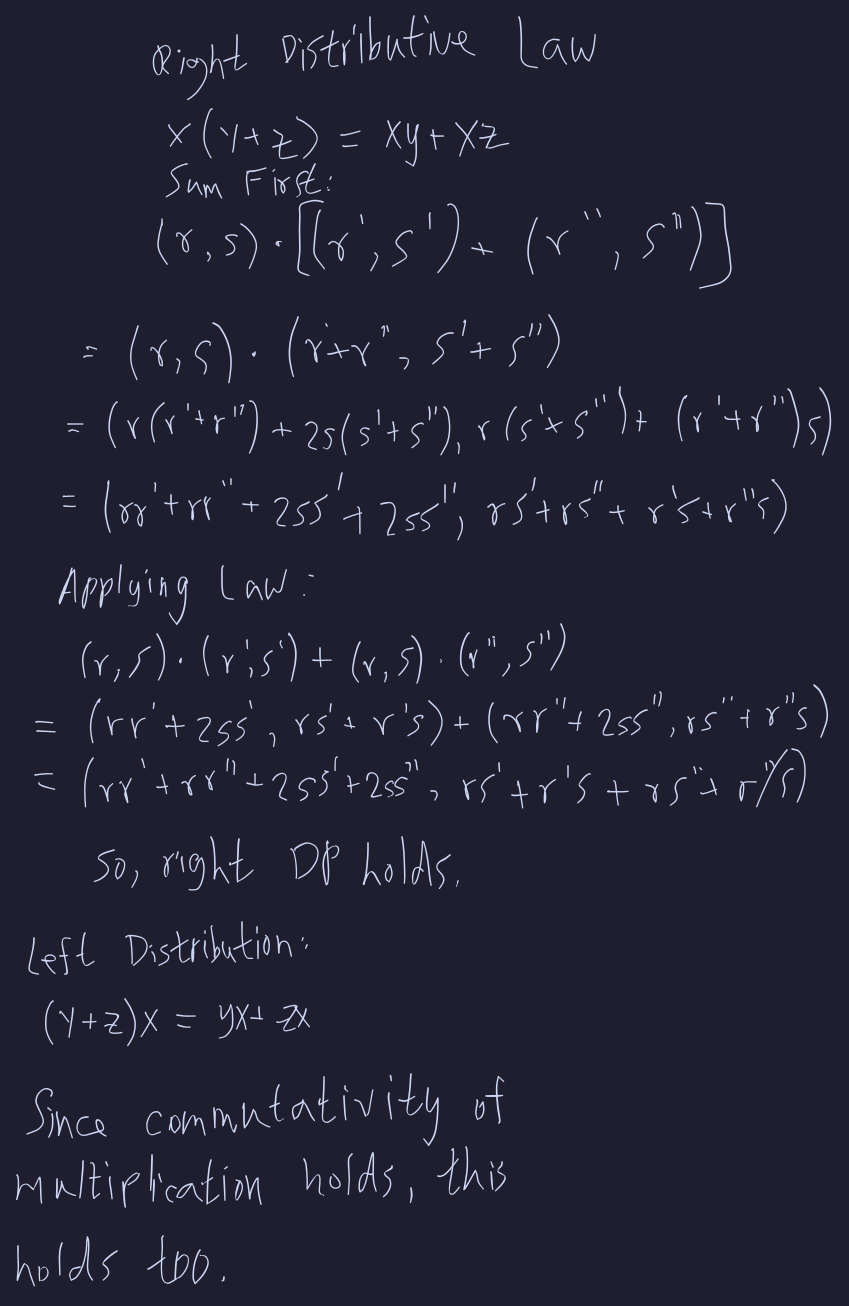
Multiplication and Addition are connected by the distributive laws.
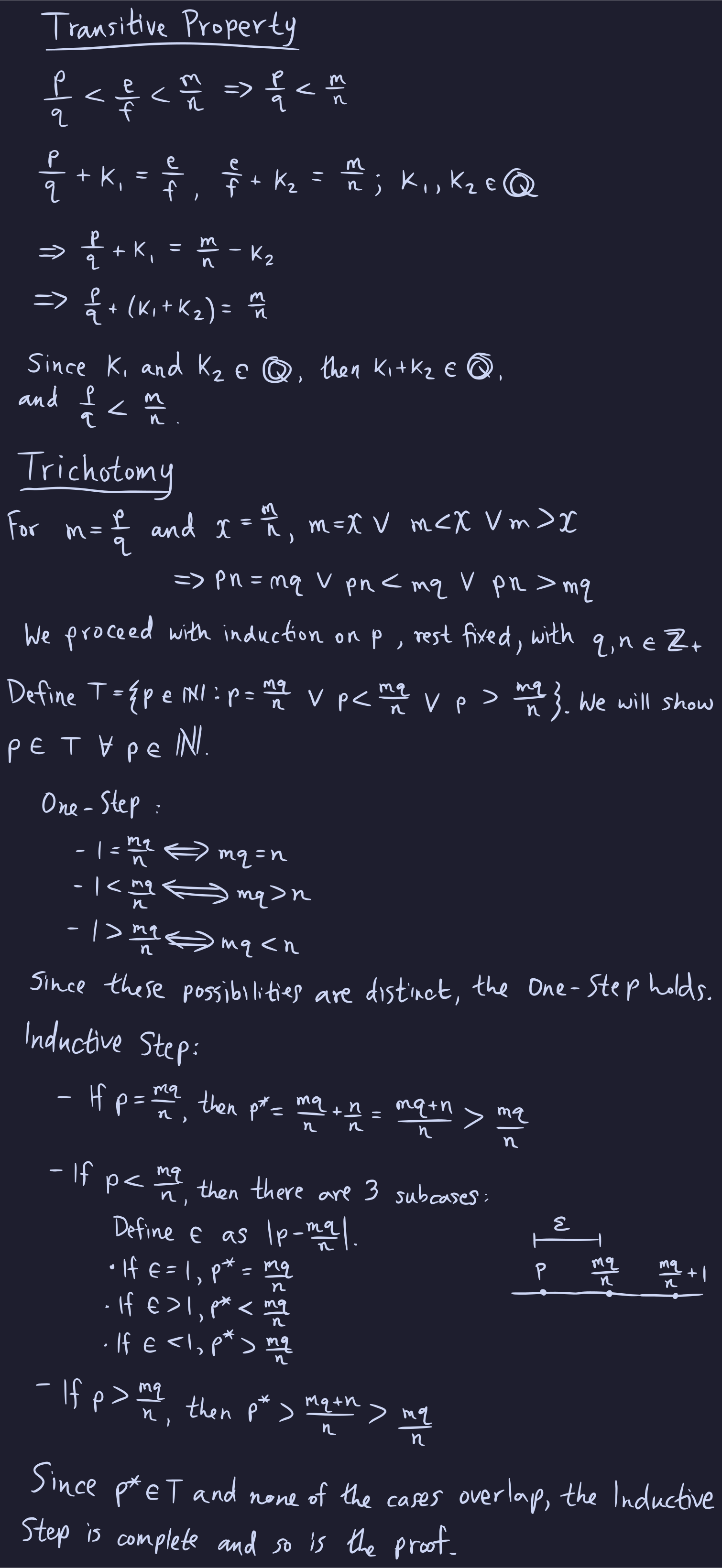
- Order of $F$ is transitive and trichotomy holds.
- Multiplication by $x > 0$ preserves order.
(EXERCISE 15
[Pedrick, A First Course in Analysis, p. 38])
(EXERCISE 16
[Pedrick, A First Course in Analysis, p. 38])
(EXERCISE 17
[Pedrick, A First Course in Analysis, p. 38])
(EXERCISE 18
[Pedrick, A First Course in Analysis, p. 38])
Measurement Density
A number system, $V$, is dense in a field, $F$, if: $\forall x < y \in F, \exists m \in V | x < m < y$
(EXERCISE 19
[Pedrick, A First Course in Analysis, p. 38])
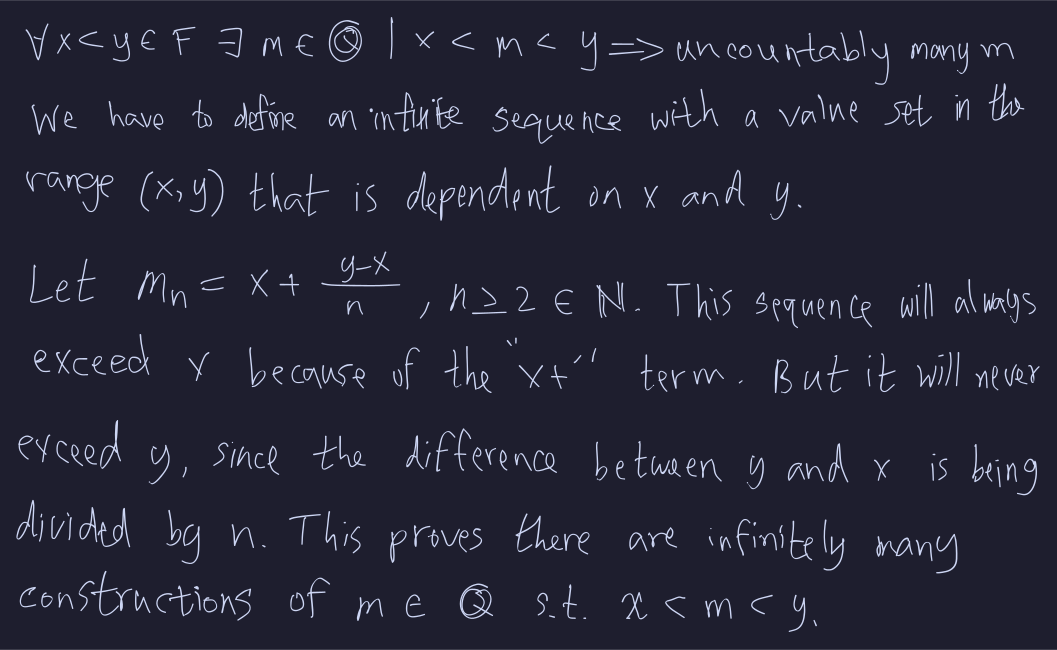
$\mathbb{Q}$ is dense in any Archimedean ordered field $F$.
Proof
[Pedrick, A First Course in Analysis, p. 39]
(EXERCISE 20
[Pedrick, A First Course in Analysis, p. 40])
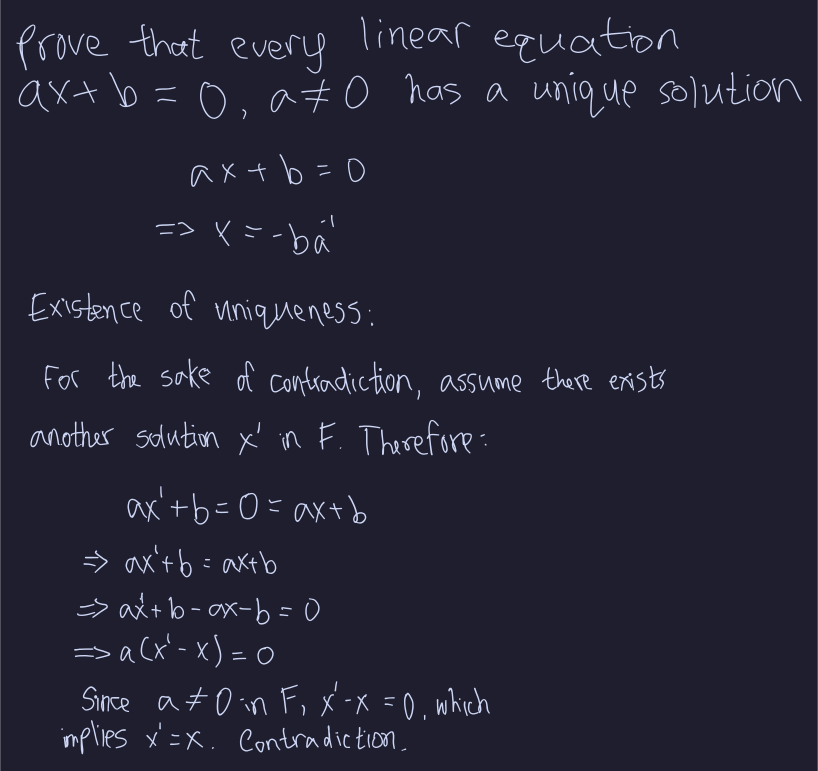
(EXERCISE 21
[Pedrick, A First Course in Analysis, p. 40])
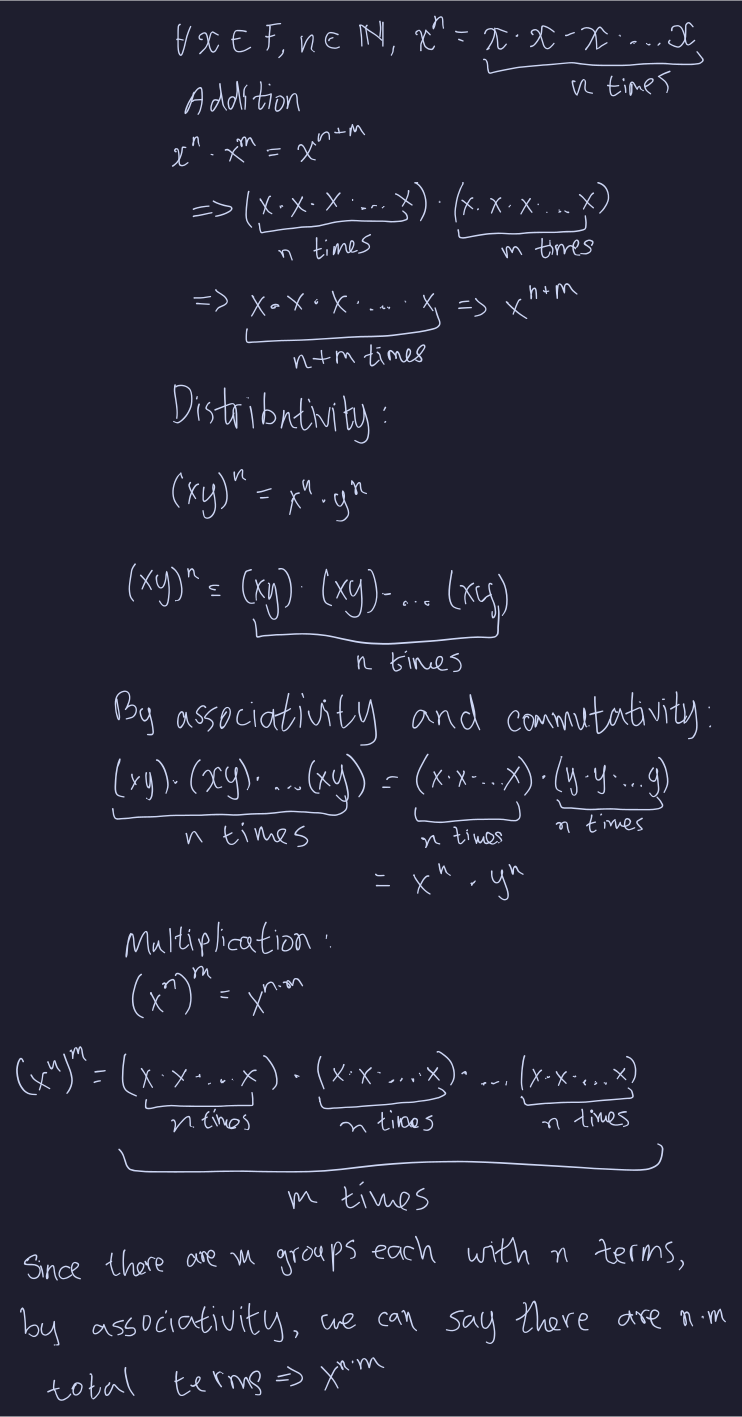
(EXERCISE 22
[Pedrick, A First Course in Analysis, p. 40])
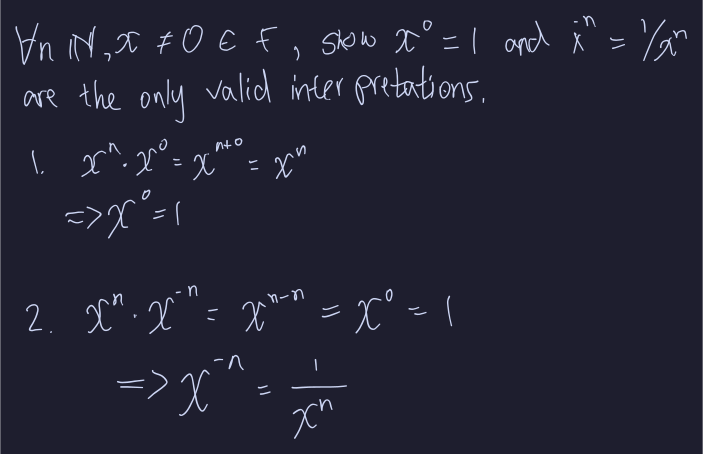
(EXERCISE 23
[Pedrick, A First Course in Analysis, p. 40])
Expanding the Definitions of Exponentiation
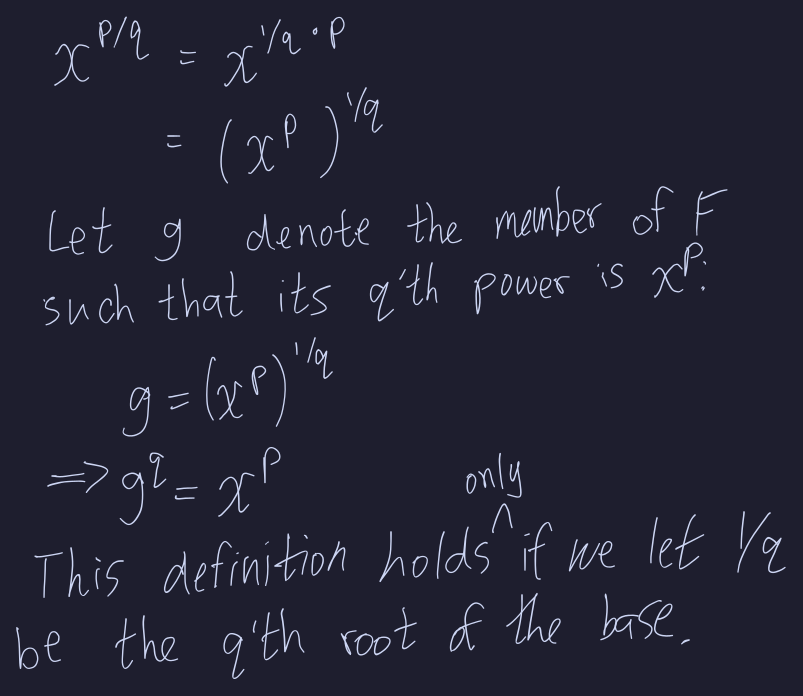
- $x^{1/q} = \sqrt[q]{x}$ is the member(s) of $F$ whose $q$th power is $x$.
- If $q$ is odd, there is one positive member in $F$.
- If $q$ is even, there are two members in $F$, one positive and one negative, in pairs. We use the current notation to refer to the positive member unless explicitly denoted otherwise.
- For this extension, we assume the member is defined to begin with. If $\sqrt[q]{x^p}$ is not a member of $F$ (i.e., irrational), we do not consider it.
Interval Notation
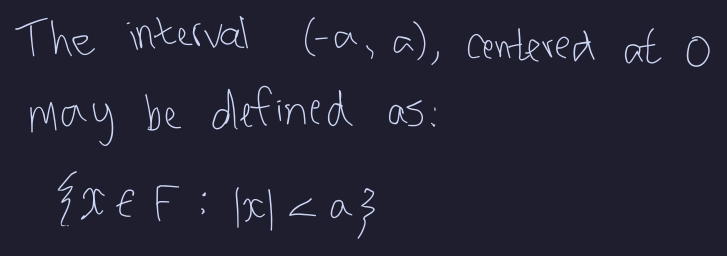
An interval is a subset defined using the order of $F$ for $a \le b$ in $F$. The interval may either be open, closed, left-closed right-open, or left-open right-closed. Open means you don’t consider the endpoint, and vice-versa. The length of the interval is $b-a$.
- We use brackets to denote closed interval and parenthesis for open interval
- For example, the notation for the open interval on $(a, b) \in F$ is:
- If $a=b$, the closed interval reduces to a point, and all other cases are $\emptyset$
- You can also use $\infty$ in interval notation to denote “half-lines” or a “full line” (which is really just the entire set of points on $F$):
- For example, the left half-line of the point $a$ (excluding the point $a$ itself) is:
We denote the absolute value of $x \in F$ by:
$$|x| = \begin{cases} x, & x>0 \\ -x, & x<0 \end{cases}$$(EXERCISE 24
[Pedrick, A First Course in Analysis, p. 41])
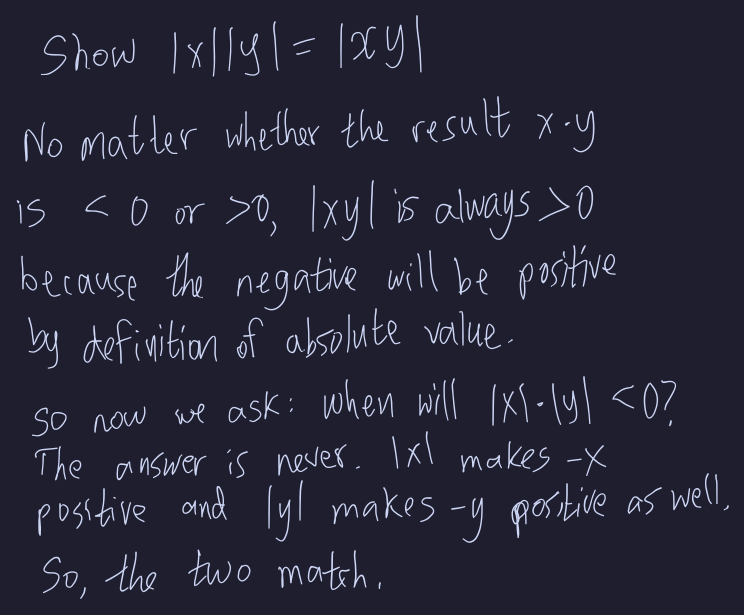
- Since $|x|$ is the distance of $x$ from the origin, we can conclude that $|b-a|$ is the distance between $a, b \in F$
- $\forall x \in F, -|x| \le x \le |x|$, and one of the equality signs must hold
(EXERCISE 25
[Pedrick, A First Course in Analysis, p. 41])
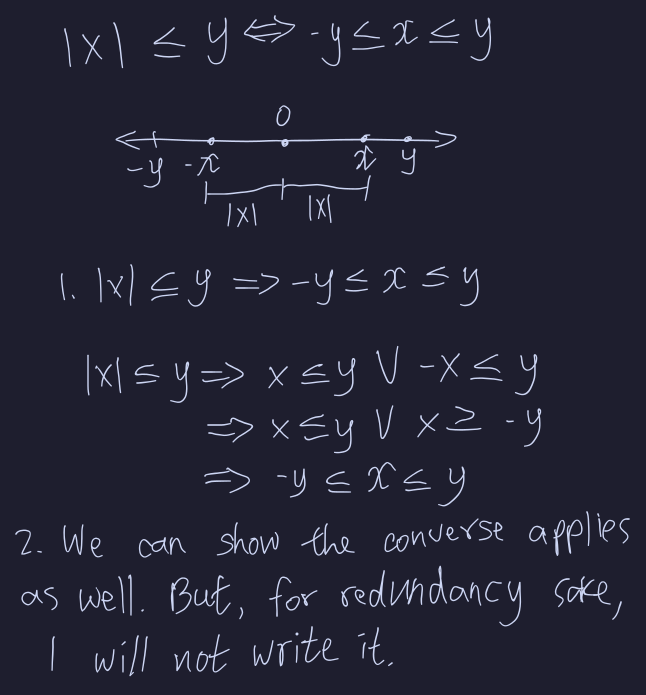
Proof
[Pedrick, A First Course in Analysis, p. 41] (using the result from the previous Exercise)
(EXERCISE 26
[Pedrick, A First Course in Analysis, p. 41])
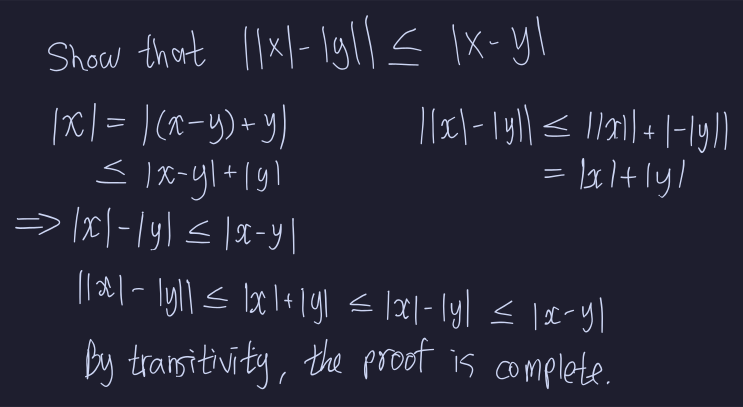
(EXERCISE 27
[Pedrick, A First Course in Analysis, p. 41])
(EXERCISE 28
[Pedrick, A First Course in Analysis, p. 41])
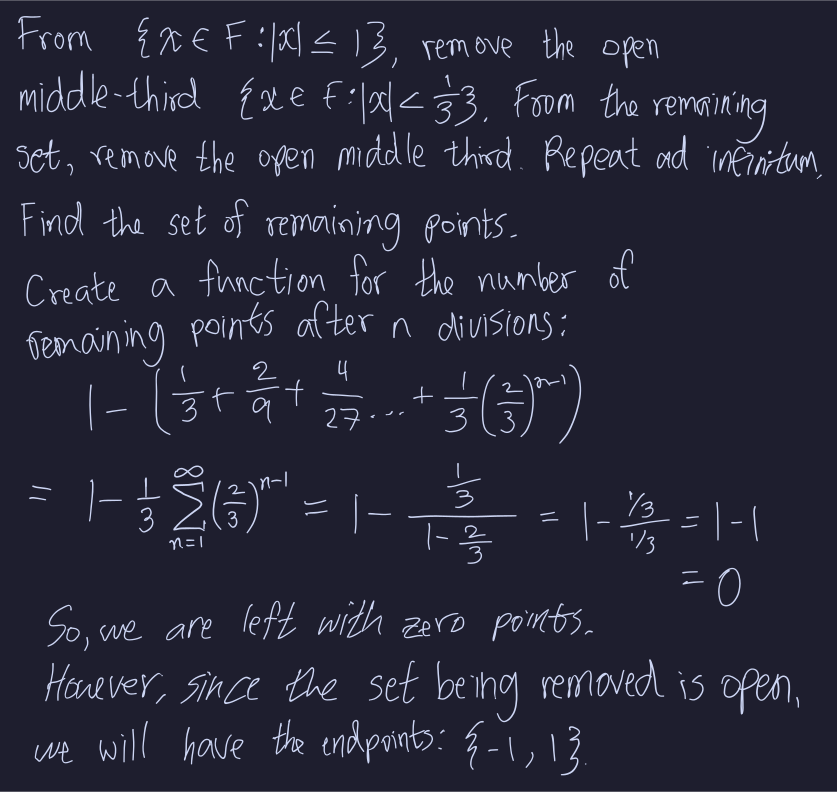
Boundedness
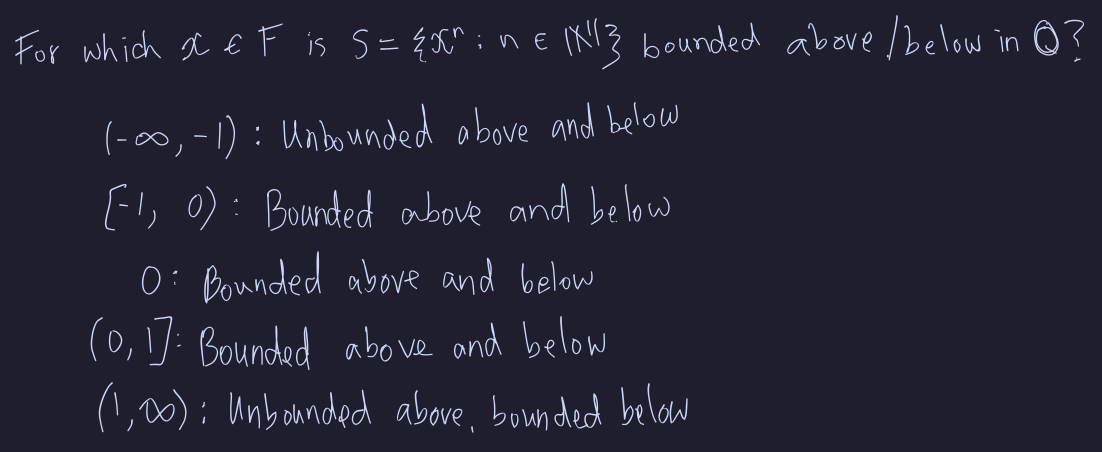
$S \subset F$ is bounded above if:
$$\exists b \in F | x \in S \implies x\le b.$$Alternatively:
$$\exists b \in F | x \le b \forall x \in S.$$- Any such $b$ is called an upper bound of $F$.
- Any member of $F$ larger than an upper bound of $S$ is also an upper bound of $S$.
Similar logic applies for bounded below:
$$\exists b \in F | x \ge b \forall x \in S.$$If $S$ is bounded above and below in $F$, it is bounded.
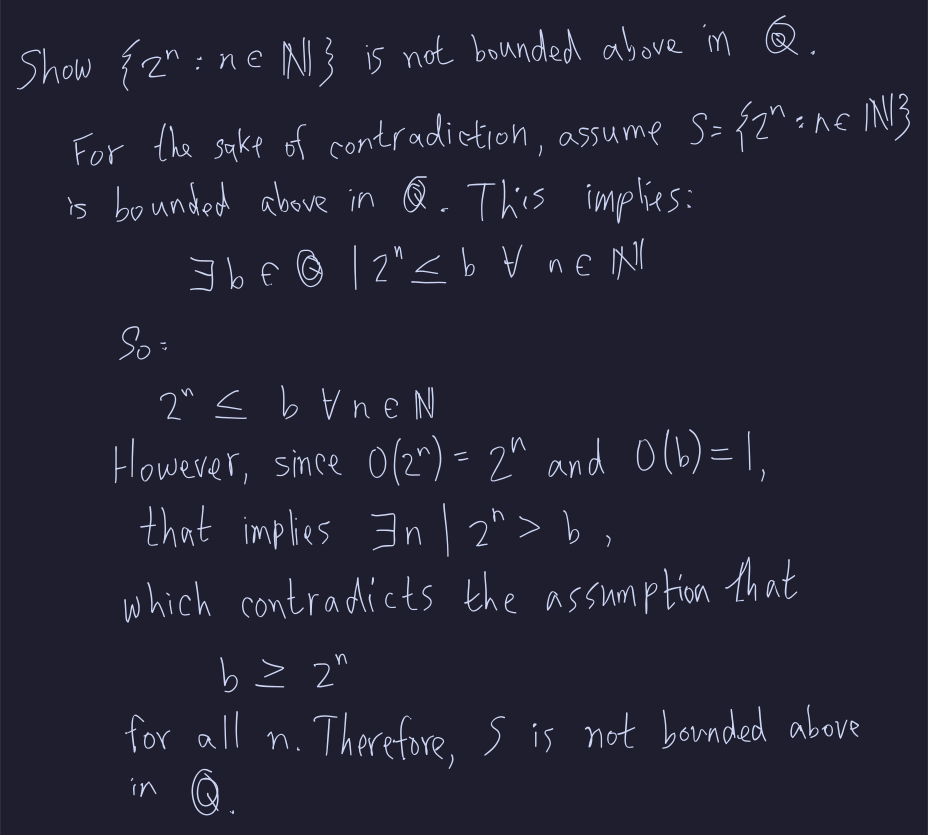
- The Archimedean property really just says that $\mathbb{N}$ is not bounded above in $F$ for any choice of unit
(EXERCISE 31
[Pedrick, A First Course in Analysis, p. 42])
(EXERCISE 32
[Pedrick, A First Course in Analysis, p. 42])
(EXERCISE 33
[Pedrick, A First Course in Analysis, p. 42])
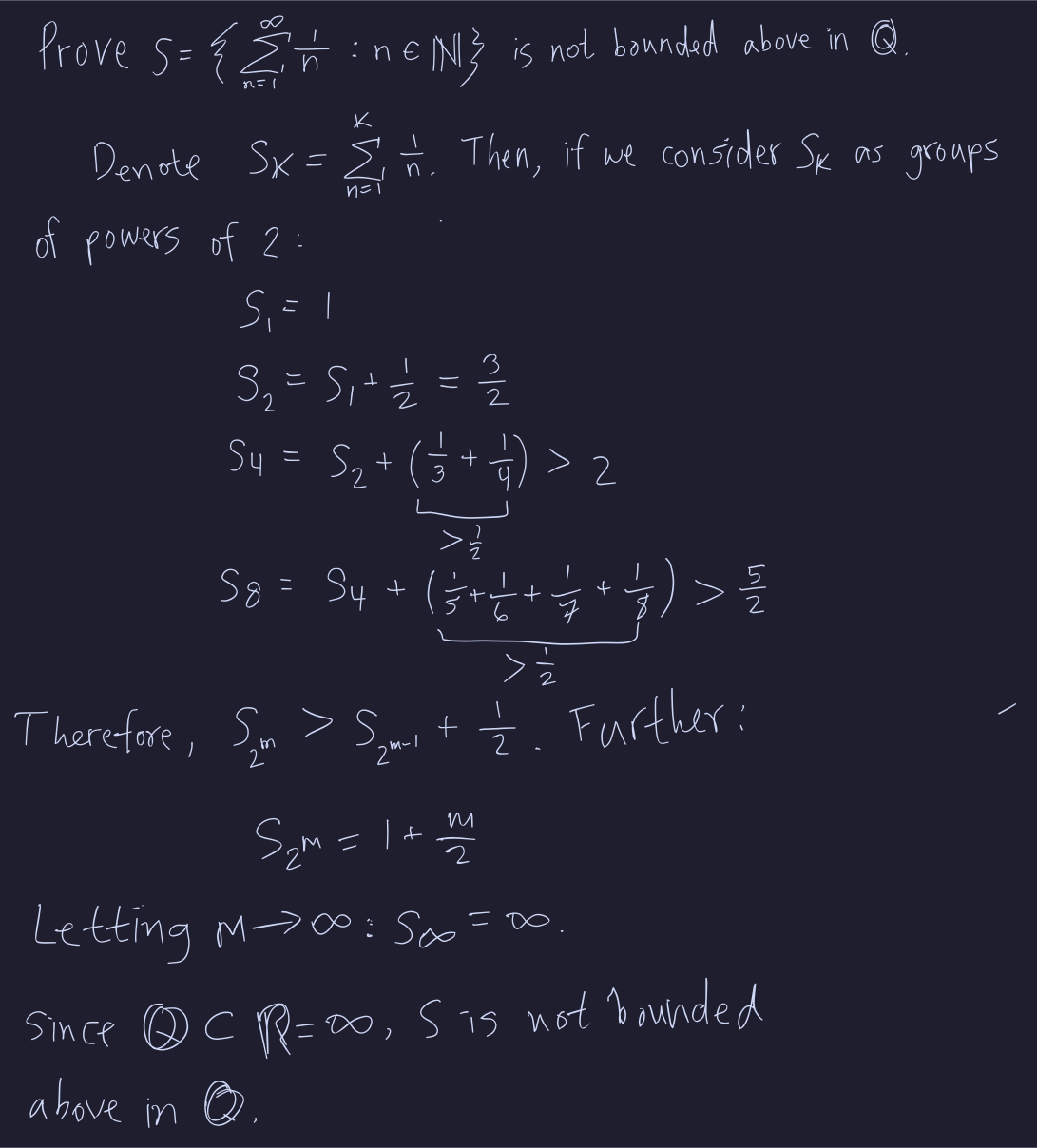
(EXERCISE 34
[Pedrick, A First Course in Analysis, p. 42])
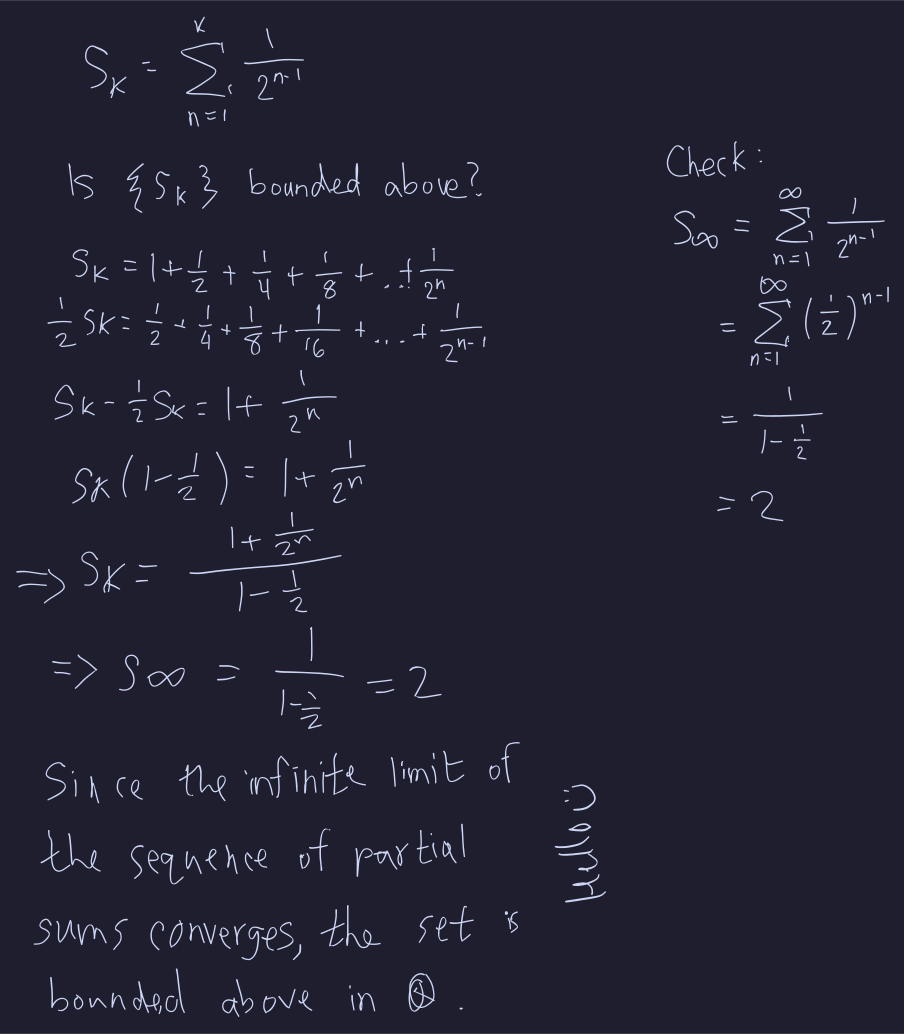
(EXERCISE 35
[Pedrick, A First Course in Analysis, p. 42])
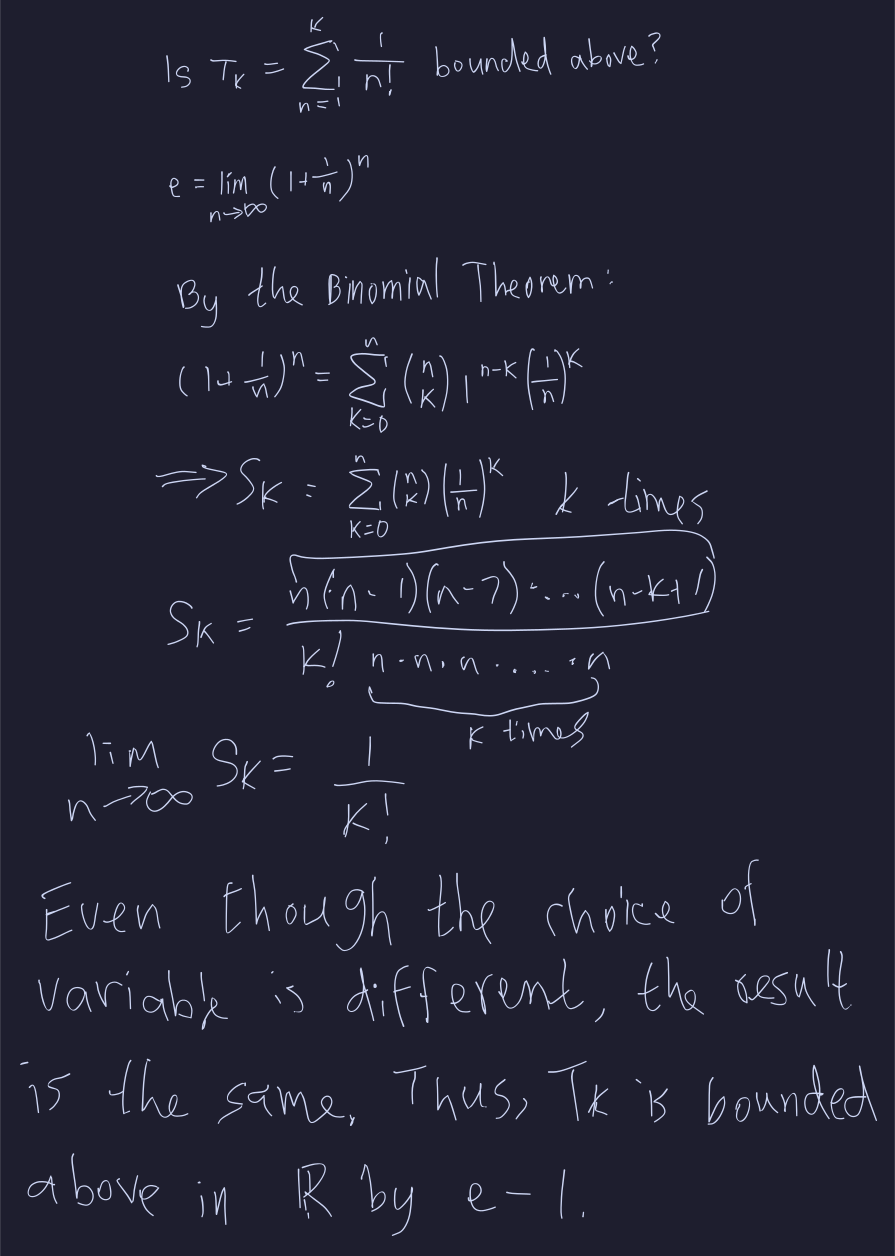
(EXERCISE 36
[Pedrick, A First Course in Analysis, p. 42])
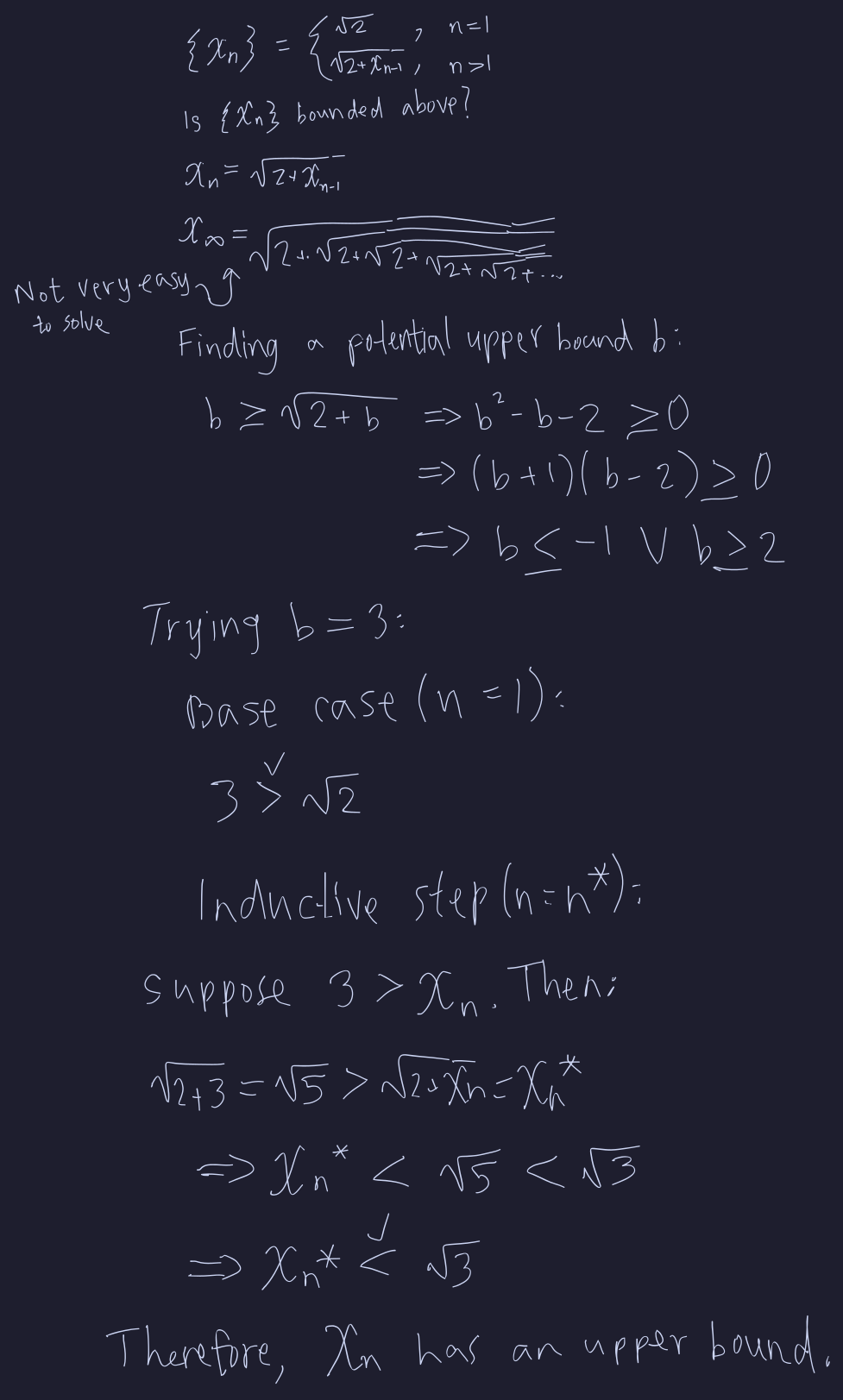
Division Algorithm
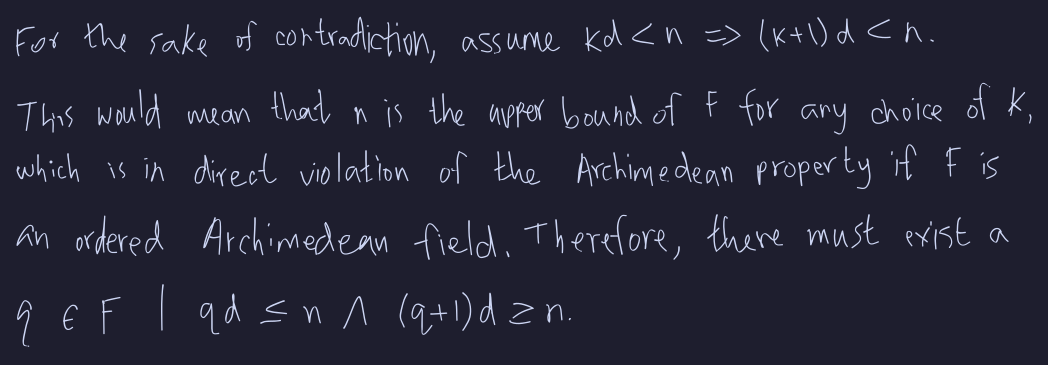
For a dividend $n \in F$ and a divisor $d > 0 \in F$, there exists a quotient $q \in \mathbb{Z}$ and a remainder $0 \le r < d$ such that:
$$n = qd + r.$$(EXERCISE 37
[Pedrick, A First Course in Analysis, p. 43])
Sources
- Pedrick, A First Course in Analysis