$[x]$ is the integer part of $x$ and $x-[x]$ is the fractional part of $x$
Definition 03.2(Decimal Representation).
Let each $b_i$ and $a_i$ be a digit. Then:
$$\begin{align}
[x] &= b_{k}b_{k-1}\dots b_{1}b_{0} \\
x - [x] &= a_{1}a_{2}a_{3} \dots \\
x &= b_{k}b_{k-1}\dots b_{1}b_{0}.a_{1}a_{2}a_{3}\dots
\end{align}$$
If $x < 0$, the representation is $|x|$ prefixed by a minus sign.
Exercise 03.3.
(EXERCISE 2[Pedrick, A First Course in Analysis, p. 43])
Decimal Expansion
Integer Part
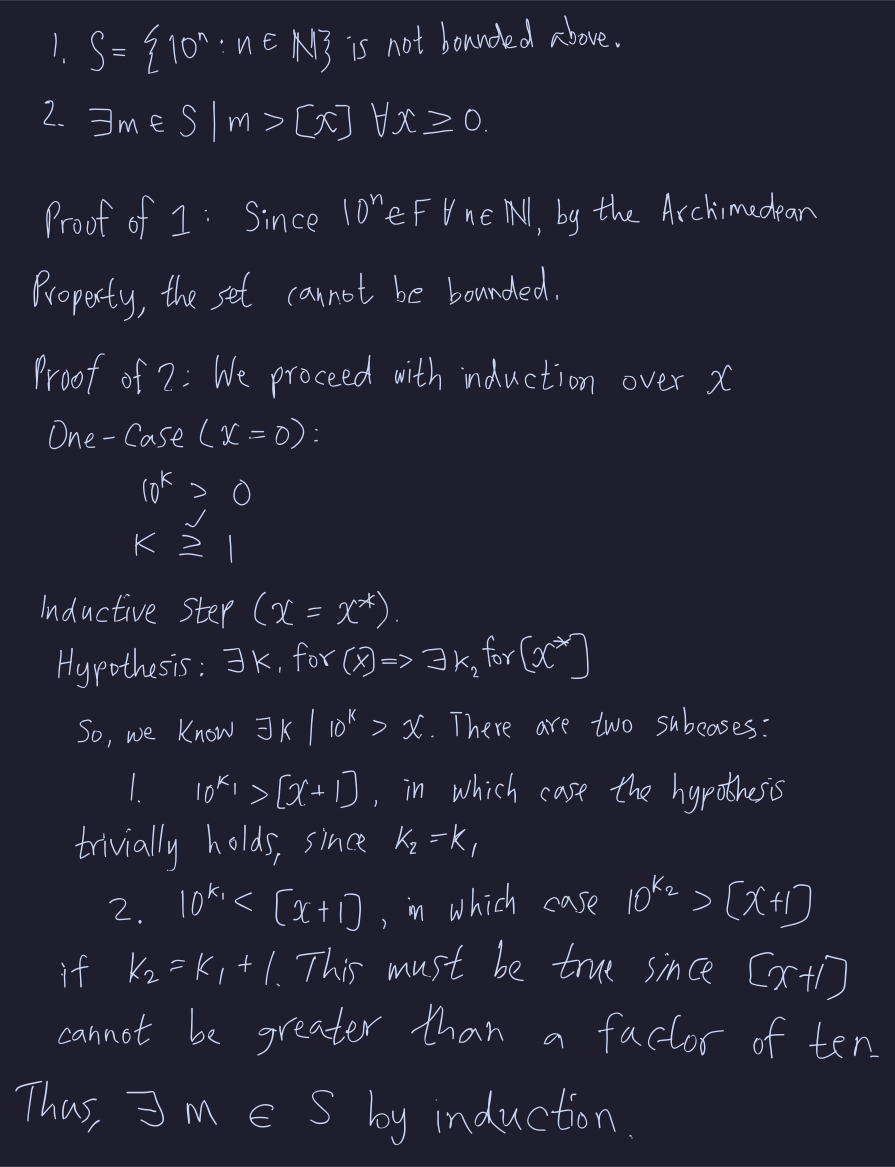
Suppose $k$ is the total number of digits of $[x]$. Then, $10^{k}$ is the upper bound of $[x]$, and we may represent $[x]$ as a unique expansion of $k$ digits multiplied by powers of ten
Dividing the interval $[0, 10^k)$ into ten equal subintervals that map to digits:
Our goal is to choose digits $a_1, a_2, a_3, \dots$ for which
$$
x - [x] = \frac{a_1}{10} + \frac{a_2}{10^2} + \frac{a_3}{10^3} + \dots
$$
Divide the interval $[0, 1)$, which contains $x - [x]$, into ten equal parts
$$
[0, \tfrac{1}{10}), [\tfrac{1}{10}, \tfrac{2}{10}), \dots, [\tfrac{9}{10}, 1)
$$
Choose $a_1$ as the digit such that $x - [x] \in [\tfrac{a_1}{10}, \tfrac{a_1 + 1}{10})$
Divide $[\tfrac{a_1}{10}, \tfrac{a_1 + 1}{10})$ into ten equal parts
$$
\left[\tfrac{a_1}{10}, \tfrac{a_1}{10} + \tfrac{1}{10^2}\right), \left[\tfrac{a_1}{10} + \tfrac{1}{10^2}, \tfrac{a_1}{10} + \tfrac{2}{10^2}\right), \dots, \left[\tfrac{a_1}{10} + \tfrac{9}{10^2}, \tfrac{a_1 + 1}{10}\right)
$$
Choose $a_2$ as the digit such that $x - [x]$ lies in the subinterval of length $1/10^2$
Continue dividing the current subinterval into ten parts of length $1/10^n$ to choose $a_n$ such that $x - [x]$ lies in the $n$th level subinterval
If $x$ is an endpoint of one of the subintervals, then all $a_n = 0$ from some stage onward and the expansion of $x$ is a finite sum
Proposition 03.4(Uniqueness of Decimal Expansion).
Distinct numbers have distinct decimal expansions.
Proof[Pedrick, A First Course in Analysis, p. 45]
Definition 03.5(Terminating Decimal).
The endpoints of each subinterval of any decimal expansion may be assigned a decimal that is terminating (i.e., concluding with an infinite repetition of the digit 0).
Definition 03.6(Recurring Decimal).
A decimal expansion $a_0, a_1, a_2, …$ is recurring if $\exists N \ge 0 \land k \ge 1 | \forall k > N$, $a_k = a_{k+p}$. That is, the digits repeat with periodicity $p$ at position $N$.
The repeating portion has an overline above it.
Terminating decimals are a special case of recurring decimals.
Proposition 03.7(Recurring Decimals and Rationals).
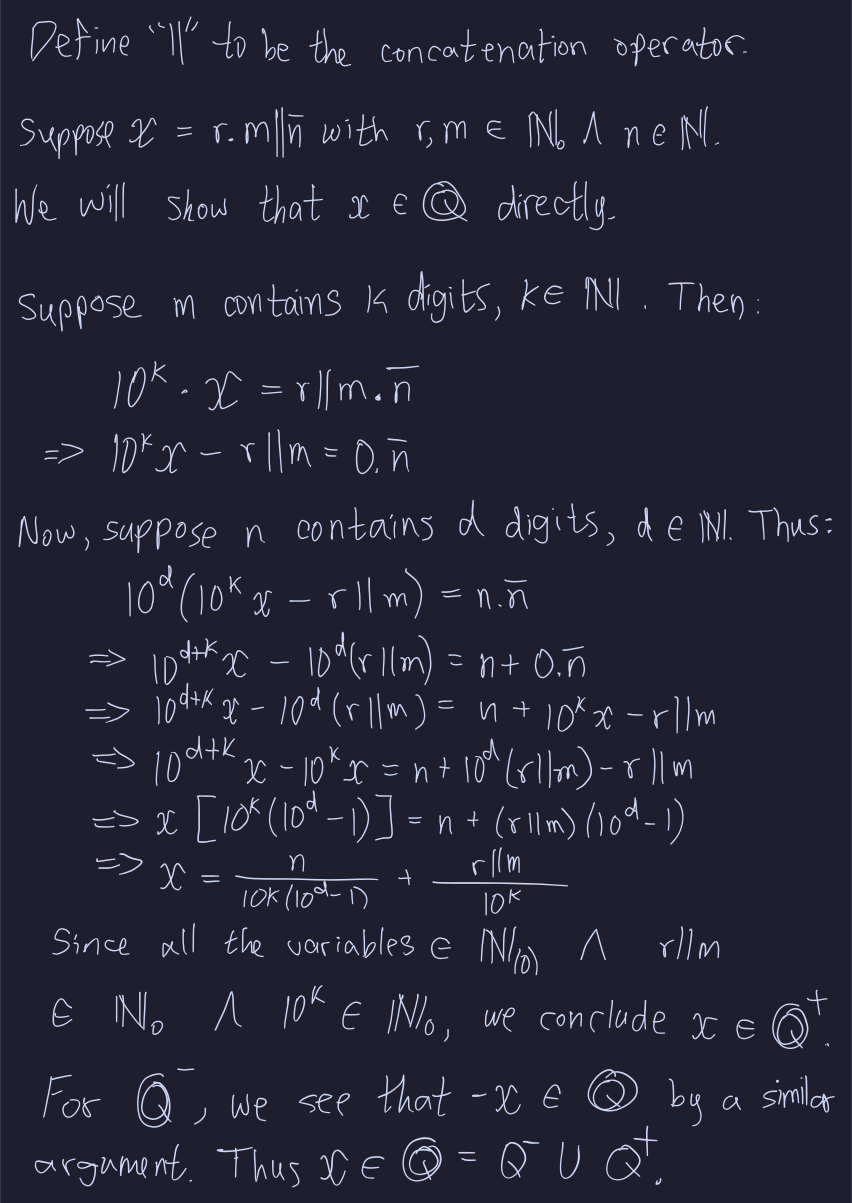
Every recurring decimal represents a rational number. (EXERCISE 4[Pedrick, A First Course in Analysis, p. 46])
Proof:
The converse that every rational number represents a recurring decimal is also true. Proof[Pedrick, A First Course in Analysis, p. 46]
Base-B Expansions
It’s possible to create $B$ subdivisions with a max digit of $B-1$
The result is called a Base-$B$ expansion
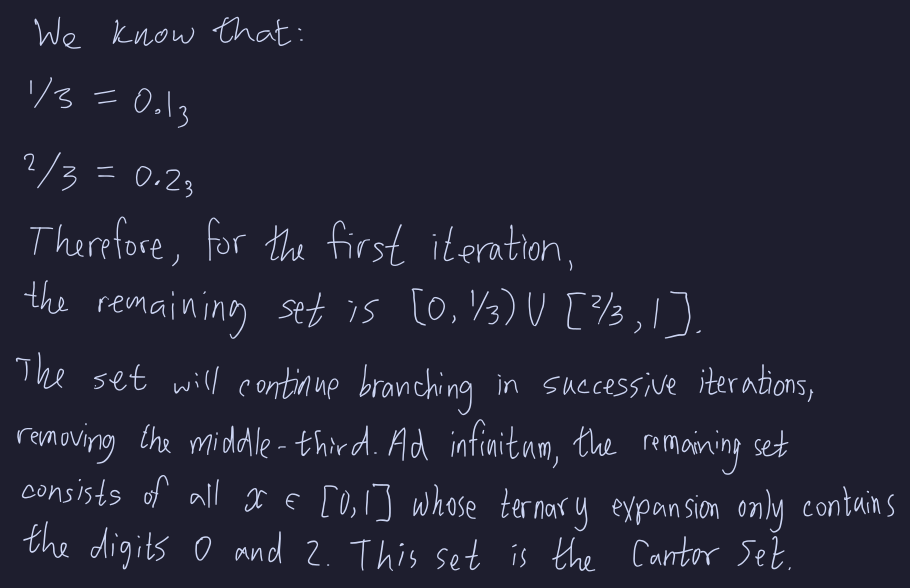
Example 03.8.
(EXERCISE 6[Pedrick, A First Course in Analysis, p. 47])
Definition 03.9(Sequence Convergence).
A sequence of numbers, $\{x_{n}\}$, in an Archimedean ordered field $F$ converges to $m$, written $x_n \rightarrow m$, if $\forall \epsilon > 0 \in F \exists$ an index $N_{\epsilon}$ such that:
$$|x_{m}| < \epsilon \ \text{if} \ m > N_{\epsilon}$$
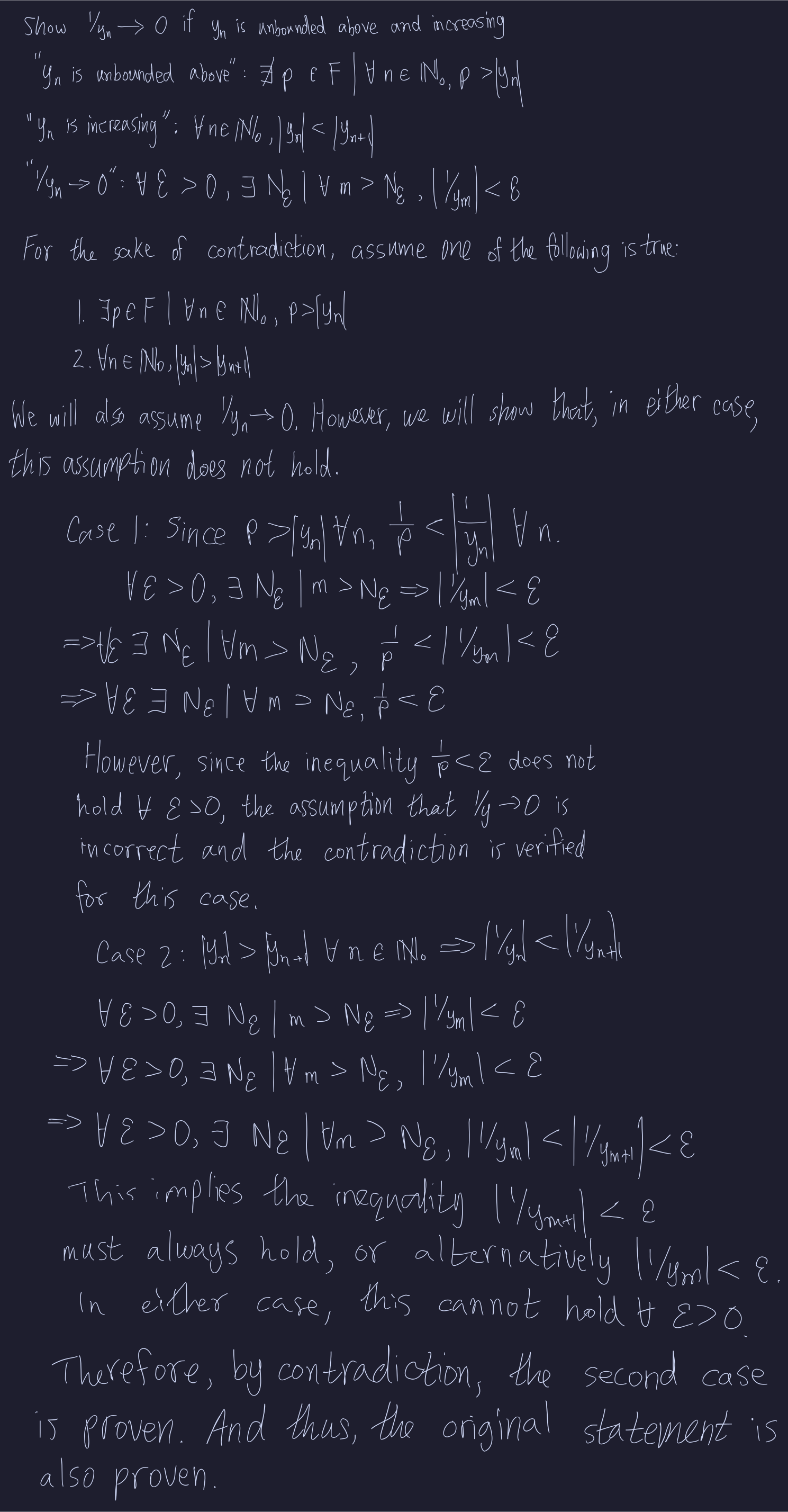
Example 03.10.
(EXERCISE 7[Pedrick, A First Course in Analysis, p. 48])