The Beauty of Spherical Harmonics, Part 2: Solving Laplace's Equation
But how do we actually determine $c_{\ell m}$?
2760 words 21 min Modified
Table of Contents
Part 2 of 3 in The Beauty of Spherical Harmonics
- Building the Basis
- Solving Laplace's Equation
- Diagonalize and Decouple
Last time, we fully diagonalized $\hat{\Lambda}$, and each $\ell$-shell turned out to hold $2\ell+1$ degenerate modes. This time, we put that basis to work.
What This Says About Our Basis
The basis is a choice. $-\ell(\ell+1)$ only pins down a $(2\ell+1)$-dimensional shell, and any orthonormal basis of it works. Ours also diagonalizes $\hat{L}_z$, i.e. we picked a $z$-axis, which is why it takes two labels ($\{\hat{\Lambda},\hat{L}_z\}$ is a complete set of commuting observables). It’s worth it when there’s a symmetry axis: point $z$ along it, every $m\neq0$ term vanishes, and only the plain Legendre series in $\theta$ survives.
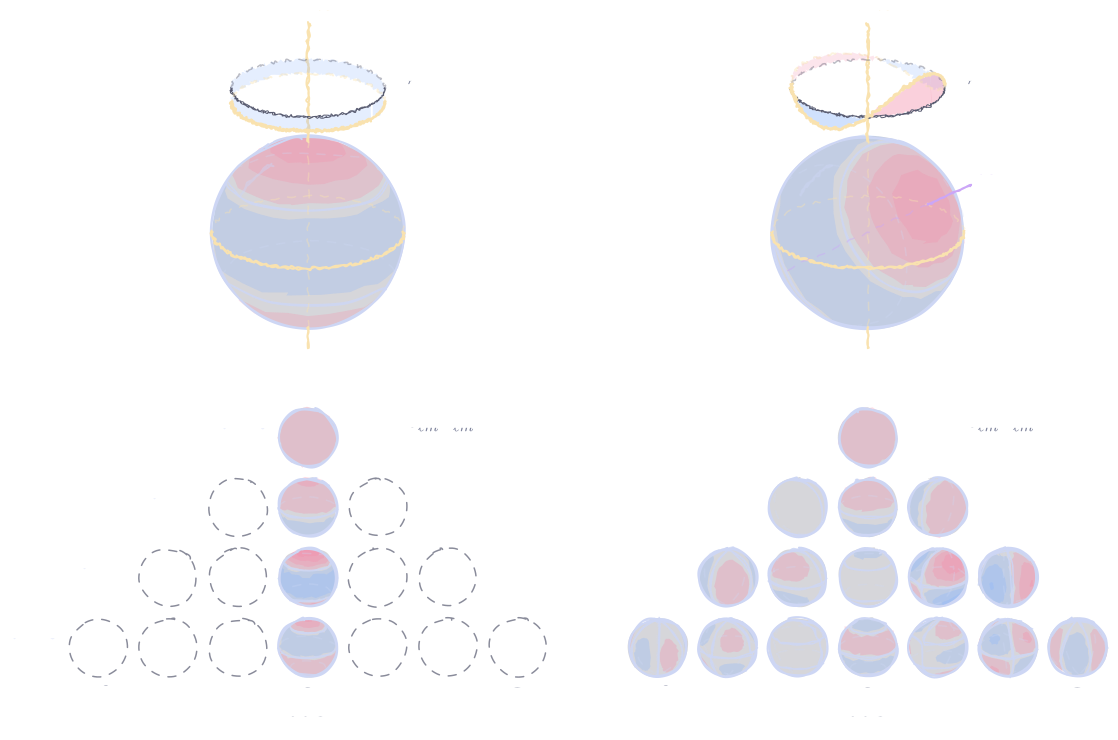
Towards Reconstructing $f$
Recall that we want to characterize any $f$ on the sphere as $\sum c_{\ell m}Y_{\ell m}$. But how do we actually determine $c_{\ell m}$?
$$ \begin{align*} c_{\ell m}&=\braket{\ell m}{f}\\ &= \int_{0}^{2\pi}\int_{0}^{\pi}\braket{\ell m}{\hat{n}}\braket{\hat{n}}{f}\sin\theta\,\mathrm{d}\theta\,\mathrm{d}\psi\\ &=\int_{0}^{2\pi}\int_{0}^{\pi}Y_{\ell m}^*(\theta,\psi)\,f(\theta,\psi)\sin\theta\,\mathrm{d}\theta\,\mathrm{d}\psi \end{align*} $$It answers the question: For any known function, what are the coefficients of that function in the eigenbasis? It conveniently works for any choice of orthonormal basis. However, therein lies the hamartia of Fourier’s Trick: in order to obtain the expansion coefficients of $f$, we simultaneously have to know what the hell $f$ is. And, under a general principle, we will never be given an analytical form of $f$ in a problem statement.
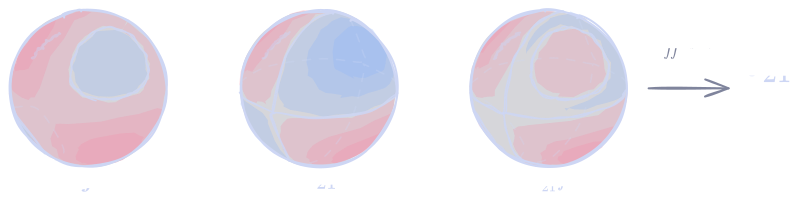
Introducing: the eigenfunction expansion
$$ \begin{align*} \mel{\ell m}{\hat{\Lambda}}{\varphi}&=\sum_{\ell' m'}\underbrace{\mel{\ell m}{\hat{\Lambda}}{\ell' m'}}_{-\ell'(\ell'+1)\,\delta_{\ell\ell'}\delta_{mm'}}\\ &\qquad\times\braket{\ell' m'}{\varphi}\\ &=-\ell(\ell+1)\braket{\ell m}{\varphi}\\ &=-\ell(\ell+1)\,c_{\ell m} \end{align*} $$It answers the question: For an unknown function that we only know through an equation it satisfies, what does the operator in that equation do to the function’s coefficients in that operator’s eigenbasis? The eigenfunction expansion allows us to find the expansion coefficients in the cases where Fourier’s Trick fails, using the diagonal basis of some operator being applied to $\ket{\varphi}$.
We can see that $\hat{\Lambda}$ acting on $\ket{\varphi}$ in the diagonal basis multiplies $c_{\ell m}$ by $-\ell(\ell+1)$. This is no coincidence: since $\hat{\Lambda}$ is diagonal in $\ket{\ell m}$, it scales the $c_{\ell m}$ of $\ket{\varphi}$ by its eigenvalue. We can use this principle to find an analytical way to compute $c_{\ell m}$ (this will be done later).
Important Properties
Now that we’ve diagonalized $\hat{\Lambda}$, its eigenbasis $\ket{\ell m}$ comes with a few special properties that allow us to actually find each $c_{\ell m}$ and reconstruct $f=\sum_{\ell m}c_{\ell m}Y_{\ell m}$.
Completeness
Summing over a basis gives back all of $f$. In the case of the sphere, there are two completeness relations in play: one for the (rather inconvenient) position basis and the eigenbasis.
Position basis (continuous).
$$ \begin{align*} \hat{1}&=\int_{0}^{2\pi}\int_{0}^{\pi}\ket{\hat{n}}\bra{\hat{n}}\sin\theta\,\mathrm{d}\theta\,\mathrm{d}\psi\\ &=\underbrace{\int_{0}^{\pi}\ket{\theta}\bra{\theta}\sin\theta\,\mathrm{d}\theta}_{\hat{1}_\theta}\\ &\quad\otimes\underbrace{\int_{0}^{2\pi}\ket{\psi}\bra{\psi}\,\mathrm{d}\psi}_{\hat{1}_\psi} \end{align*} $$With $\braket{\theta}{\ell}_{m}=P_{\ell}^{|m|}(\cos\theta)$ and $\braket{\psi}{m}=e^{im\psi}$, this is what turns every bra-ket in the sections below into an integral over the sphere.
Spherical eigenbasis (discrete).
$$ \hat{1}=\sum_{\ell=0}^{\infty}\sum_{m=-\ell}^{\ell}\ket{\ell m}\bra{\ell m} $$Implications: any two functions with the same $\braket{\ell m}{\cdot}$ are the same function. This is what allows for boundary condition matching, one mode at a time. We will use this property as a weapon later on.
Strategically inserting $\hat{1}$ into an inner product expresses it as a sum (or integral, in the case of continuous bases):
$$ \begin{align*} f(\hat{n})&=\braket{\hat{n}}{f}\\ &=\sum_{\ell m}\braket{\hat{n}}{\ell m}\braket{\ell m}{f}\\ &=\sum_{\ell m}c_{\ell m}\,Y_{\ell m}(\hat{n}) \end{align*} $$We can now plainly see that we are very close to our original goal of expressing $f$ as a sum. There’s just a couple of more things left to handle to get a more thorough, low entropy description of $f$.
Normalization
Every basis ket gets scaled so that its inner product with itself is “one”. For a discrete basis that’s literally $1$; for a continuous basis, it’s $\delta(\cdot)$. An eigenvalue equation only fixes a ket up to a constant. Choosing that constant is what $N_{\ell m}$ does.
Position basis (continuous). Demand that $\hat{1}_\theta$ and $\hat{1}_\psi$ each hand back $f$:
$$ \begin{align*} \theta:&\quad\braket{\theta'}{f}\\ &\quad=\int_{0}^{\pi}\braket{\theta'}{\theta}\braket{\theta}{f}\sin\theta\,\mathrm{d}\theta\\ &\quad\overset{!}{=}f(\theta')\\ &\quad\implies\braket{\theta'}{\theta}=\frac{\delta(\theta-\theta')}{\sin\theta}\\ \psi:&\quad\braket{\psi'}{f}\\ &\quad=\int_{0}^{2\pi}\braket{\psi'}{\psi}\braket{\psi}{f}\,\mathrm{d}\psi\\ &\quad\overset{!}{=}f(\psi')\\ &\quad\implies\braket{\psi'}{\psi}=\delta(\psi-\psi') \end{align*} $$$$ \begin{align*} \implies\braket{\hat{n}'}{\hat{n}}&=\braket{\theta'}{\theta}\braket{\psi'}{\psi}\\ &=\underbrace{\frac{1}{\sin\theta}}_{\text{"}N^2\text{"}}\delta(\theta-\theta')\,\underbrace{1}_{\text{"}N^2\text{"}}\delta(\psi-\psi') \end{align*} $$The $\frac{1}{\sin\theta}$ plays the role of $N^2$ for the continuous kets. Where it lives is a choice: we put $\sin\theta$ in the measure of $\hat{1}_\theta$, so the inner product has to carry $\frac{1}{\sin\theta}$ to undo it.
Spherical eigenbasis (discrete). Recall that we wrote $Y_{\ell m}=N_{\ell m}P_{\ell}^{|m|}(\cos\theta)\,e^{im\psi}$ in Part 1, and I said “we would come back to finding $N_{\ell m}$ later.” We can now use the normalization property of $\ket{\ell m}$ to find $N_{\ell m}$:
$$ \begin{align*} 1=\braket{\ell m}{\ell m}&=N_{\ell m}^2\,\braket{m}{m}\;{}_{m}\!\braket{\ell}{\ell}_m\\ &=N_{\ell m}^2\underbrace{\int_{0}^{2\pi}\left|e^{im\psi}\right|^2\mathrm{d}\psi}_{2\pi}\\ &\quad\times\underbrace{\int_{0}^{\pi}\left[P_{\ell}^{|m|}(\cos\theta)\right]^2\sin\theta\,\mathrm{d}\theta}_{\frac{2}{2\ell+1}\frac{(\ell+|m|)!}{(\ell-|m|)!}}\\ \implies N_{\ell m}&=\sqrt{\frac{2\ell+1}{4\pi}\frac{(\ell-|m|)!}{(\ell+|m|)!}} \end{align*} $$
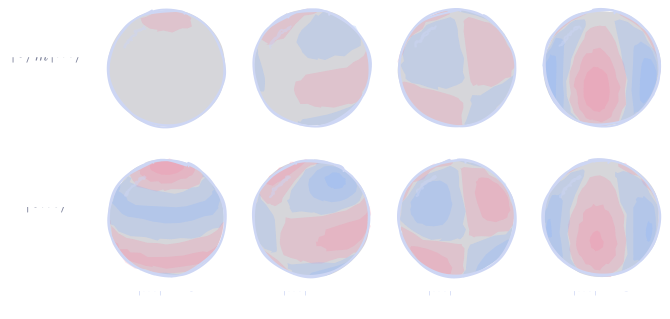
Where ${}_{m}\!\braket{\ell}{\ell}_m=\frac{2}{2\ell+1}\frac{(\ell+|m|)!}{(\ell-|m|)!}$ comes from
Only $|m|$ enters, so take $m\geq0$ and write
$$ I_{\ell m}\equiv{}_{m}\!\braket{\ell}{\ell}_m=\int_{0}^{\pi}\left[P_{\ell}^{m}(\cos\theta)\right]^2\sin\theta\,\mathrm{d}\theta $$Start at $m=0$. Same substitution $x=\cos\theta$ as in the Legendre equation, then Rodrigues and $\ell$ integrations by parts (every boundary term still carries a factor of $x^2-1$, which vanishes at $x=\pm1$):
$$ \begin{align*} I_{\ell 0}&=\int_{0}^{\pi}\left[P_{\ell}(\cos\theta)\right]^2\sin\theta\,\mathrm{d}\theta\\ &=\frac{1}{(2^\ell\ell!)^2}\int_{-1}^{1}\partial_{x}^{\ell}(x^2-1)^\ell\\ &\qquad\times\partial_{x}^{\ell}(x^2-1)^\ell\,\mathrm{d}x\\ &=\frac{(-1)^\ell}{(2^\ell\ell!)^2}\int_{-1}^{1}(x^2-1)^\ell\\ &\qquad\times\underbrace{\partial_{x}^{2\ell}(x^2-1)^\ell}_{(2\ell)!}\,\mathrm{d}x\\ &=\frac{(2\ell)!}{(2^\ell\ell!)^2}\int_{-1}^{1}(1-x^2)^\ell\,\mathrm{d}x\\ &=\frac{(2\ell)!}{(2^\ell\ell!)^2}\underbrace{\int_{0}^{\pi}\sin^{2\ell+1}\theta\,\mathrm{d}\theta}_{\text{Wallis: }\frac{2\,(2^\ell\ell!)^2}{(2\ell+1)!}}\\ &=\frac{2}{2\ell+1} \end{align*} $$Climb in $m$. From
$$ P_{\ell}^{m}(\cos\theta)=(-1)^m\sin^m\theta\left.\partial_{x}^{m}P_{\ell}(x)\right\vert_{x=\cos\theta} $$and $\partial_{\theta}=-\sin\theta\,\partial_{x}$:
$$ P_{\ell}^{m+1}(\cos\theta)=\left(\partial_{\theta}-m\cot\theta\right)P_{\ell}^{m}(\cos\theta) $$Integrating by parts against $\sin\theta\,\mathrm{d}\theta$ (the boundary term carries $\sin\theta$ and dies at the poles), the adjoint of $\partial_{\theta}-m\cot\theta$ is $-\left(\partial_{\theta}+(m+1)\cot\theta\right)$. Their product, with $\cot^2\theta=\frac{1}{\sin^2\theta}-1$:
$$ \begin{align*} &-\left(\partial_{\theta}+(m+1)\cot\theta\right)\\ &\quad\times\left(\partial_{\theta}-m\cot\theta\right)\\ &\quad=-\Big[\partial_{\theta}^2+\cot\theta\,\partial_{\theta}\\ &\qquad\quad+\frac{m}{\sin^2\theta}-m(m+1)\cot^2\theta\Big]\\ &\quad=-\Big[\underbrace{\partial_{\theta}^2+\cot\theta\,\partial_{\theta}-\frac{m^2}{\sin^2\theta}}_{\hat{D}_m}\Big]\\ &\qquad-m(m+1) \end{align*} $$So:
$$ \begin{align*} I_{\ell,m+1}&=\int_{0}^{\pi}P_{\ell}^{m}(\cos\theta)\\ &\qquad\times\left[-\hat{D}_m-m(m+1)\right]\\ &\qquad\times P_{\ell}^{m}(\cos\theta)\sin\theta\,\mathrm{d}\theta\\ &=\left[\ell(\ell+1)-m(m+1)\right]I_{\ell m}\\ &=(\ell-m)(\ell+m+1)\,I_{\ell m} \end{align*} $$$\hat{D}_m$ shows up again, and its eigenvalue does all the work. Stacking the steps:
$$ \begin{align*} I_{\ell m}&=\frac{2}{2\ell+1}\prod_{k=0}^{m-1}(\ell-k)(\ell+k+1)\\ &=\frac{2}{2\ell+1}\cdot\frac{\ell!}{(\ell-m)!}\cdot\frac{(\ell+m)!}{\ell!}\\ &=\frac{2}{2\ell+1}\frac{(\ell+m)!}{(\ell-m)!} \end{align*} $$Implication: previously, with the raw kets $\ket{\ell}_m\ket{m}$, every result carried $\braket{m}{m}\;{}_{m}\!\braket{\ell}{\ell}_m=2\pi\cdot\frac{2}{2\ell+1}\frac{(\ell+|m|)!}{(\ell-|m|)!}$ around. Plugging in the actual values, that’s exactly $\frac{1}{N_{\ell m}^2}$.
The diagonalized $\hat{\Lambda}$:
$$ \begin{align*} \hat{\Lambda}&=\sum_{m}\sum_{\ell\geq|m|}-\ell(\ell+1)\,\frac{\ket{\ell}_m\,{}_{m}\!\bra{\ell}}{{}_{m}\!\braket{\ell}{\ell}_m}\\ &\qquad\otimes\frac{\ket{m}\bra{m}}{\braket{m}{m}}\\ &=\sum_{m}\sum_{\ell\geq|m|}-\ell(\ell+1)\,\frac{1}{2\pi}\cdot\frac{2\ell+1}{2}\frac{(\ell-|m|)!}{(\ell+|m|)!}\\ &\qquad\times\Big(\ket{\ell}_m\ket{m}\Big)\Big({}_{m}\!\bra{\ell}\bra{m}\Big)\\ &=\sum_{m}\sum_{\ell\geq|m|}-\ell(\ell+1)\left(\sqrt{\frac{2\ell+1}{4\pi}\frac{(\ell-|m|)!}{(\ell+|m|)!}}\right)^2\\ &\qquad\times\Big(\ket{\ell}_m\ket{m}\Big)\Big({}_{m}\!\bra{\ell}\bra{m}\Big)\\ &=\sum_{m}\sum_{\ell\geq|m|}-\ell(\ell+1)\\ &\qquad\times\left(\sqrt{\frac{2\ell+1}{4\pi}\frac{(\ell-|m|)!}{(\ell+|m|)!}}\,\ket{\ell}_m\ket{m}\right)\\ &\qquad\times\left(\sqrt{\frac{2\ell+1}{4\pi}\frac{(\ell-|m|)!}{(\ell+|m|)!}}\,{}_{m}\!\bra{\ell}\bra{m}\right)\\ &\longrightarrow\;\sum_{\ell m}-\ell(\ell+1)\ket{\ell m}\bra{\ell m} \end{align*} $$The matrix elements:
$$ \begin{align*} &\left({}_{m'}\!\bra{\ell'}\otimes\bra{m'}\right)\hat{\Lambda}\left(\ket{\ell}_m\otimes\ket{m}\right)\\ &\quad=-\ell(\ell+1)\cdot2\pi\cdot\frac{2}{2\ell+1}\frac{(\ell+|m|)!}{(\ell-|m|)!}\\ &\qquad\times\delta_{\ell\ell'}\delta_{mm'}\\ &\left(\sqrt{\frac{2\ell+1}{4\pi}\frac{(\ell-|m|)!}{(\ell+|m|)!}}\right)^2\\ &\quad\times\left({}_{m'}\!\bra{\ell'}\otimes\bra{m'}\right)\hat{\Lambda}\left(\ket{\ell}_m\otimes\ket{m}\right)\\ &\quad=-\ell(\ell+1)\left(\sqrt{\frac{2\ell+1}{4\pi}\frac{(\ell-|m|)!}{(\ell+|m|)!}}\right)^2\\ &\qquad\times2\pi\cdot\frac{2}{2\ell+1}\frac{(\ell+|m|)!}{(\ell-|m|)!}\,\delta_{\ell\ell'}\delta_{mm'}\\ &\quad=-\ell(\ell+1)\,\frac{2\ell+1}{4\pi}\frac{(\ell-|m|)!}{(\ell+|m|)!}\\ &\qquad\times\frac{4\pi}{2\ell+1}\frac{(\ell+|m|)!}{(\ell-|m|)!}\,\delta_{\ell\ell'}\delta_{mm'}\\ &\longrightarrow\;\mel{\ell' m'}{\hat{\Lambda}}{\ell m}=-\ell(\ell+1)\,\delta_{\ell\ell'}\delta_{mm'} \end{align*} $$The coefficients of $f$. In the raw modes, $f=\sum_{\ell m}a_{\ell m}P_{\ell}^{|m|}(\cos\theta)\,e^{im\psi}$:
$$ \begin{align*} a_{\ell m}&=\frac{\left({}_{m}\!\bra{\ell}\otimes\bra{m}\right)\ket{f}}{\braket{m}{m}\;{}_{m}\!\braket{\ell}{\ell}_m}\\ &=\frac{1}{2\pi\cdot\frac{2}{2\ell+1}\frac{(\ell+|m|)!}{(\ell-|m|)!}}\\ &\quad\times\int_{0}^{2\pi}\int_{0}^{\pi}P_{\ell}^{|m|}(\cos\theta)\,e^{-im\psi}\\ &\qquad\times f(\theta,\psi)\sin\theta\,\mathrm{d}\theta\,\mathrm{d}\psi \end{align*} $$In the normalized modes:
$$ \begin{align*} c_{\ell m}=\braket{\ell m}{f}&=\sqrt{\frac{2\ell+1}{4\pi}\frac{(\ell-|m|)!}{(\ell+|m|)!}}\\ &\quad\times\int_{0}^{2\pi}\int_{0}^{\pi}P_{\ell}^{|m|}(\cos\theta)\,e^{-im\psi}\\ &\qquad\times f(\theta,\psi)\sin\theta\,\mathrm{d}\theta\,\mathrm{d}\psi\\ &=\sqrt{\frac{2\ell+1}{4\pi}\frac{(\ell-|m|)!}{(\ell+|m|)!}}\\ &\quad\times2\pi\cdot\frac{2}{2\ell+1}\frac{(\ell+|m|)!}{(\ell-|m|)!}\,a_{\ell m}\\ &=\sqrt{\frac{4\pi}{2\ell+1}\frac{(\ell+|m|)!}{(\ell-|m|)!}}\;a_{\ell m}\\ &\longrightarrow\;c_{\ell m}=\frac{a_{\ell m}}{N_{\ell m}} \end{align*} $$Orthogonality
A projection kills every term in the sum but one.
Position basis (continuous). This is just the normalization from before:
$$ \begin{align*} \braket{\hat{n}'}{\hat{n}}&=\frac{\delta(\theta-\theta')}{\sin\theta}\,\delta(\psi-\psi')\\ &=0\qquad(\hat{n}'\neq\hat{n}) \end{align*} $$Spherical eigenbasis (discrete).
$$ \begin{align*} \braket{\ell' m'}{\ell m}&=N_{\ell' m'}N_{\ell m}\underbrace{\int_{0}^{2\pi}e^{i(m-m')\psi}\,\mathrm{d}\psi}_{\braket{m'}{m}}\\ &\quad\times\underbrace{\int_{0}^{\pi}P_{\ell'}^{|m'|}(\cos\theta)\,P_{\ell}^{|m|}(\cos\theta)\sin\theta\,\mathrm{d}\theta}_{{}_{m'}\!\braket{\ell'}{\ell}_m} \end{align*} $$$\psi$ slot: for $m\neq m'$, $\braket{m'}{m}=\frac{e^{2\pi i(m-m')}-1}{i(m-m')}=0$, since $m-m'\in\mathbb{Z}$.
$\theta$ slot (same $m$): previously, we had
$$ \hat{D}_m P_{\ell}^{|m|}(\cos\theta)=-\ell(\ell+1)P_{\ell}^{|m|}(\cos\theta) $$with $\hat{D}_m=\frac{1}{\sin\theta}\partial_{\theta}(\sin\theta\,\partial_{\theta})-\frac{m^2}{\sin^2\theta}$. So:
$$ \begin{align*} &\left[\ell'(\ell'+1)-\ell(\ell+1)\right]{}_{m}\!\braket{\ell'}{\ell}_m\\ &\quad=\int_{0}^{\pi}\Big[P_{\ell'}^{|m|}(\cos\theta)\,\hat{D}_m P_{\ell}^{|m|}(\cos\theta)\\ &\qquad\quad-P_{\ell}^{|m|}(\cos\theta)\,\hat{D}_m P_{\ell'}^{|m|}(\cos\theta)\Big]\sin\theta\,\mathrm{d}\theta\\ &\quad=\Big[\sin\theta\Big(P_{\ell'}^{|m|}(\cos\theta)\,\partial_{\theta}P_{\ell}^{|m|}(\cos\theta)\\ &\qquad\quad-P_{\ell}^{|m|}(\cos\theta)\,\partial_{\theta}P_{\ell'}^{|m|}(\cos\theta)\Big)\Big]_{0}^{\pi}\\ &\quad=0 \end{align*} $$$\sin\theta$ vanishes at the poles, and $P_{\ell}^{|m|}(\cos\theta)$ is finite there. $Q_{\ell}^{m}(\cos\theta)$ would blow up and keep this term alive, which is the real reason we threw it out.
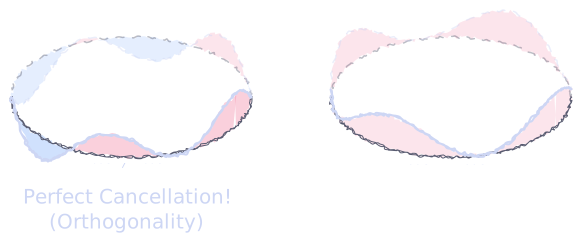
Together with the normalization:
$$ \braket{\ell' m'}{\ell m}=\delta_{\ell\ell'}\delta_{mm'} $$Implications: each coefficient comes from its own projection, so adding more terms never changes the ones already found. The boundary conditions that quantized $m$ and $\ell$ (periodicity, finiteness at the poles) are the same ones that make the basis orthogonal.
Eigenfunction Expansion
It finds the coefficients of an unknown function from an equation it satisfies. In the operator’s eigenbasis, the operator only rescales each coefficient, so the equation splits mode by mode.
Example: Laplace with boundary data. Given $\varphi\equiv V$ on $r=R$, and nothing else about $\varphi$ except $\hat{\nabla}^2\varphi=0$. With $\hat{\nabla}^2=\frac{1}{r^2}\partial_{r}(r^2\partial_{r})+\frac{1}{r^2}\hat{\Lambda}$, sandwich with $\bra{\ell' m'}$:
$$ \begin{align*} \mel{\ell' m'}{\hat{\nabla}^2}{\varphi}&=\frac{1}{r^2}\partial_{r}\left(r^2\partial_{r}\braket{\ell' m'}{\varphi}\right)\\ &\quad+\frac{1}{r^2}\mel{\ell' m'}{\hat{\Lambda}}{\varphi}\\ &=0 \end{align*} $$$\bra{\ell' m'}$ has no $r$ in it, so only the $\hat{\Lambda}$ term cares about the basis. Previously, we had
$$ \mel{\ell' m'}{\hat{\Lambda}}{\varphi}=-\ell'(\ell'+1)\braket{\ell' m'}{\varphi} $$The $\delta$’s leave exactly one term. In the position basis there is no such luck:
$$ \mel{\hat{n}}{\hat{\Lambda}}{\varphi}\approx\frac{4}{\varepsilon^2}\left(\left<\varphi\right>_{\varepsilon}-\varphi(\hat{n})\right) $$As we saw before, each $\hat{n}$ is tied to its nearest neighbors (nonzero off-diagonals), so the equation never comes apart.
One equation per mode. Plug back in and drop the primes:
$$ \left[\frac{1}{r^2}\partial_{r}\left(r^2\partial_{r}\right)-\frac{\ell(\ell+1)}{r^2}\right]\braket{\ell m}{\varphi(r)}=0 $$Every term scales the same way under $r\to\lambda r$, so try $\braket{\ell m}{\varphi(r)}\propto r^{k}$:
$$ \begin{align*} &\left[k(k+1)-\ell(\ell+1)\right]r^{k-2}=0\\ &\implies k=\ell\ \text{ or }\ k=-(\ell+1) \end{align*} $$Inside, $r^{-(\ell+1)}$ blows up at the origin $\implies\braket{\ell m}{\varphi(r)}=A_{\ell m}r^{\ell}$. Outside, $r^{\ell}$ blows up at infinity $\implies\braket{\ell m}{\varphi(r)}=B_{\ell m}r^{-(\ell+1)}$ (the Method of Inversion below hands this one over for free).
Match the boundary. $\varphi(R)=V\implies A_{\ell m}R^{\ell}=\braket{\ell m}{V}$:
$$ \braket{\ell m}{\varphi(r)}=\left(\frac{r}{R}\right)^{\ell}\braket{\ell m}{V} $$I said we would find an analytical way to compute $c_{\ell m}$ later; this is it. The left side comes out of the equation, and the only projection actually computed is $\braket{\ell m}{V}$, on the known $V$.
Why not just Fourier’s-trick $V$? That only gives $\varphi$’s coefficients at $r=R$. The sandwiched equation says how each one evolves in $r$. Same split as in QM: Fourier’s trick on $\psi(x,0)$ gives the starting values, and sandwiching the Schrödinger equation with $\bra{n}$ gives each one’s $e^{-iE_nt}$. Laplace is second order in $r$, so it needs one more condition than Schrödinger: regularity at $0$ (inside) or at $\infty$ (outside).
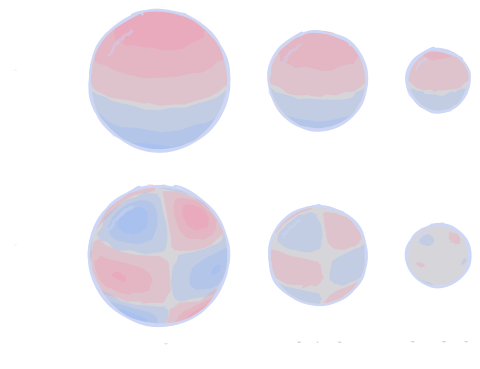
Example: no leftover coordinate. For $\hat{\Lambda}\ket{u}=\ket{g}$, there’s nothing to solve, only a division:
$$ \braket{\ell m}{u}=-\frac{\braket{\ell m}{g}}{\ell(\ell+1)} $$Equivalently, as an operator:
$$ \hat{\Lambda}^{-1}=\sum_{\ell\geq1}\sum_{m=-\ell}^{\ell}\frac{-1}{\ell(\ell+1)}\ket{\ell m}\bra{\ell m} $$$\hat{\Lambda}Y_{00}=0$, so $\braket{0\,0}{u}$ has to be supplied separately (the $+C$), and $\braket{0\,0}{g}$ has to vanish. E.g.
$$ g=-4Y_{10}-30Y_{21}\implies u=C\,Y_{00}+2Y_{10}+5Y_{21} $$Implication: the full solve is three moves: (1) sandwich the equation (eigenbasis only): one equation per coefficient of the unknown; (2) sandwich the known data (Fourier’s trick, any orthonormal basis): fixes the constants; (3) sum the modes (completeness).
Method of Inversion
Previously, inside the sphere we had
$$ \braket{\ell m}{\varphi_{\text{in}}(r)}=\left(\frac{r}{R}\right)^{\ell}\braket{\ell m}{V} $$Outside, the same $V$ needs the other root, $r^{-(\ell+1)}$. Can the interior solution be recycled into the exterior one instead of solving again?
Swap inside and outside while leaving the sphere fixed: reflect the radius through the sphere,
$$ r\;\longmapsto\;\frac{R^2}{r} $$$r<R\iff\frac{R^2}{r}>R$, the sphere $r=R$ stays put, and the center goes to infinity.
First guess: evaluate the interior solution at the reflected point,
$$ \varphi_{\text{out}}(r,\theta,\psi)\overset{?}{=}\varphi_{\text{in}}\!\left(\frac{R^2}{r},\theta,\psi\right) $$On $r=R$ this is $\varphi_{\text{in}}(R,\theta,\psi)=V(\theta,\psi)$, so the boundary is fine. But does it solve Laplace?
The reflection only touches $r$, and $\bra{\ell m}$ has no $r$ in it, so sandwich:
$$ \begin{align*} \braket{\ell m}{\varphi_{\text{in}}(R^2/r)}&=\left(\frac{R^2/r}{R}\right)^{\ell}\braket{\ell m}{V}\\ &=\left(\frac{R}{r}\right)^{\ell}\braket{\ell m}{V}\\ &\propto r^{-\ell} \end{align*} $$Previously, $r^{k}$ solves the radial equation only if $k(k+1)=\ell(\ell+1)$. At $k=-\ell$:
$$ (-\ell)(-\ell+1)=\ell(\ell-1)\neq\ell(\ell+1) $$The guess fails. It lands on $r^{-\ell}$, one power short of $r^{-(\ell+1)}$.
Why one power short? Complete the square:
$$ k(k+1)=\left(k+\tfrac{1}{2}\right)^2-\tfrac{1}{4} $$$k(k+1)$ only sees how far $k$ is from $-\frac{1}{2}$, and the two roots sit symmetrically about it: $\ell=-\frac{1}{2}+\left(\ell+\frac{1}{2}\right)$ and $-(\ell+1)=-\frac{1}{2}-\left(\ell+\frac{1}{2}\right)$. The reflection sends $r^{k}\mapsto r^{-k}$, a mirror about $0$. A mirror about $-\frac{1}{2}$ is $k\mapsto-1-k$: the same flip, followed by one extra factor of $r^{-1}$.
So multiply the guess by a power of $r$ and a constant, and let the equation pick them:
$$ \varphi_{\text{out}}(r,\theta,\psi)=C\,r^{p}\,\varphi_{\text{in}}\!\left(\frac{R^2}{r},\theta,\psi\right) $$$$ \begin{align*} \braket{\ell m}{\varphi_{\text{out}}(r)}&=C\,r^{p}\left(\frac{R}{r}\right)^{\ell}\braket{\ell m}{V}\\ &\propto r^{p-\ell}\\ p-\ell&=-(\ell+1)\\ \implies p&=-1 \end{align*} $$The $\ell$ cancels: one power of $r$ fixes every mode at once, so the map acts on $\varphi_{\text{in}}$ as a whole, with no expansion needed.
The boundary fixes $C$. At $r=R$:
$$ \begin{align*} \varphi_{\text{out}}(R,\theta,\psi)&=\frac{C}{R}\,\varphi_{\text{in}}(R,\theta,\psi)\\ &=\frac{C}{R}\,V(\theta,\psi)\\ &\overset{!}{=}V(\theta,\psi)\\ \implies C&=R \end{align*} $$Together:
$$ \varphi_{\text{out}}(r,\theta,\psi)=\frac{R}{r}\,\varphi_{\text{in}}\!\left(\frac{R^2}{r},\theta,\psi\right) $$$\frac{1}{r}$ makes it solve Laplace; $R$ makes it equal $V$ on the sphere. This is the Method of Inversion. Mode by mode, it hands over the exterior solution with its constant already fixed, $B_{\ell m}=R^{\ell+1}\braket{\ell m}{V}$:
$$ \begin{align*} \braket{\ell m}{\varphi_{\text{out}}(r)}&=\frac{R}{r}\left(\frac{R}{r}\right)^{\ell}\braket{\ell m}{V}\\ &=\left(\frac{R}{r}\right)^{\ell+1}\braket{\ell m}{V} \end{align*} $$
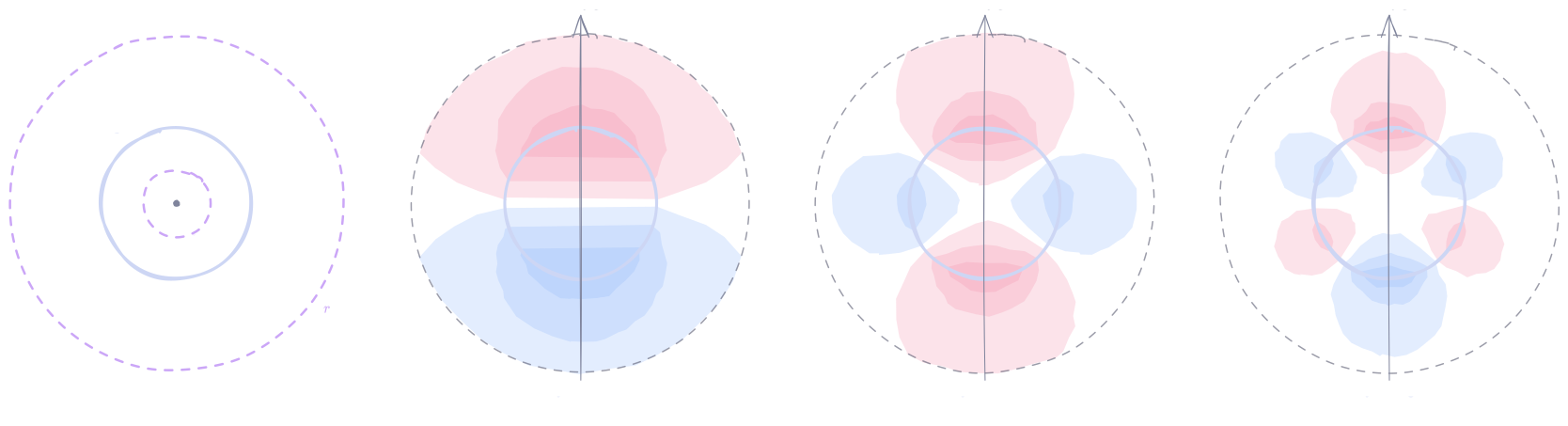
Implication: solve the interior problem once, and the exterior one is a substitution away.
Fourier’s Trick
It finds the coefficients of a known function. Same $\delta$ collapse as before, but with no operator in the sandwich, so it works in any orthonormal basis.
Position basis (continuous). The $\delta$ from before collapses the integral, and the “coefficient” is just the value of $f$:
$$ \begin{align*} \braket{\hat{n}'}{f}&=\int_{0}^{2\pi}\int_{0}^{\pi}\braket{\hat{n}'}{\hat{n}}\braket{\hat{n}}{f}\sin\theta\,\mathrm{d}\theta\,\mathrm{d}\psi\\ &=f(\hat{n}') \end{align*} $$Spherical eigenbasis (discrete).
$$ \begin{align*} \braket{\ell' m'}{f}&=\sum_{\ell m}c_{\ell m}\underbrace{\braket{\ell' m'}{\ell m}}_{\delta_{\ell\ell'}\delta_{mm'}}\\ &=c_{\ell' m'} \end{align*} $$To actually compute it, insert the position-basis completeness. Previously, we had
$$ \begin{align*} c_{\ell m}&=\braket{\ell m}{f}\\ &=\int_{0}^{2\pi}\int_{0}^{\pi}Y_{\ell m}^*(\theta,\psi)\,f(\theta,\psi)\sin\theta\,\mathrm{d}\theta\,\mathrm{d}\psi \end{align*} $$So Fourier’s trick is a change of basis: continuous components $f(\theta,\psi)$ in, discrete components $c_{\ell m}$ out.
Can the double integral be done one slot at a time? Yes: $\bra{\ell m}=N_{\ell m}\,{}_{m}\!\bra{\ell}\otimes\bra{m}$ splits along the same two slots we diagonalized, so the projection splits into the same two steps.
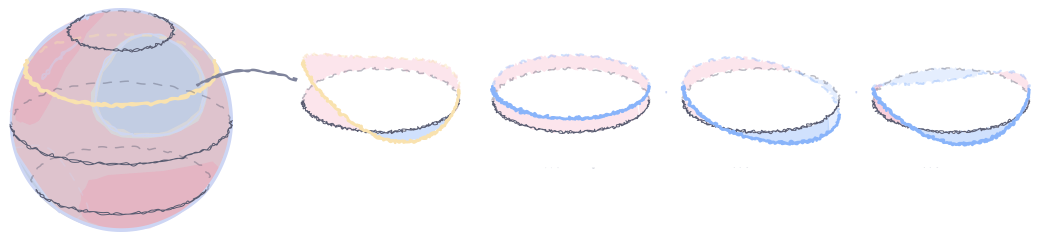
Step 1 ($\psi$ slot): at fixed $\theta$, each latitude ring is periodic, so Fourier-series it:
$$ \begin{align*} f(\theta,\psi)&=\sum_{m}f_m(\theta)\,e^{im\psi}\\ f_m(\theta)&=\frac{\braket{m}{f}}{\braket{m}{m}}\\ &=\frac{1}{2\pi}\int_{0}^{2\pi}f(\theta,\psi)\,e^{-im\psi}\,\mathrm{d}\psi \end{align*} $$Only $\psi$ gets integrated, so $f_m$ is still a function of $\theta$. Since $\hat{\Lambda}$ never mixes $m$’s, each $f_m$ is handled alone by $\hat{D}_m$.
Step 2 ($\theta$ slot): expand each $f_m$ in its own block’s eigenfunctions:
$$ \begin{align*} f_m(\theta)&=\sum_{\ell\geq|m|}a_{\ell m}\,P_{\ell}^{|m|}(\cos\theta)\\ a_{\ell m}&=\frac{{}_{m}\!\braket{\ell}{f_m}}{{}_{m}\!\braket{\ell}{\ell}_m} \end{align*} $$Different $m$, different $\hat{D}_m$, different family of modes. The only boundary condition is finiteness at the poles.
Previously, we had $c_{\ell m}=\frac{a_{\ell m}}{N_{\ell m}}$, so the two steps reassemble $f$:
$$ \begin{align*} f(\theta,\psi)&=\sum_{m}\sum_{\ell\geq|m|}a_{\ell m}\,P_{\ell}^{|m|}(\cos\theta)\,e^{im\psi}\\ &=\sum_{m}\sum_{\ell\geq|m|}c_{\ell m}\,Y_{\ell m}(\theta,\psi) \end{align*} $$Example: Laplace with boundary data. Previously, inside the sphere we had $\braket{\ell m}{\varphi(r)}=\left(\frac{r}{R}\right)^{\ell}\braket{\ell m}{V}$. Summing the modes:
$$ \begin{align*} \varphi(r,\theta,\psi)&=\sum_{\ell m}\left(\frac{r}{R}\right)^{\ell}\braket{\ell m}{V}\\ &\qquad\times Y_{\ell m}(\theta,\psi) \end{align*} $$The only integral left is Fourier’s trick on the known $V$:
$$ \braket{\ell m}{V}=\int_{0}^{2\pi}\int_{0}^{\pi}Y_{\ell m}^*(\theta,\psi)\,V(\theta,\psi)\sin\theta\,\mathrm{d}\theta\,\mathrm{d}\psi $$With azimuthal symmetry and plain $P_{\ell}(\cos\theta)$ (the usual convention), the $\psi$ slot cancels and it’s “overlap over length squared”:
$$ \begin{align*} \varphi(r,\theta)&=\sum_{\ell}A_{\ell}r^{\ell}P_{\ell}(\cos\theta)\\ A_{\ell}R^{\ell}&=\frac{\braket{\ell}{V}}{\braket{\ell}{\ell}}\\ &=\frac{2\ell+1}{2}\int_{0}^{\pi}V(\theta)\,P_{\ell}(\cos\theta)\sin\theta\,\mathrm{d}\theta \end{align*} $$Putting It Together: $V=V_0\cos^2\theta$
Previously, the full solve was three moves: sandwich the equation, sandwich the data, sum the modes. What does that look like on an actual boundary? Hold the sphere at $V(\theta)=V_0\cos^2\theta$ and find $\varphi$ inside and outside.
Sandwich the equation. Previously, we had, inside and (by inversion) outside:
$$ \begin{align*} \braket{\ell m}{\varphi_{\text{in}}(r)}&=\left(\frac{r}{R}\right)^{\ell}\braket{\ell m}{V}\\ \braket{\ell m}{\varphi_{\text{out}}(r)}&=\left(\frac{R}{r}\right)^{\ell+1}\braket{\ell m}{V} \end{align*} $$Sandwich the data. $V$ has no $\psi$, so only $m=0$ survives, and previously we had
$$ A_{\ell}R^{\ell}=\frac{2\ell+1}{2}\int_{0}^{\pi}V(\theta)\,P_{\ell}(\cos\theta)\sin\theta\,\mathrm{d}\theta $$With $\int_{0}^{\pi}\cos^{2k}\theta\,\sin\theta\,\mathrm{d}\theta=\frac{2}{2k+1}$:
$$ \begin{align*} A_0&=\frac{1}{2}\int_{0}^{\pi}V_0\cos^2\theta\,\sin\theta\,\mathrm{d}\theta\\ &=\frac{V_0}{2}\cdot\frac{2}{3}\\ &=\frac{V_0}{3} \end{align*} $$$$ \begin{align*} A_2R^2&=\frac{5}{2}\int_{0}^{\pi}V_0\cos^2\theta\,\frac{3\cos^2\theta-1}{2}\,\sin\theta\,\mathrm{d}\theta\\ &=\frac{5V_0}{4}\left(3\cdot\frac{2}{5}-\frac{2}{3}\right)\\ &=\frac{2V_0}{3} \end{align*} $$What about every other $\ell$? These two already rebuild $V$ exactly:
$$ \begin{align*} &\frac{V_0}{3}P_0(\cos\theta)+\frac{2V_0}{3}P_2(\cos\theta)\\ &\quad=\frac{V_0}{3}+\frac{2V_0}{3}\cdot\frac{3\cos^2\theta-1}{2}\\ &\quad=\frac{V_0}{3}+V_0\cos^2\theta-\frac{V_0}{3}\\ &\quad=V_0\cos^2\theta \end{align*} $$Each coefficient comes from its own projection, so nothing is left over for the rest: $A_{\ell}=0$ for $\ell\neq0,2$.
Sum the modes:
$$ \begin{align*} \varphi_{\text{in}}(r,\theta)&=\frac{V_0}{3}\\ &\quad+\frac{2V_0}{3}\left(\frac{r}{R}\right)^{2}P_2(\cos\theta)\\ \varphi_{\text{out}}(r,\theta)&=\frac{V_0}{3}\,\frac{R}{r}\\ &\quad+\frac{2V_0}{3}\left(\frac{R}{r}\right)^{3}P_2(\cos\theta) \end{align*} $$
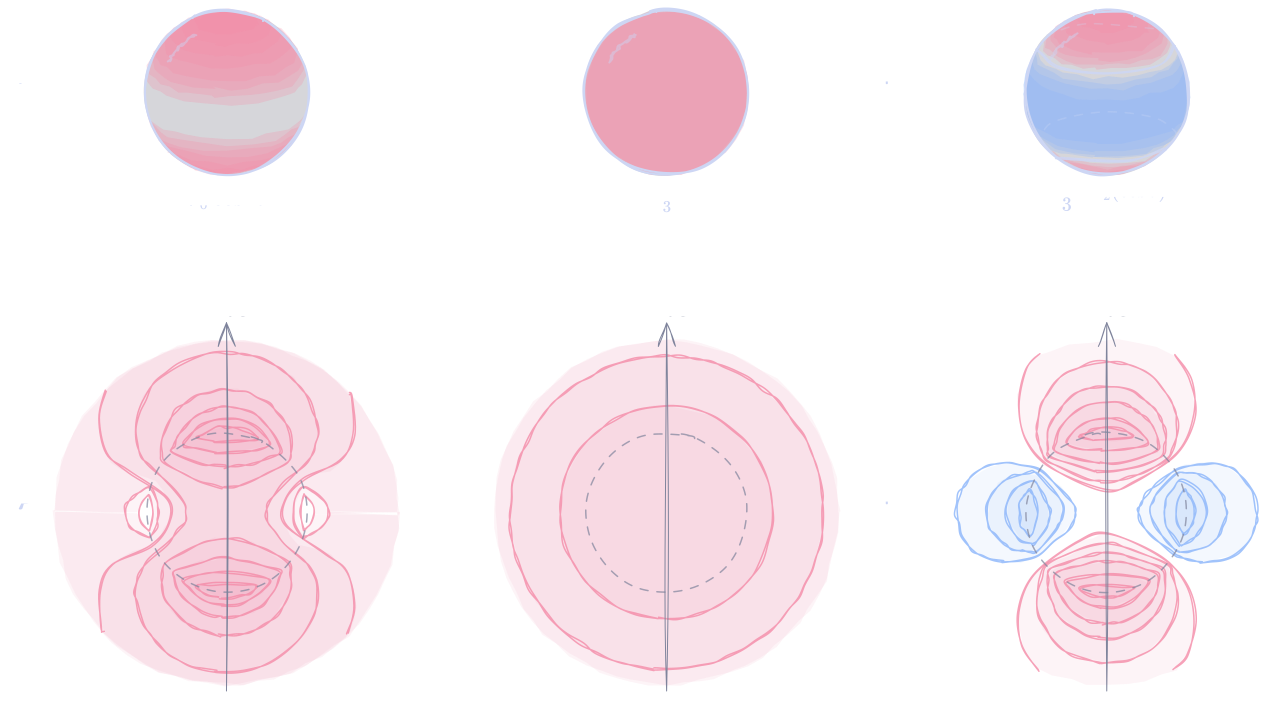
Interpretation: each mode carries its piece of $V$ off the sphere by its own radial law, and $\varphi$ is just their sum. $\ell=0$: flat inside, $\frac{R}{r}$ outside. $\ell=2$: grows from $0$ as $r^2$ inside, dies as $r^{-3}$ outside. At the center every $\ell\geq1$ carries $r^{\ell}\to0$, so $\varphi(0)=\frac{V_0}{3}$: the average of $V$ over the sphere. Far away, $\left(\frac{R}{r}\right)^{3}$ dies first, so only $\varphi_{\text{out}}\approx\frac{V_0R}{3r}$ survives: from far away, the sphere looks like a point charge.
This is the Goal from the top: decompose $V$ into $Y_{\ell m}$’s, and the decomposition solves Laplace mode by mode.
Intuition
Previously, we had $\left< f \right>_{\varepsilon}-f\approx\frac{\varepsilon^2}{4}\mel{\hat{n}}{\hat{\Lambda}}{f}$. What does that say about a single $Y_{\ell m}$?
$$ \left< Y_{\ell m} \right>_{\varepsilon} - Y_{\ell m} \approx -\frac{\varepsilon^2}{4}\ell(\ell+1)Y_{\ell m} $$$\ell$ labels the eigenvalue of $\hat{\Lambda}$: how wiggly the pattern is. Bigger $\ell$ means every point differs more from its neighbors’ average.
$m$ labels the eigenvalue of $\hat{L}_z=-i\partial_{\psi}$: how the pattern responds to spinning about $z$, i.e. how much of that wiggliness wraps around the $z$-axis. $m$ = number of full wavelengths around any circle of latitude.
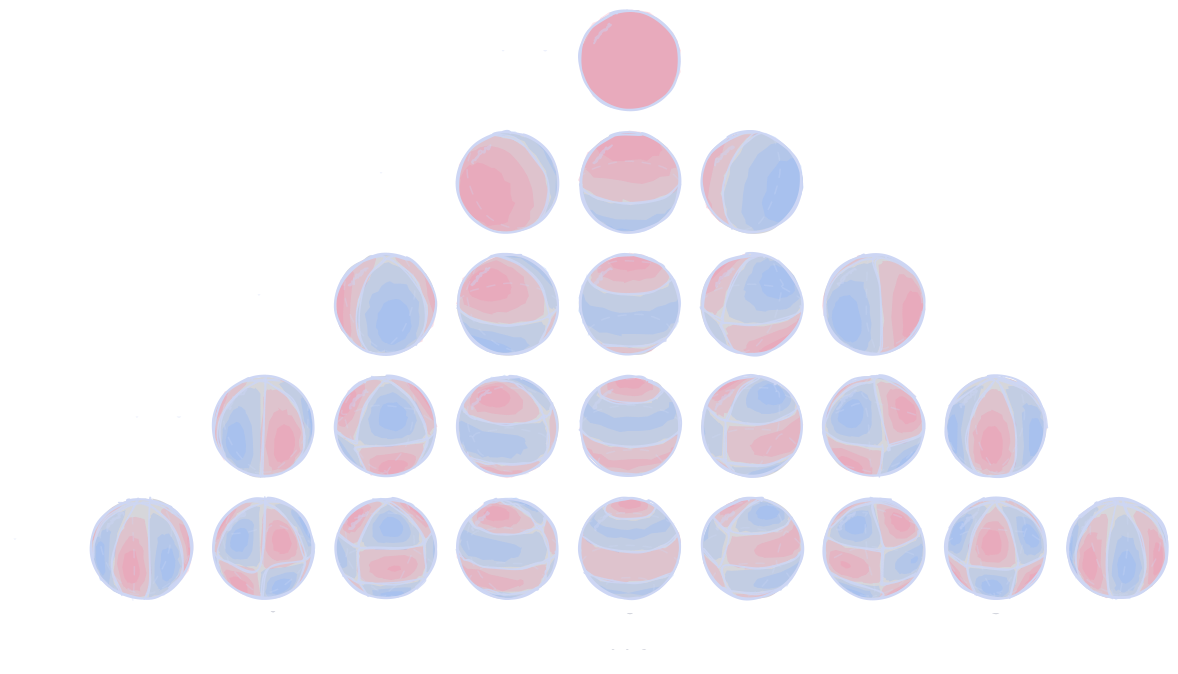
Nodal lines: the real version combines $e^{\pm im\psi}$ into $\cos(m\psi)$ and $\sin(m\psi)$. Previously, we had
$$ \begin{align*} P_{\ell}^{|m|}(\cos\theta)&=(-1)^{|m|}\sin^{|m|}\theta\sum_{k=0}^{\lfloor (\ell-|m|)/2 \rfloor }(-1)^k\\ &\quad\times\frac{(2\ell-2k)!}{2^\ell k! (\ell-k)! (\ell-2k-|m|)!}\\ &\quad\times\cos^{(\ell-2k-|m|)}\theta \end{align*} $$The sum is a degree-$(\ell-|m|)$ polynomial in $\cos\theta$ with $\ell-|m|$ zeros, all in $\theta\in(0,\pi)$ (standard fact for these orthogonal polynomials): $\ell-|m|$ latitude circles. $\sin^{|m|}\theta$ only vanishes at the poles, so no new lines. $\cos(m\psi)$ vanishes at $2|m|$ values of $\psi$, and each pair ($\psi$ and $\psi+\pi$) is one great circle through both poles: $|m|$ meridian great circles. Total: $\ell$ nodal lines.
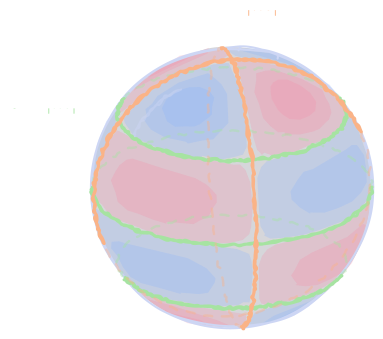
Extremes. $m=0$: all latitude lines, no $\psi$ dependence, symmetric about $z$ (the plain $P_{\ell}(\cos\theta)$). $|m|=\ell$: all meridian lines; the sum is a constant, so $P_{\ell}^{\ell}(\cos\theta)\propto\sin^{\ell}\theta$ and the pattern hugs the equator.
Why $|m|\leq\ell$, intuitively: $m$ counts meridians, which are a subset of the $\ell$ nodal lines. There can’t be more meridians than total lines. Algebraically: $P_{\ell}(\cos\theta)$ is a degree-$\ell$ polynomial in $\cos\theta$, so differentiating it $|m|>\ell$ times with respect to $\cos\theta$ leaves nothing.
References
- R. L. Herman, An Introduction to Mathematical Physics via Oscillations, Chapter 9, “Oscillations in Higher Dimensions,” University of North Carolina Wilmington (2012). PDF, licensed CC BY-NC-SA 3.0.
- D. J. Griffiths, Introduction to Electrodynamics, 4th ed., Cambridge University Press (2017), Chapter 3.
- J. D. Jackson, Classical Electrodynamics, 3rd ed., Wiley (1999), Chapter 3.
- F. W. J. Olver et al., eds., NIST Digital Library of Mathematical Functions, §14.17, Integrals and §14.30, Spherical and Spheroidal Harmonics.
- Kelvin transform, Wikipedia.
<EOF>
Next time, we will see what happens when the sum has to stop, and then take the same moves to drums, laser beams, hydrogen, and point charges.