Notes › PHYS 3571: Quantum Computing Lecture 4
Quantum Circuits
279 words 2 min Modified
Table of Contents
Quantum Circuits
- Represented by a line with a starting state and the gates as operators on the state
- CNOT gate is a 2-qubit gate with one qubit acting as a control to see if the other qubit state is NOTed
- The gates are applied from left to right, but the operators are written in right to left order
Matrix Representation
- Goal: represent states with column matrices
Ket
$$\ket{0} \doteq \left( \begin{matrix} 1 \\ 0 \end{matrix} \right), \ \ \ \ \ \ket{1} \doteq \left( \begin{matrix} 0 \\ 1 \end{matrix} \right)$$- For any state $\ket{\psi} = \alpha \ket{0} + \beta \ket{1}$:
Bra
- What is $\bra{0}$?
- What about $\bra{1}$?
- What about $\bra{\psi}$?
- Interchange the rows and columns
Inner Product
- What is the inner product of $\psi$ onto itself?
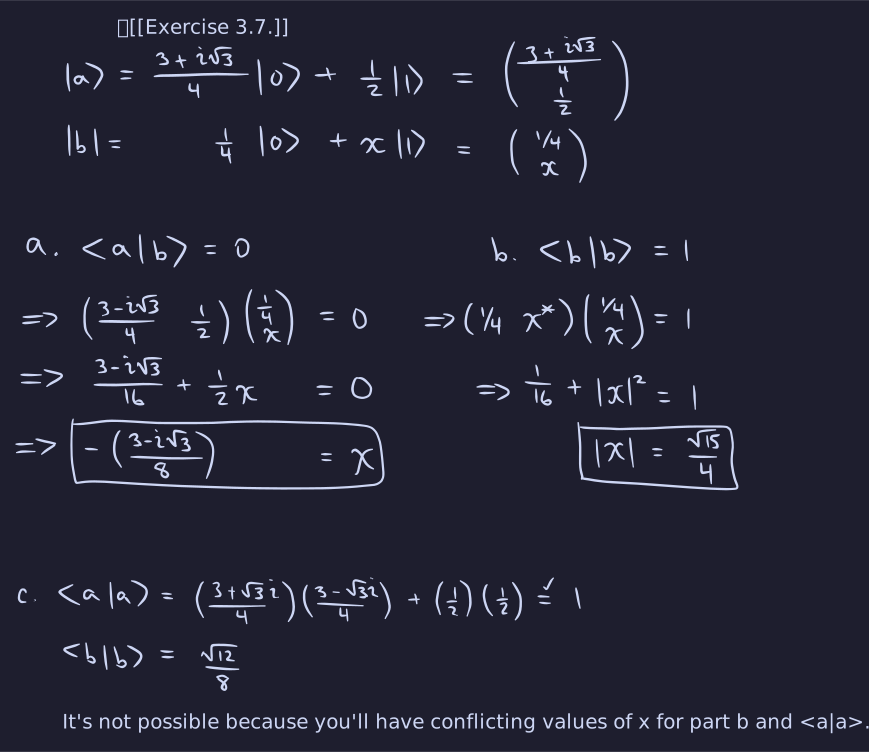
Inner Product Example
Operators
- Represented by $2 \times 2$ matrices
Definition 04.1 (Hermitian).
The transpose of the conjugate matrix, denoted $M^{^{\dagger}}$. Has the following property:
$$\hat{U}^{\dagger} \hat{U} = \hat{U} \hat{U}^{\dagger} = \hat{I}$$Definition 04.2 (Unitary Operators).
Any operator with the property $\hat{U}^{-1}=\hat{U}^{\dagger}$.
Definition 04.3 (Reversible Operators).
Given any operator $\hat{M}$, we say $\hat{M}$ is invertible (reversible) if $\exists \hat{M}^{-1}$ st:
$$\hat{M} \hat{M}^{-1} = I = \hat{M}^{-1}\hat{M}$$