Notes › PHYS 3571: Quantum Computing Lecture 5
2-Qubit States
442 words 2 min Modified
Table of Contents
2-Qubit Basis
- Subscript tells you which qubit each ket is apart of
- Qubit 0: $\left\{ \ket{0}_{0}, \ket{1}_{0} \right\} \to \left\{ \left( \begin{matrix}1 \\ 0\end{matrix} \right)_{0}, \left( \begin{matrix}0 \\ 1\end{matrix} \right)_{0} \right\}$
- Qubit 1: $\left\{ \ket{0}_{1}, \ket{1}_{1} \right\}\to \left\{ \left( \begin{matrix}1 \\ 0\end{matrix} \right)_{1}, \left( \begin{matrix}0 \\ 1\end{matrix} \right)_{1} \right\}$
- To form the 2-qubit basis, take the tensor product of the single-qubit bases:
- The topmost line of the quantum circuit is the rightmost bit of the bitstring
- “Little endian” => LSB is the rightmost
- Constructing the matrices for tensor product basis:
Inner Product
- Take the single-qubit inner product, grouping by the qubit index
CNOT Example
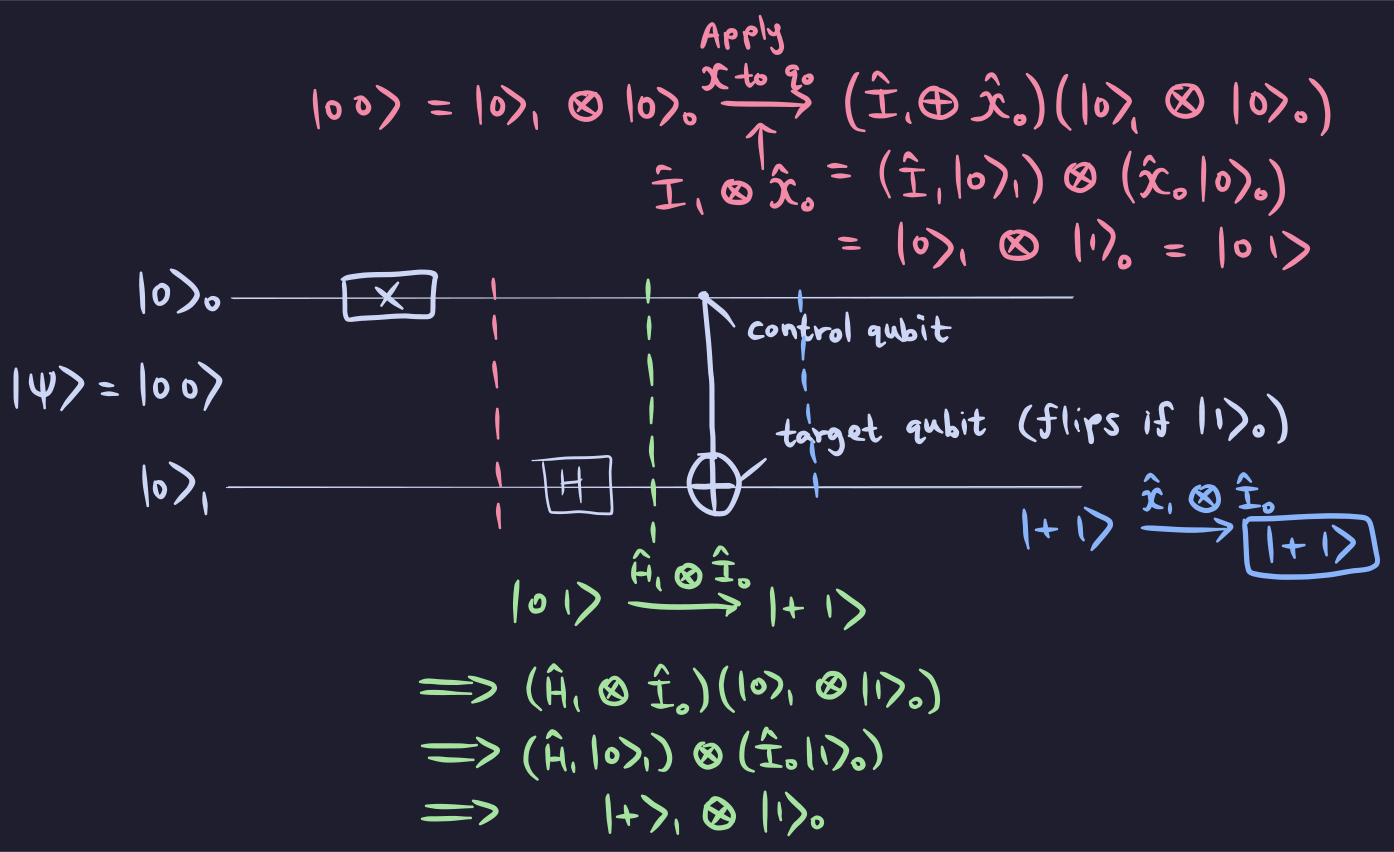
CNOT With Haddamard Example
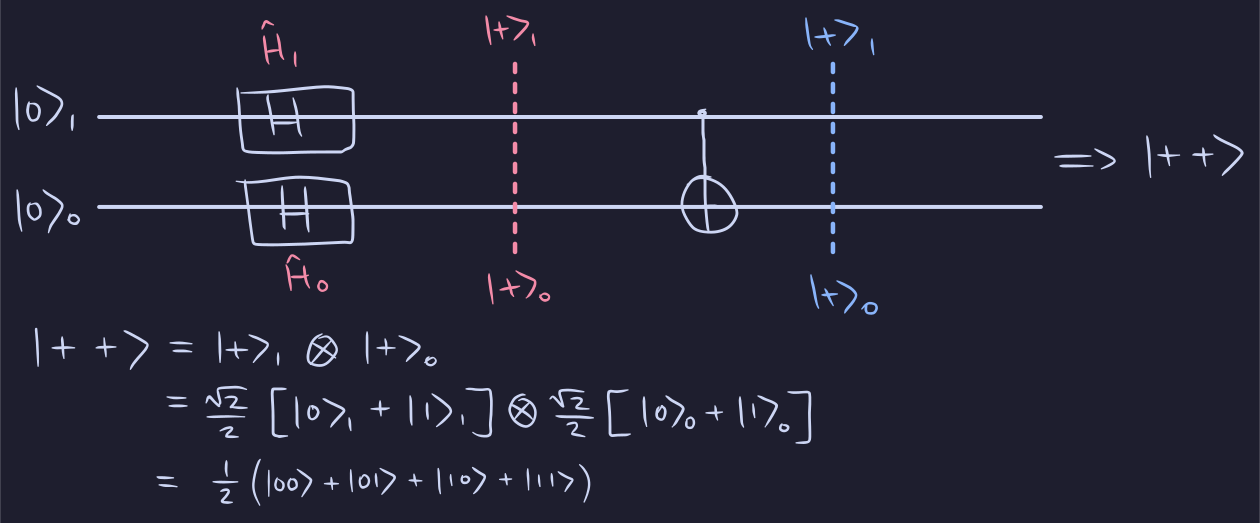
Measuring Individual Qubits from 2-Qubit State
- Projection operator onto state $\ket{0}_{1}$:
- The probability is:
- Shortcut: it’s the sum of the squares of the coefficients for any 2-qubit whose first is 0/1
- Q: If we measured $q_1$ and got $\ket{0}_{1}$, what is the new wave function?
- A:
Entangled States
- A 2-qubit state is entangled if it can’t be written as the product of 2 single-qubit states
- General unentangled state:
- Entangled state
- Entangled because there’s no solution to get it into the unentangled state