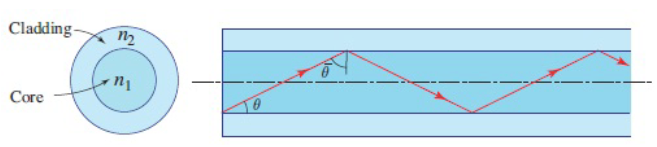
Often made with silica glass (a.k.a. fused silica/amorphous silicon dioxide ($\text{SiO}_{2}$)) due to its excellent optical/mechanical properties
Refractive index can be modified via doping (often with $\text{GeO}_{2}$)
TIR Reflection Condition
Definition(Notation peculiarities in this section).
My notation:
Overbar $\coloneqq$ measured from the surface normal
Unbarred $\coloneqq$ measured from the optical axis
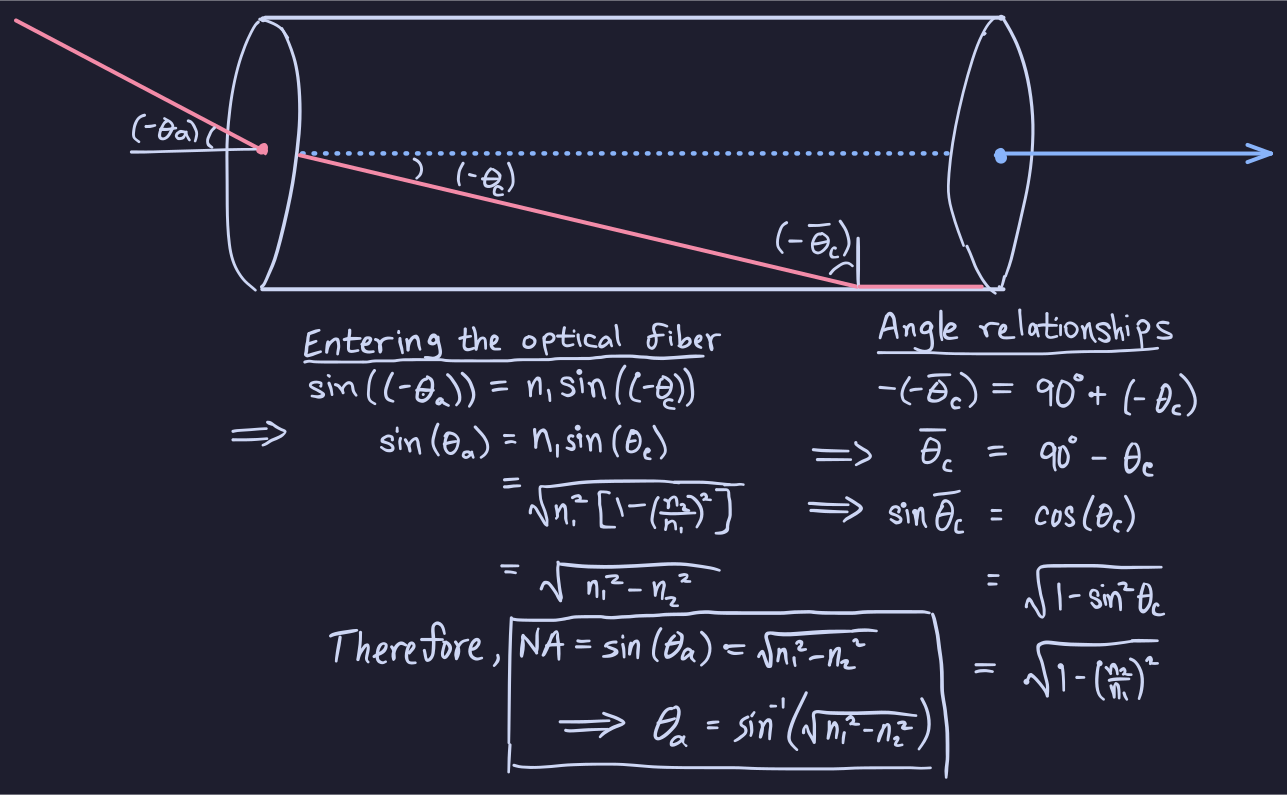
Subscript $c$ marks the critical value of the variable it is attached to.
This reverses Saleh’s notation in the book (p. 185 [Saleh & Teich, Fundamentals of Photonics, p. 185]), where $\theta_c \coloneqq \sin^{-1}(n_2/n_1)$ and $\bar{\theta}_c \coloneqq 90^\circ - \theta_c$.
In other words: $\bar{\theta}_{c}$ here $=$ $\theta_{c}$ in the main TIR note. The unbarred $\theta_c$ here is fiber-specific and has no counterpart there.
The cone of acceptable rays without undergoing refraction at the cladding is characterized by the half-angle, $\theta_a$, (a.k.a. the acceptance angle):