Notes › MATH 5339: Partial Differential Equations Lecture 4
Wave Equation
363 words 3 min Modified
Table of Contents
Plucked String
- If a PDE is dependent on time, it is called evolutionary
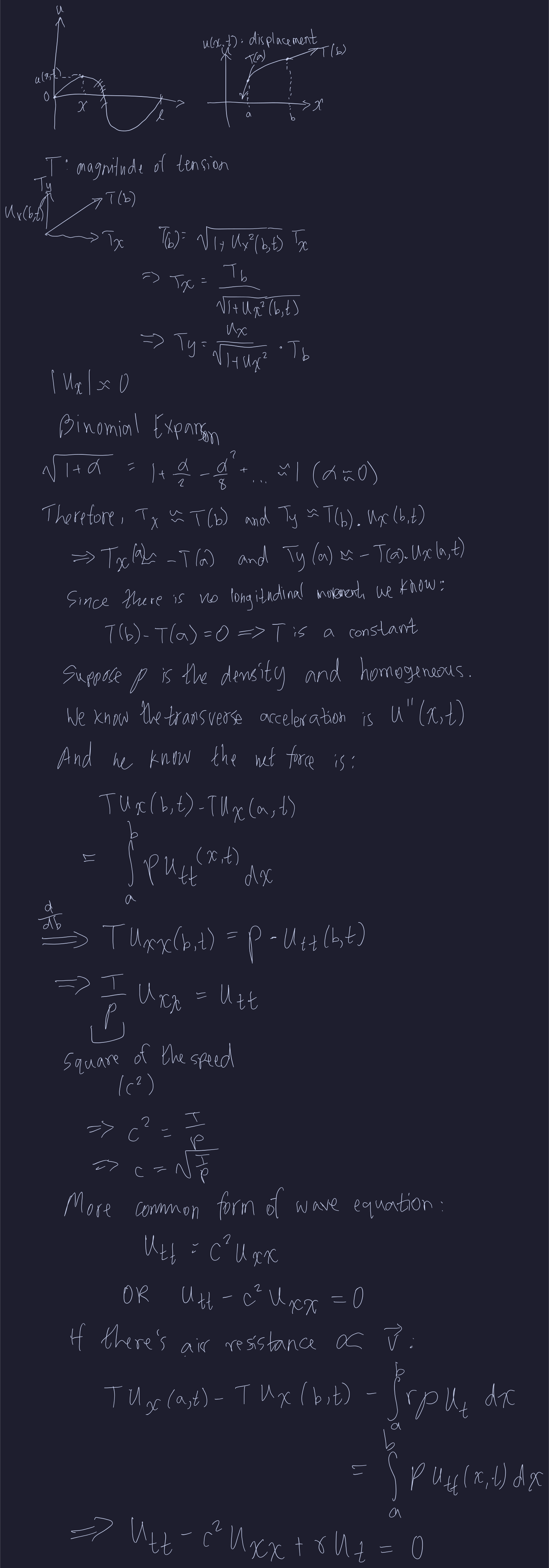
- Suppose there is a fixed string between two points that can only move transversely (up and down)
- We need to find an equation to describe the displacement of the string at a particular time $u(x, t)$
Generalizing for Higher Dimensions
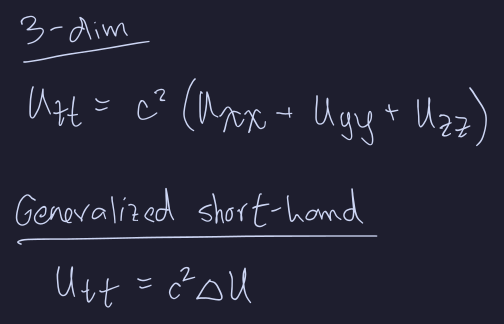
- Add extra partial derivatives in the equation for the extra space variables
What if the String is in Equilibrium?
- The displacement is no longer changing with respect to time, which implies $U_{tt} = 0$, which implies $\Delta U = 0$
- Thus, the string is no longer evolving with time
- 1-D case: $U_{xx} = 0 \implies$ linear solution
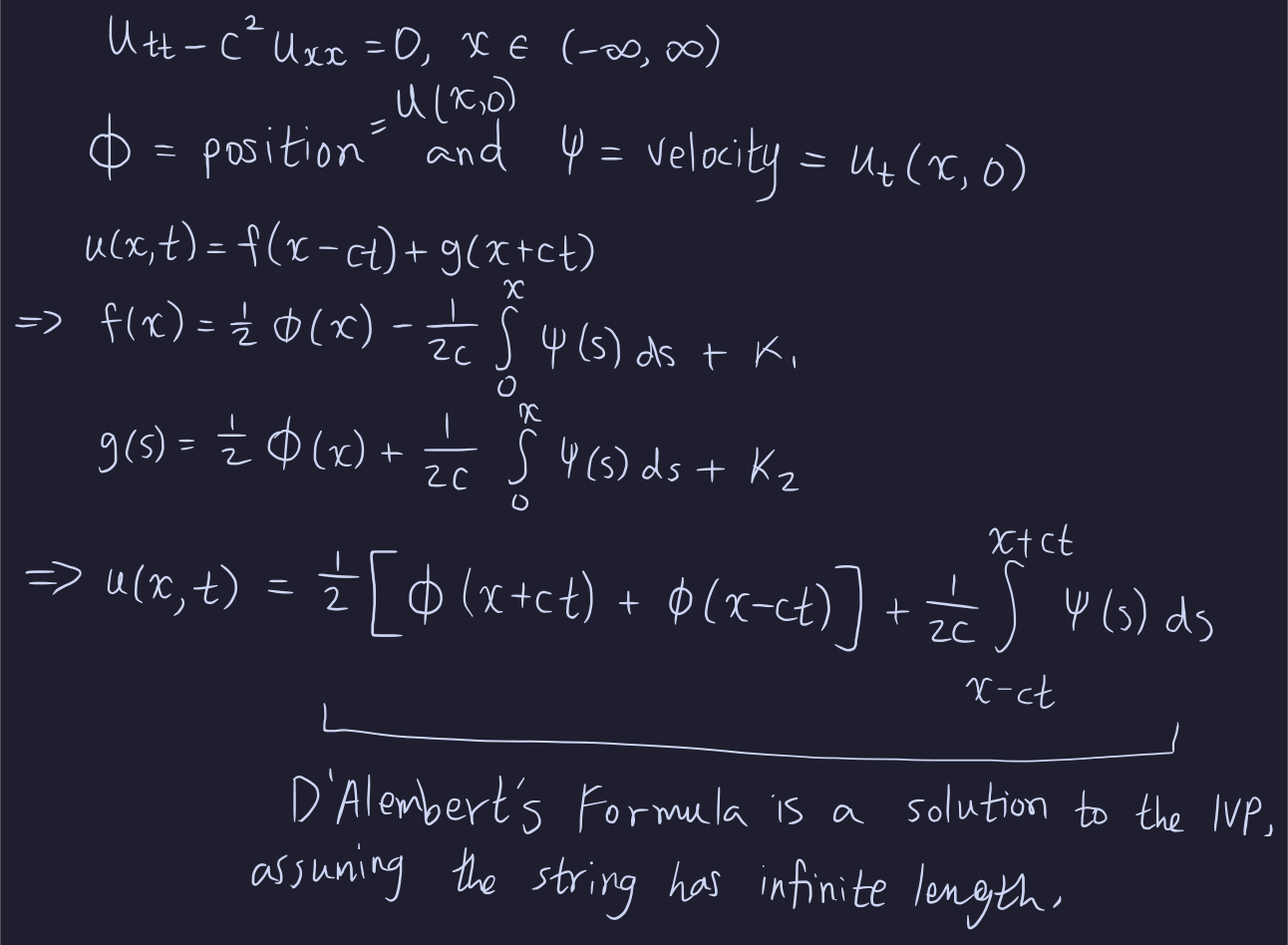
D’Alembert’s Formula to Solve the Wave Equation
Example 04.1.
Wave Equation D’Alembert’s Example
- This is a standing wave, which means that it doesn’t actually move laterally
- Formed via the superposition of two traveling waves
Example 04.2.
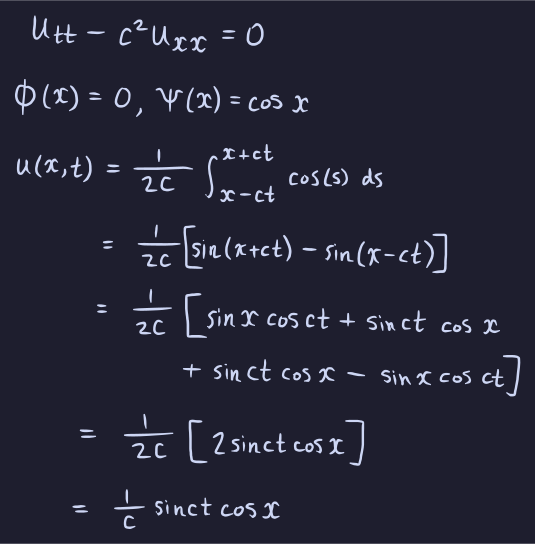
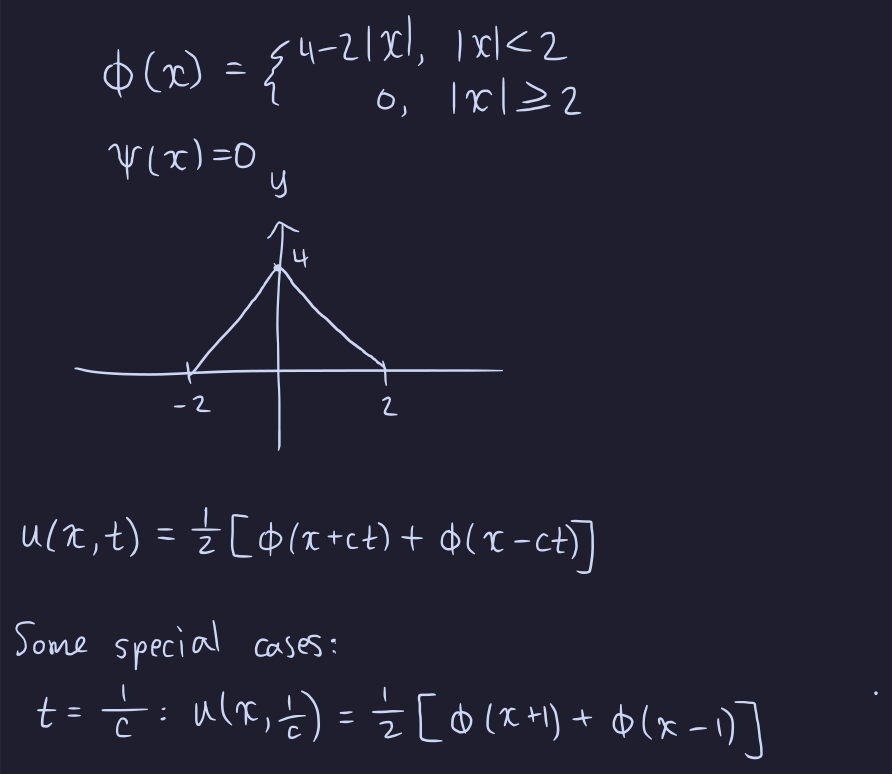
Wave Equation (no Initial velocity) Example
- This is a plucked string where you hold the string in an initial configuration and then let go and see the effect
Principle of Causality
- Disturbances in the wave equation propagate cannot exceed $c$
- No effect can be felt outside the cone bounded by the characteristics $x = x_0 \pm ct$
- The solution at a point $(x_0,t_0)$ depends only on initial data in the interval $[x_0 - ct_0, x_0 + ct_0]$
- Signals do not travel instantaneously
Domain of Influence
- For a point $(x_0,t_0)$ the domain of influence is the set of initial points that can affect $(x_0,t_0)$
- Bounded by the forward characteristics $x = x_0 \pm ct$
- Shows how information spreads forward in time
Domain of Dependence
- For a point $(x,t)$ the domain of dependence is the set of earlier points that determine the solution at $(x,t)$
- In 1D this region is the triangle bounded by the backward characteristics $x \pm ct$ traced back to $t=0$
- Encodes causality only data within this region can influence the solution at $(x,t)$
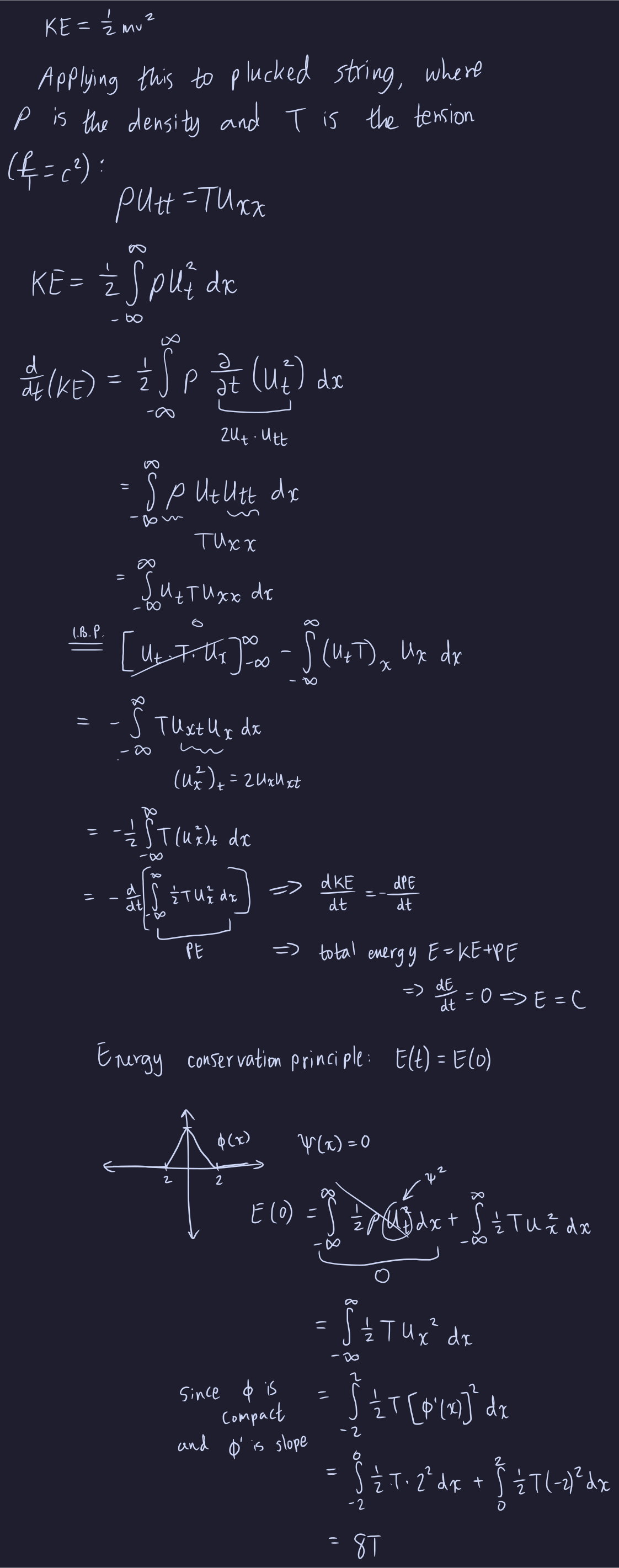
Conservation of Energy
Final Remarks
- Huygen’s Principle: The Wave Equation in three dimensions (and odd-numbered dimensions) has an exact speed $c$
- However, in even-numbered dimensions, this is not necessarily the case; you will then have a lagging term that changes the speed