Notes › MATH 5339: Partial Differential Equations Lecture 3
Transport and Wave Equations
237 words 2 min Modified
Table of Contents
Characteristic lines are of the form $bx-ay=C$ for an arbitrary equation $a U_x + b U_y = 0$
Transport Equation
$$U_{t} + C U_{x} = 0$$where $C$ is the speed of the fluid
- The solution is $u(x, t) = f(x-ct)$
- On each of the characteristic lines, the function $u$ remains constant
- As time progresses, the information contained in $u$ will be transported to the right at the speed $C$
WHAT THE FREAK IS A NONDEGENERATE LINEAR TRANSFORM for $… = ax+by$ and $\eta = bx-ay$ (jacobian nonzero)
Wave Equation
-
Suppose $U_x + y U_y = 0$. Then, you can represent it as:
$$\langle 1, y\rangle \cdot \nabla U = 0$$ -
Thus, the vectors get steeper as $y$ increases
-
We want to find a curve such that, for every point along the curve, its slope matches the vector
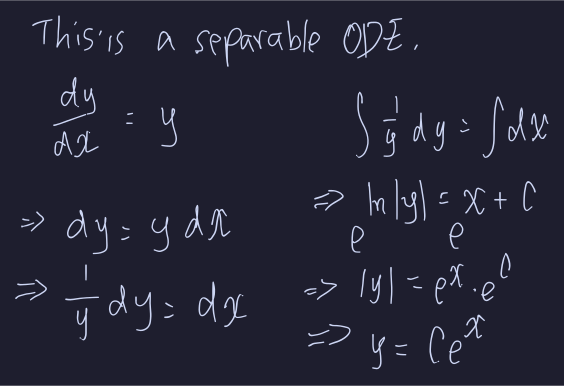
- Therefore, as long as $C$ is fixed, $U$ is constant. Proof:
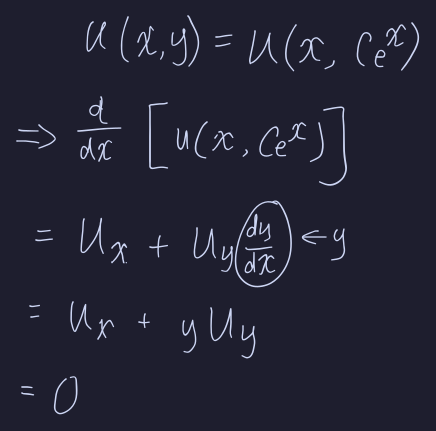
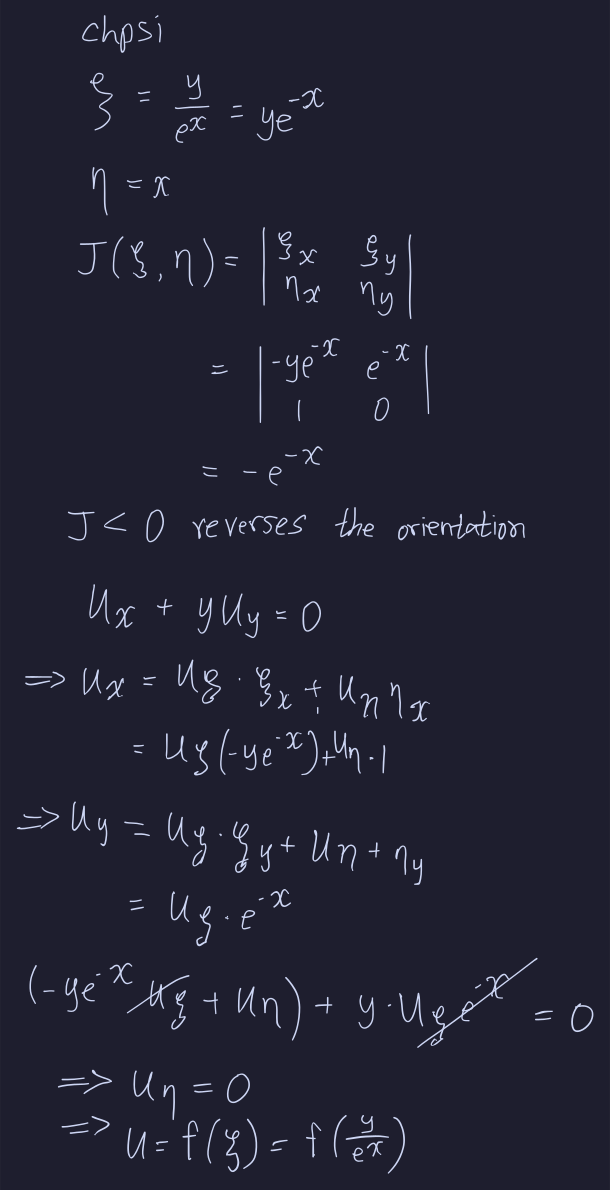
- We can claim, then, that our solution is only dependent on $C$
Change of Variable
- Alternatively, we can find new coordinates to express the solution in the form of one derivative
- This method is good because it allows us to solve a first-order ODE with more terms (e.g. some forcing/external thing on a system which makes it inhomogeneous)
Example 03.1 (Adding another term).
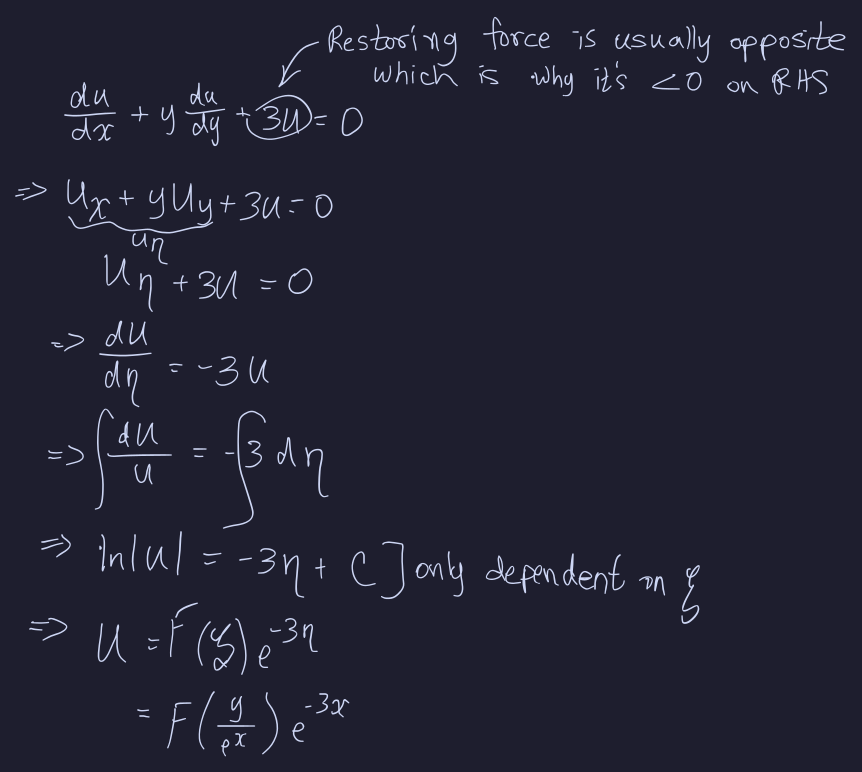
- If the RHS is nonzero, you have to solve a first-order system using integrating factor since it’s no longer separable