Notes › ENGR 2341: Signals and Systems Lecture 18
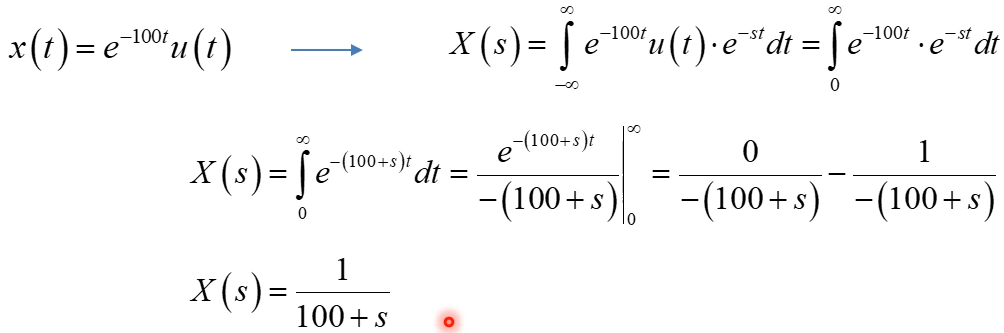
Laplace Transform
206 words 2 min Modified
Table of Contents
Laplace Transform
- Determined using the Laplace transform integral or laplace transform table [Laplace transform table (course handout)]
- Most continuous functions have a Laplace transform
Inverse Laplace Transform
- Usually not practical using the mathematical definition of ILT
- Must change the $s$-domain function so that it can be evaluated with a table [Laplace transform table (course handout)]
- Accomplished with partial fraction decomposition or clever manipulation
Partial Fraction Decomposition
- Every proper rational function can be expressed as a sum of first-order rational functions
- Each term in the sum is a residue, $r_k$, divided by $s$ minus a pole factor, $p_k$
Partial Fraction Decomposition with MATLAB
- Useful functions for partial fraction decomposition:
residue,roots,poly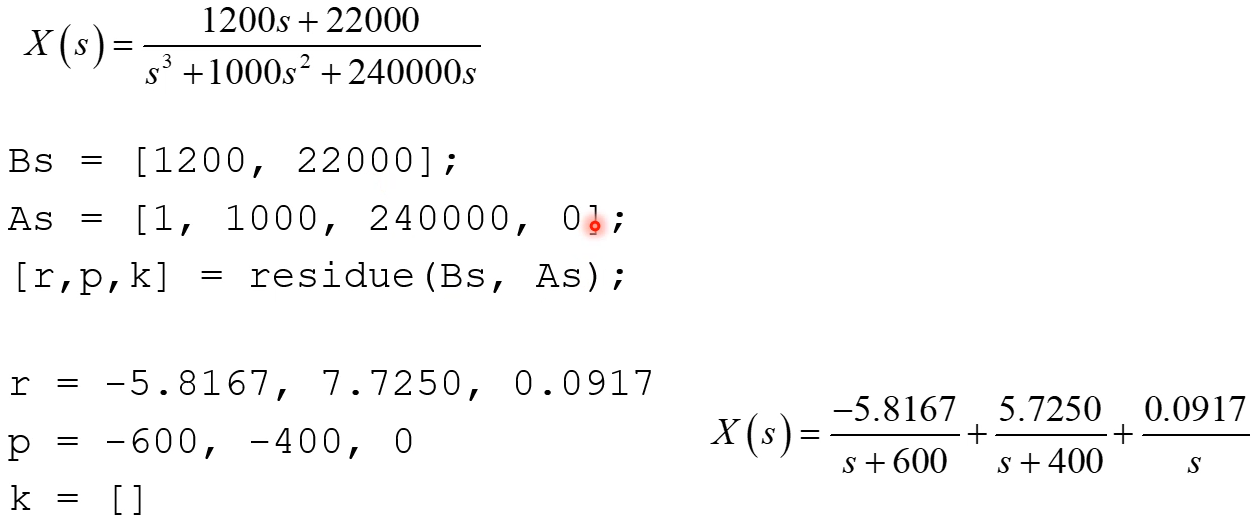
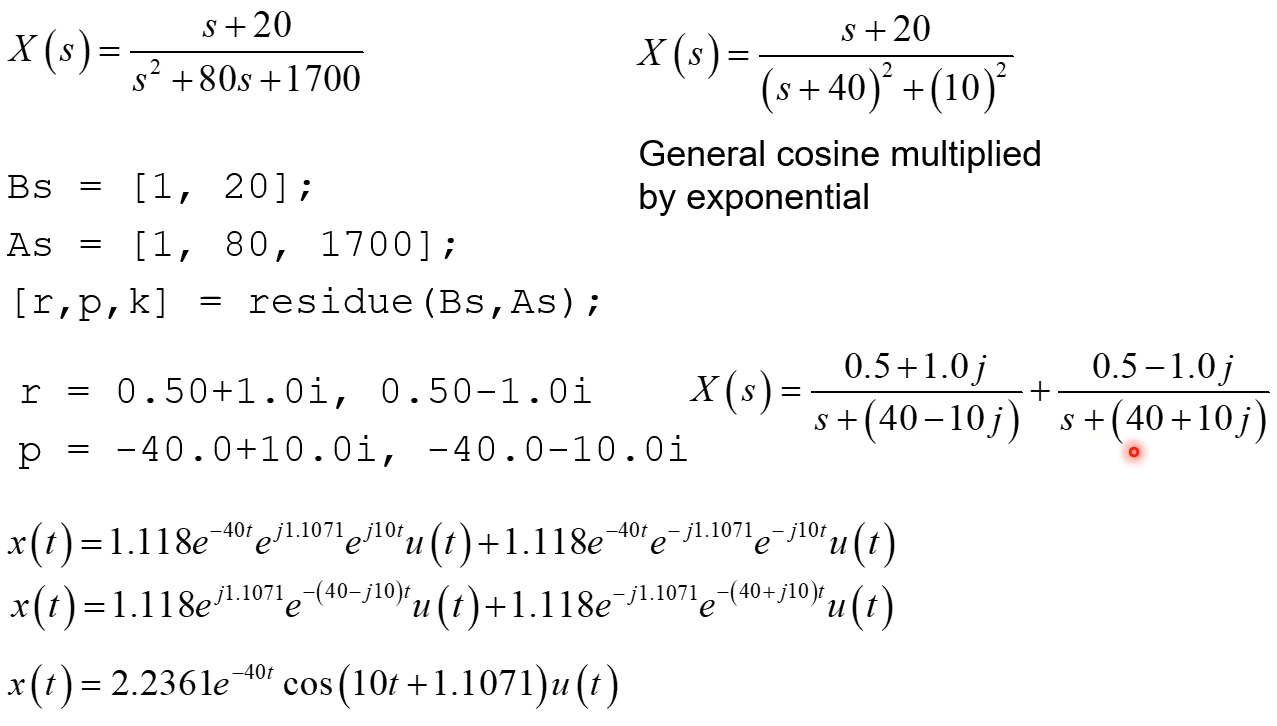
Complex Pole Pair
Shortcuts
- Commonly-encountered functions that are not directly shown in the table
Laplace Transform
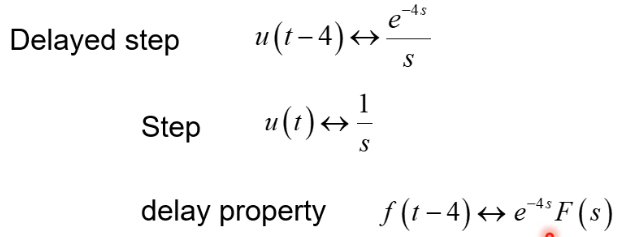
Delayed Step
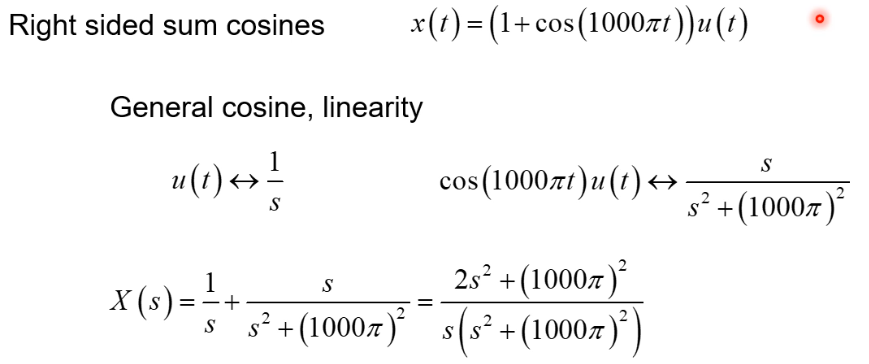
Right-sided Sum of Sines
- Distribute $u(t)$ and evaluate each sine independently as a general sine
- The example shown below is pretty poor since it has a constant for the first term instead of a sinusoid
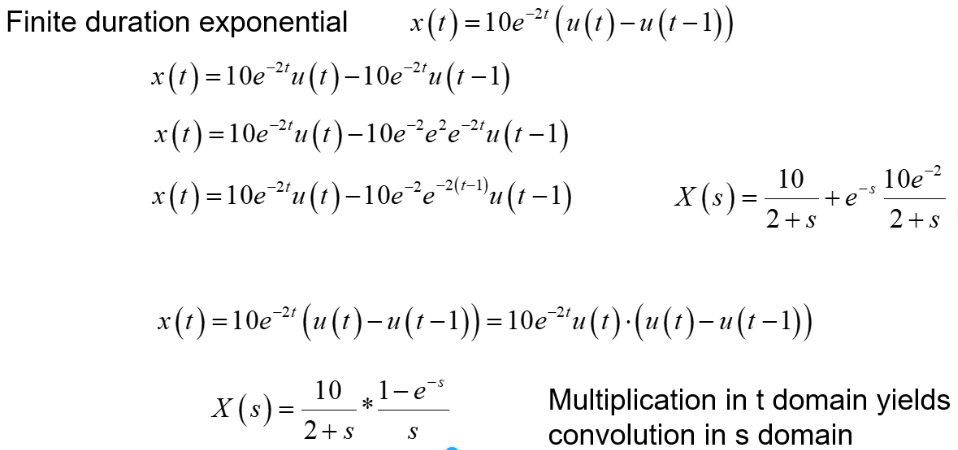
Finite Duration Exponential
- Two methods: algebraic manipulation and use the table, or convolution in the $s$-domain (harder)
Inverse Laplace Transform
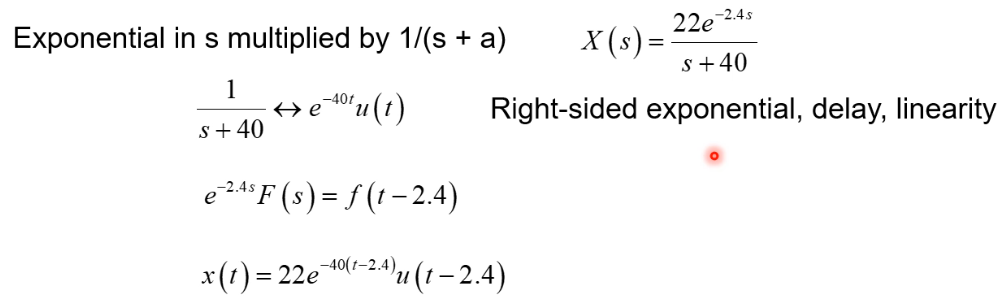
Exponential with Linear Term in Denominator $\left(\frac{1}{s+a}\right)$
References
- Laplace transform (course handout)
Sources
- Laplace transform
- Laplace transform table (course handout)