Notes › ENGR 2341: Signals and Systems Lecture 17
Discrete Fourier Transform and Fast Fourier Transform
363 words 2 min Modified
Table of Contents
DFT
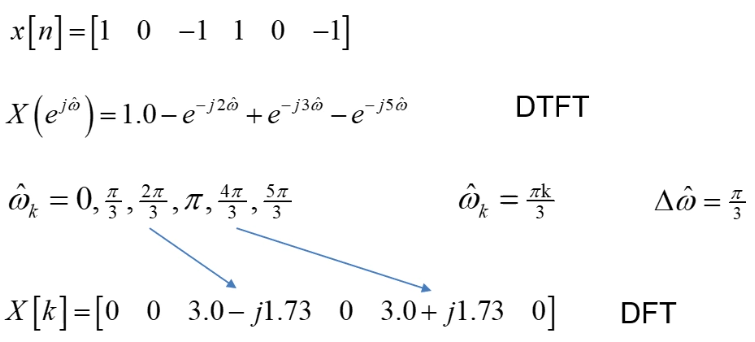
- Takes $x[n]$ and returns the corresponding $X[k]$, where $X[k]$ is the discrete spectrum with complex amplitudes corresponding to the discrete frequencies
- Numerical method for computing DTFT over a finite number of samples
- Frequency resolution ($\Delta \hat{\omega} = \frac{2\pi}{N}$) is proportional to $N$
- First half are the complex amplitudes for $\hat{\omega_{k}} \gt 0$ and the second half are the complex amplitudes for $\hat{\omega_{k}} \lt 0$
Inverse DFT
Inverse DFT:
$$x[n] = \frac{1}{N}\sum_{k=0}^{N-1}X[k]e^{j(2 \pi k / N)n}, n \in [0, N-1]$$Computing using DFT:
$$x[n] = \frac{1}{N}\left(\sum_{k=0}^{N-1}X^*[k]e^{-j(2 \pi k / N)n}\right)^*, n \in [0, N-1]$$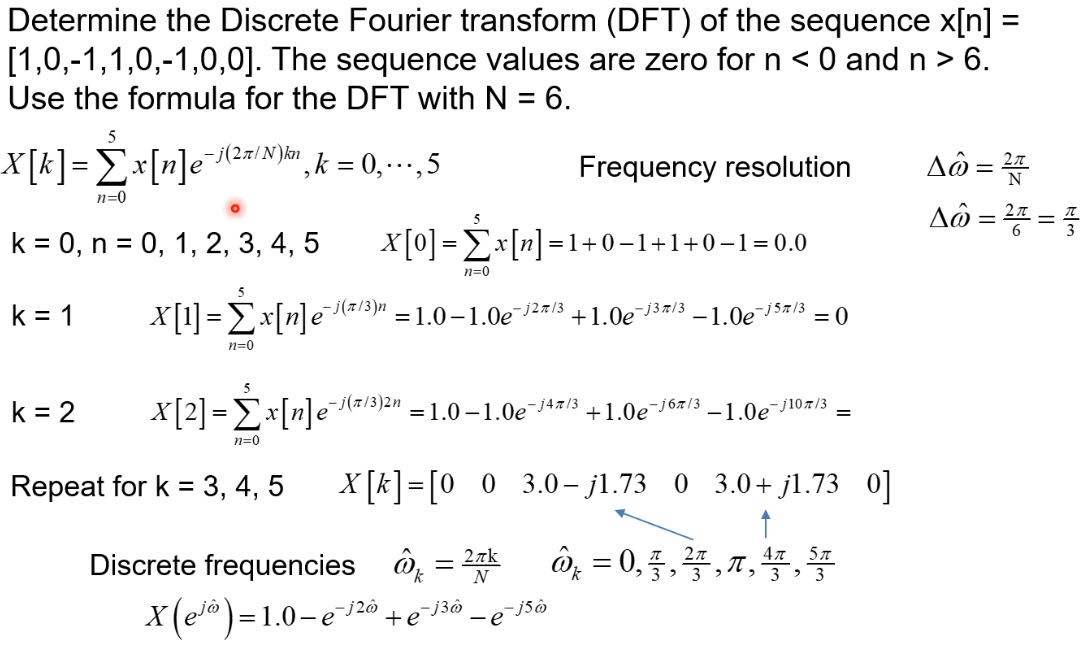
FFT
- Faster way to compute DFT
- Cooley-Turkey algorithm breaks an N-point DFT into smaller DFTs
- DFT requires $N^2$ complex multiplications and $N^2 - N$ complex additions to compute $X[k]$ for $x[n]$
- FFT requires $N\log_2(N) - N$ complex multiplications and $N\log_2(N)$ complex additions additions to compute $X[k]$ assuming $N$ is an integer power of 2
MATLAB FFT
- Use
fftfunction will pad the signal with zeros or truncate the signal to match the number of points $N$ - The result is interpreted as follows:
- The frequency resolution is $2\pi / N$
- $X[k]$ is complex amplitude for $\hat{\omega}$
- The amplitudes are scaled by $1 / N$ to match the two-sided spectrum
Frequency Resolution for FFT
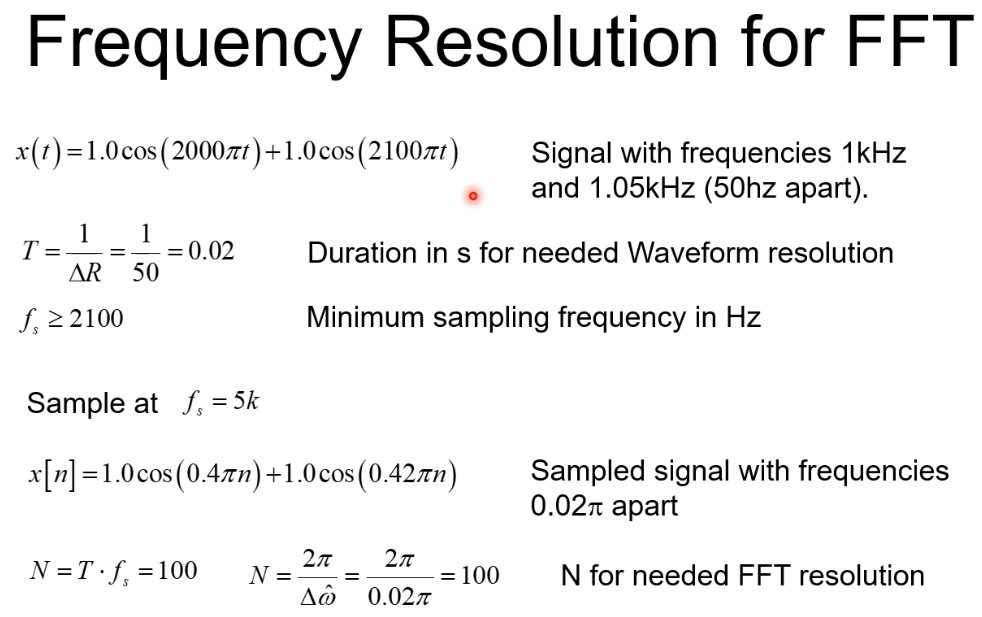
- The waveform resolution of continuous-time frequencies is $\Delta R = 1 / T$ where T is the duration of the captured signal without padding
- The FFT resolution in terms of continuous-time frequency is $\Delta R = f_s / N$
- When choosing FFT size:
- The waveform resolution needs to be smaller than the minimum distance between two frequencies
- FFT resolution should be at least the waveform resolution
- The frequencies of interest should not be split among several FFT points
- Zero padding can be used to make the signal length a power of 2 for better computation
Uses of FFT
- Spectrum of discrete-time signals
- Frequency response of discrete-time signals
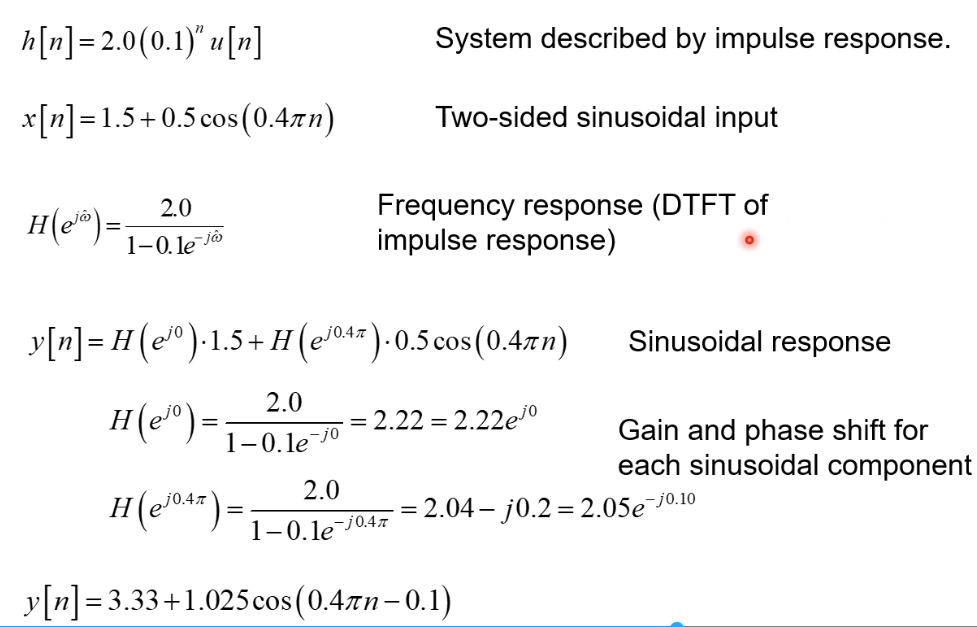
- System response
Sinusoidal System Response
References
- Dft and fft (course handout)
- When to use DTFT vs DFT?
- Discrete Fourier transform
Sources
- Dft and fft