Notes › ENGR 2341: Signals and Systems Lecture 2
Discrete Time Signals
146 words 1 min Modified
Table of Contents
- Discrete-time signals have an independent variable (typically represented with $n$) that only takes integers
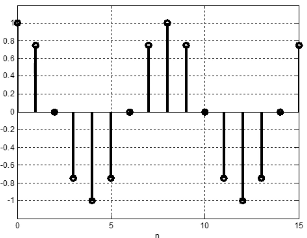
- Digital signals are a type of discrete-time signal that accepts values from a finite set.
- This occurs by sampling continuous-time signals
- Digital and discrete-time can be used interchangeably
- Digital and discrete-time signals can be represented by:
- Formula: $x[n] = 0.5e^{0.1n}(u[n]-u[n-3])$
- Weighted sum of discrete-time impulses: $x[n] = 0.5\delta[n]+0.553\delta[n-1]+0.611\delta[n-2]$
- Is 1 for $n=0$ or at $n=d$ for $\delta[n-d]$ (timeshifted)
- Number sequence: $x[n]=(0.5, 0.553,0.611,0,\dots)$
Example
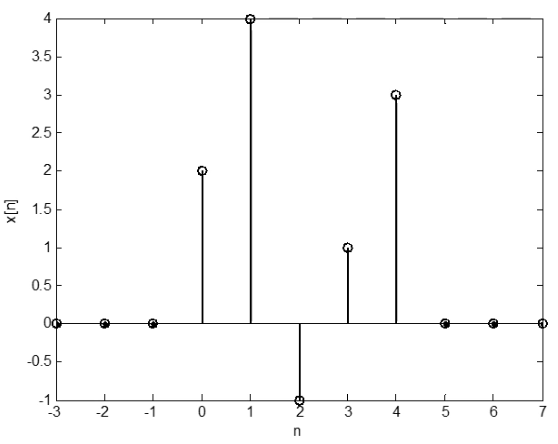
- Weighted sum form: $x[n] = 2\delta[n]+4\delta[n-1]-\delta[n-2]+\delta[n-3]+3\delta[n-4]$
- Sequence form: $x[n] = (2, 4, -1, 1, 3, 0, \dots)$
Sampling
- A continuous-time signal can be converted into digital signals by periodically sampling its values at regular intervals, quantizing them
- $x[n] = x(t) \vert_{t=nT_s} = x(nT_s) = x(n / f_s)$
- The sample rate should be at least twice the highest frequency component in the signal (Shannon/Nyquist rate)
References
- Discrete-time signals (course handout)
Sources
- Discrete-time signals