Notes › ENGR 2341: Signals and Systems Lecture 1
Continuous Time Signals
546 words 4 min Modified
Table of Contents
- Physical signals are analog
- Examples include: impulses, steps, exponentials, ramps, sinusoids, and combinations of them
Impulse Signals
-
Non-zero signals concentrated around a specific moment in time
-
Has an area of 1
-
Not a function, but can be approximated with the
Dirac Delta Function
A limiting case of a rectangular pulse function, $\delta_{\Delta}(t)$, as the width $\Delta \rightarrow 0$.
Rectangular Pulse Function
- For $-\Delta \le t \le \Delta$, the rectangular pulse has a value of $\frac{1}{2\Delta}$
- Outside this range, the function is 0
Normalization Property
- Regardless of the choice of $\Delta$, the area of $\delta_{\Delta} = 1$
- This ensures that the height of the pulse increases proportionally as the width becomes narrower
Dirac Delta as a Limit
- $\delta(t)$ is defined as the limit of this rectangular pulse as $\Delta \rightarrow 0$
Sampling Property
- A function multiplied by an impulse scales the function by its value at the time of the impulse
- $f(t)\delta(t-t_{0}) = f(t_{0})\delta(t-t_{0})$
- Basically, you’re getting the value of $f(t)$ specifically only at $t_0$, and 0 everywhere else
Example of Impulse Sampling
Simplify this as much as possible: $x_{2}(t) = e^{-(t-5)}u(t-5)\delta(t-10)$
$$ \begin{align} x_{2}(t) &= e^{-(10-5)}u(10-5)\delta(t-10) \\ &= e^{-5} \cdot 1 \cdot \delta(t-10) \\ &= e^{-5}\delta(t-10) \end{align} $$Step Signals
- Signals that are nonzero for $t \ge 0$
- Unit step signals have a height of 1
- Used to create one sided signals (usually right-sided)
- Discontinuous at $t = 0$ due to the piecewise nature of the function
$$
$$
Pulse Signals
- Pulses are only non-zero between $t_1$ and $t_2$
- Unit pulses have a height of 1
- Technically a difference of step signals
- Multiplying a function by a pulse gives us a finite duration signal
- This gives us a cosine wave with $f = 3 \pi$ rad/s and $A = 5$ for $t \in [0, 2]$
Continuity
- Signals are time-continuous if the value of the signal at a time $t$ is the same as the limit of the right and left sides
- Signals that are continuous for all time are called continuous signals
Time Shifts
- Signals can shift left/right in time with respect to $t = 0$.
- Leftward shifts: advance in time; rightward shifts: delay in time
Periodicity
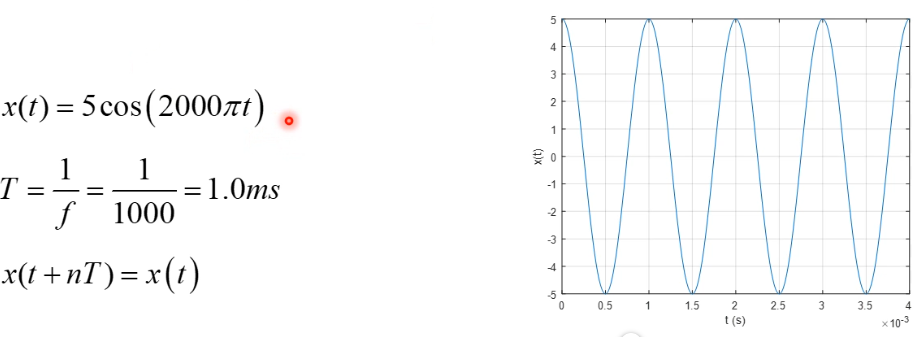
- A continuous-time signal $x(t)$ is periodic if $\exists \ T \ | \ x(t+T) = x(t) \ \forall \ t$
- The fundamental period $T_0$ is the smallest $T$ that satisfies periodicity
- $T_0 = \frac{1}{f}$, assuming $f$ is the frequency in rad/s
- The sinusoid has $A = 5, f = 2000$ rad/s, and phase shift of 0 rad
References
- Continuous-time signals (course handout)
- Sinusoidal signals (course handout)
Sources
- Continuous-time signals
- Sinusoidal signals