Notes › ENGR 2334: Electric Circuits I Lecture 5
Circuit Theorems
173 words 1 min Modified
Table of Contents
Source Transformations
- Actual circuits are not ideal, and the voltage decreases as you add more load
Examples
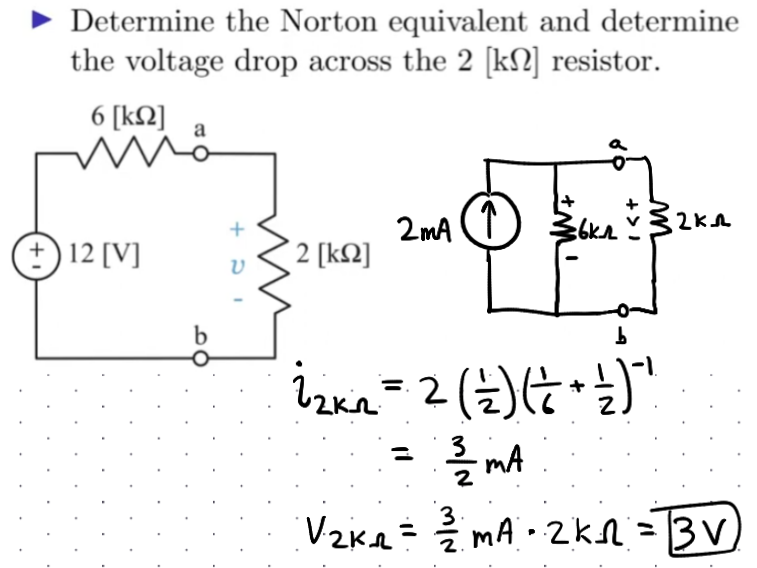
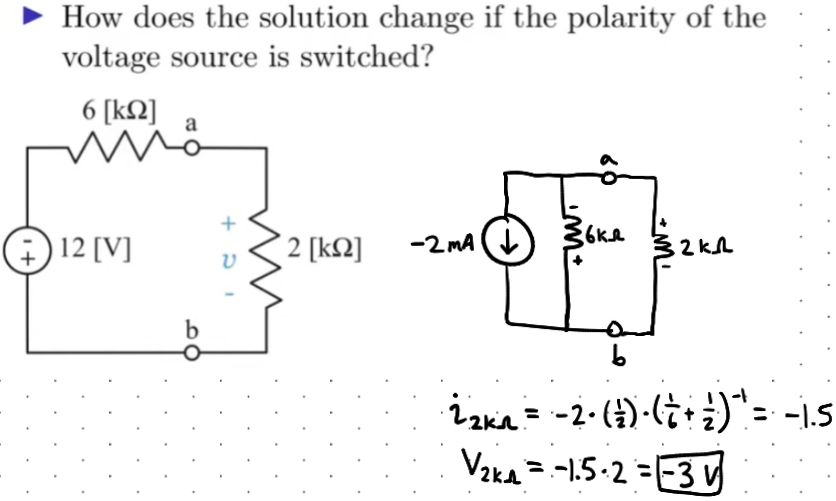
Superposition
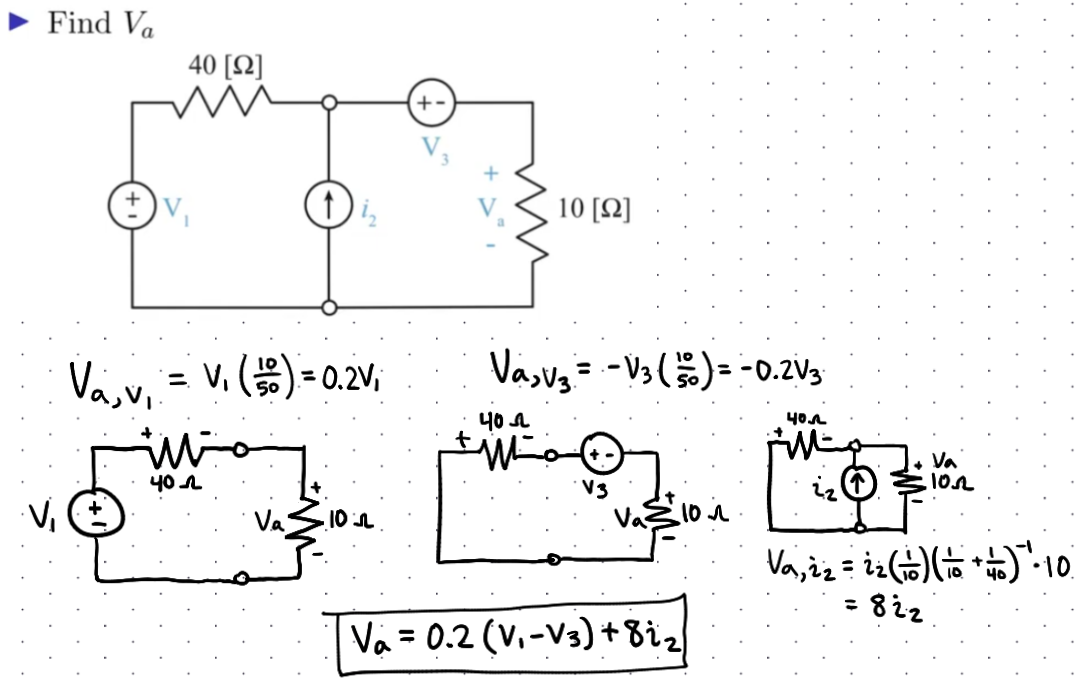
- The total response of a circuit is the sum of the responses of each independent source
- This can be done by shorting each voltage source or creating an open circuit for each current source
Examples
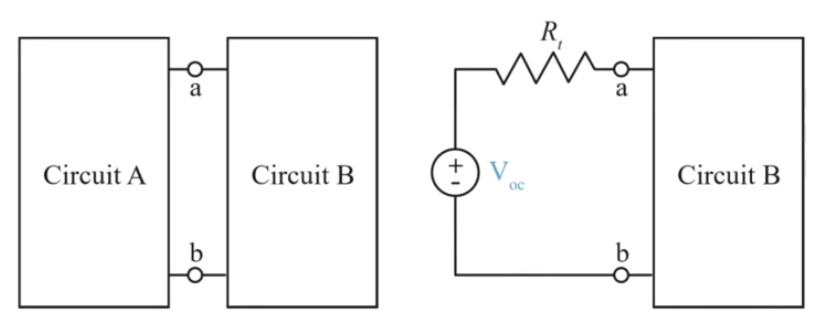
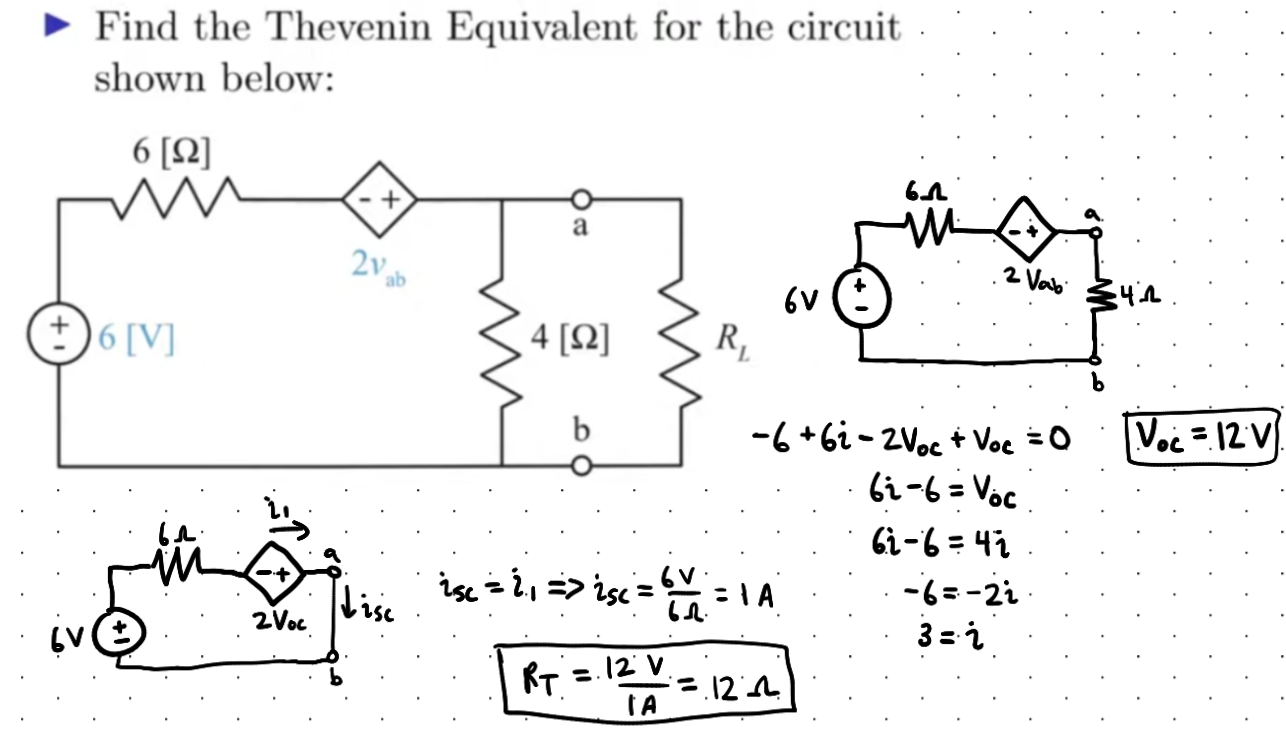
Thevenin’s Theorem
- Any part of a circuit can be represented as a Thevenin Equivalent
- If there is a dependent source, must find the equivalent voltage $V_{\text{oc}}$ using superposition/analysis
Examples
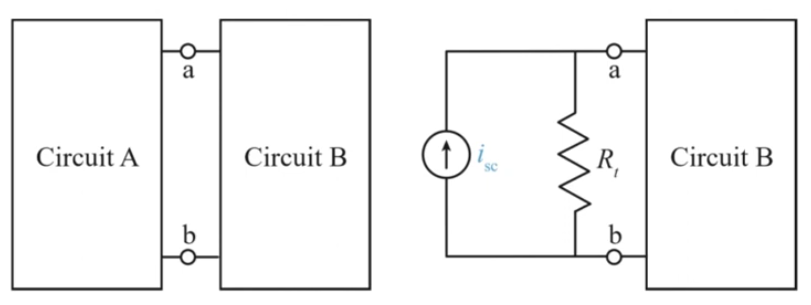
Norton’s Theorem
- Any part of a circuit can be represented as a Norton Equivalent
- If there is a dependent source, must find the equivalent current $i_{\text{sc}}$ using superposition/analysis
Examples
Maximum Power Transfer Theorem
- Answers one of two questions:
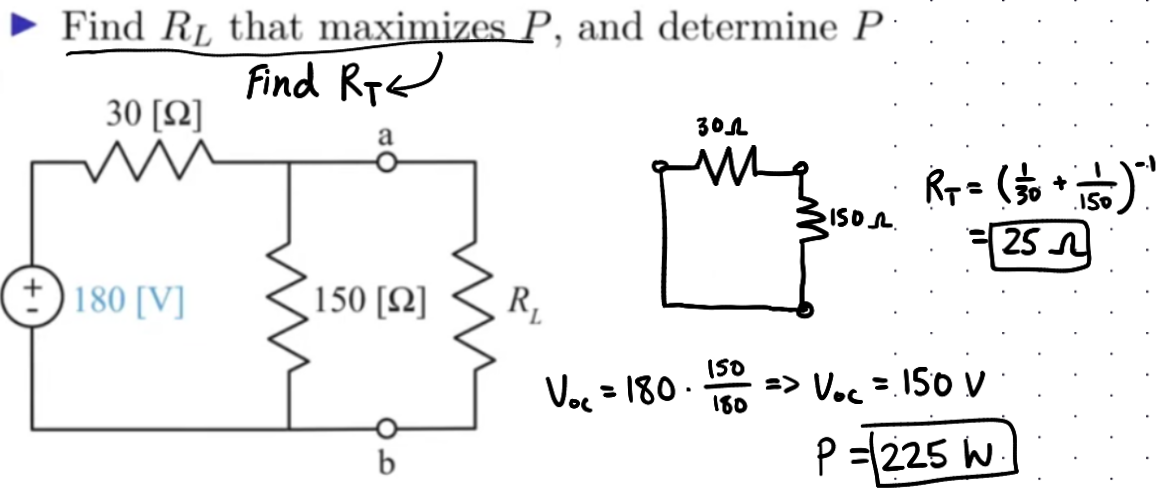
- Choose an $R_L$ to maximize $P$
- Choose a circuit to provide max $P$ given $R_L$
- Expression for power
- Taking the derivative of $P$ wrt $R_L$, we obtain that the max power is achieved when $R_T = R_L$
Examples
References
- Course slides, chapter 5: Circuit Theorems
Sources
- Course slides, chapter 5: Circuit Theorems