Notes › ENGR 2334: Electric Circuits I Lecture 2
Circuit Elements
592 words 4 min Modified
Table of Contents
Types of Circuit Elements
Passive Elements
- Dissipate power from the circuit and obey passive sign convention
- Types:
- Resistors (R)
- Inductors (L)
- Capacitors (C)
- Diodes
Active Elements
- Supply power to the circuit and obey active sign convention
- Types:
- Voltage sources
- Current sources
- Controlled sources
- Op-amps
Properties of Linear Elements
- Superposition: Output is the sum of individual inputs
- Homogeneity/Scaling: If input is scaled, output scales proportionally
- Combining both properties:
Ohm’s Law
- The potential difference across a resistor is proportional to the current, with a constant of proportionality (slope) being resistance
- $V$ is dependent upon the direction of $i$
Resistors and Resistance
Resistance
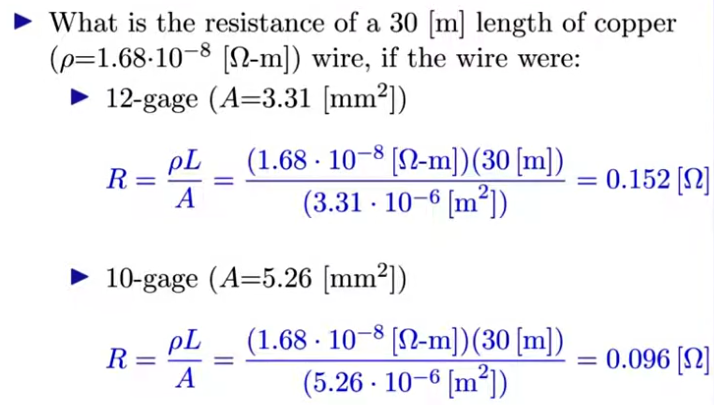
- The physical property of an element or device that impedes current flow
Example
Linear Resistors
- Since resistors are linear, $V$ will be a function of $i$ and $R$ will be independent of both $V$ and $i$
- When two currents $i_1$ and $i_2$ flow through a resistor with resistance $R$ with corresponding voltages $V_1 = i_1R$ and $V_2 = i_2R$, the total voltage would be:
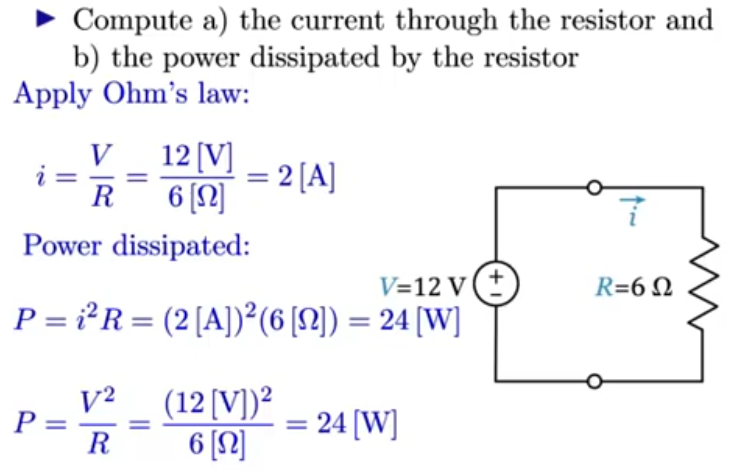
Power Dissipated by a Resistor
- Substituting Ohm’s Law into the power equation:
- Also expressed as:
Independent Sources
- Independent sources are ideal
- This means they supply a voltage/current regardless of the current drawn or the potential difference across that source
- In the real world, this is not the case, however
Voltage Source
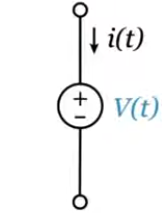
- Supplies a potential $V(t)$
- The resulting current is a result of the remainder of the circuit
- We usually draw voltage sources to obey the active sign convention, even though the image below obeys passive sign convention
Current Source
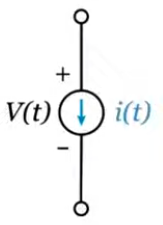
- Supplies a current $i(t)$
- The resulting voltage is a result of the remainder of the circuit
- In the real world, this is accomplished by adjusting the voltage to provide the desired current
- We usually draw current sources to obey the active sign convention, even though the image below obeys passive sign convention
Measuring Devices
- Measures current or voltage when models can’t be established
- Red lead goes to (+) terminal, black lead to (-)
- Otherwise, device will read negative values
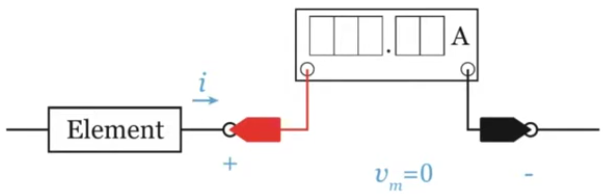
Ammeter
- Measures current in A
- Wired in series
- Assume resistance is zero
- This creates a short circuit; current flows through the device but no potential difference exists
Voltmeter
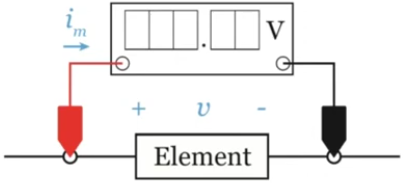
- Measures potential difference in V
- Wired in parallel
- Assume resistance is infinite
- This creates an open circuit; no current exists but there is still a potential difference
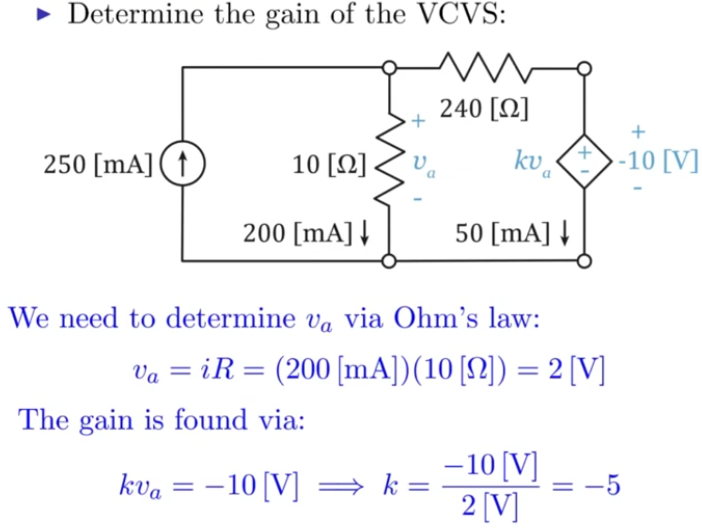
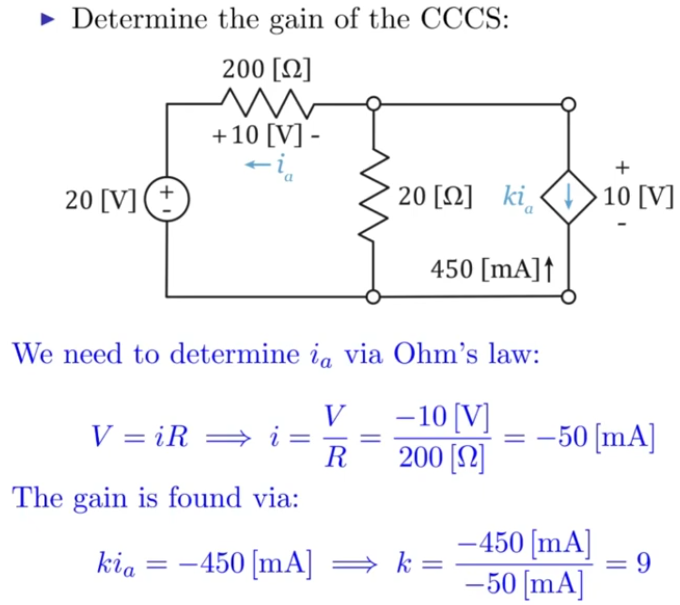
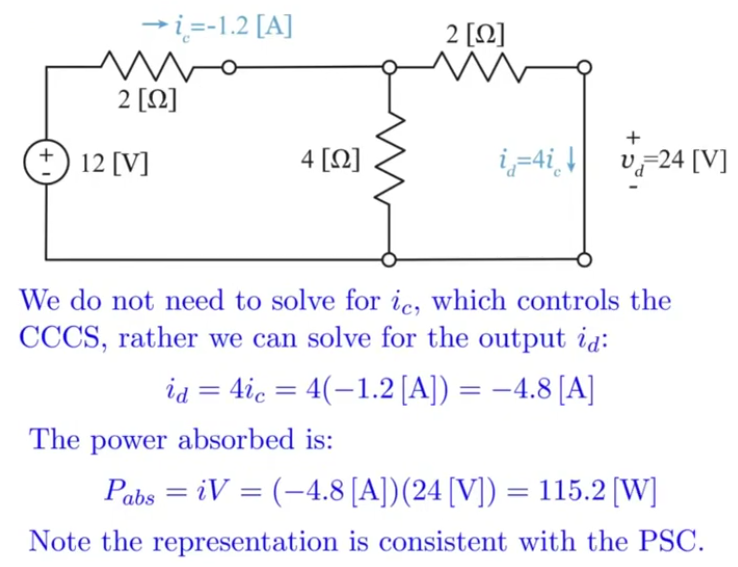
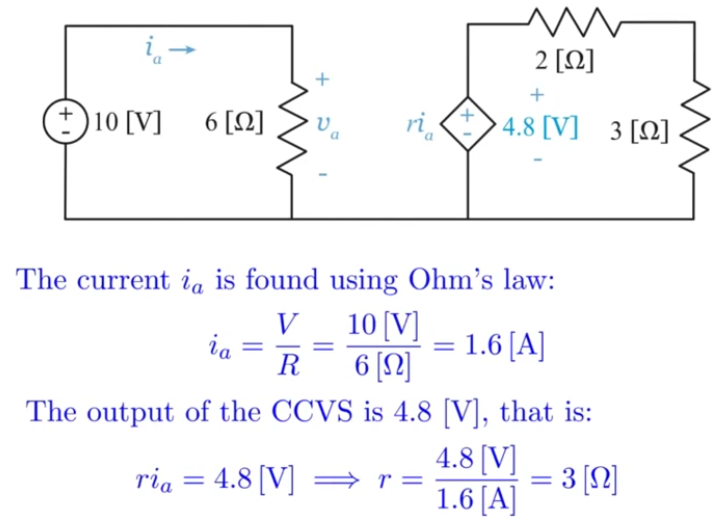
Dependent Sources
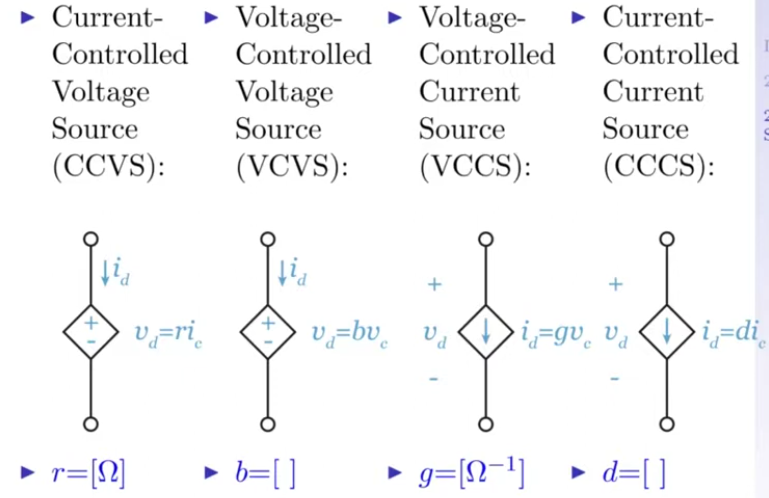
- Used to model transistors and amplifiers
- $b=g=d=r \equiv k$ is the gain of the system
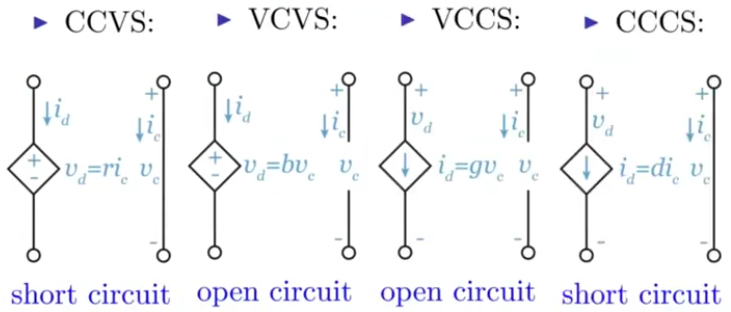
- Current-controlled sources are short circuits
- This is because current sources don’t restrict current
- Voltage-controlled sources are open circuits
- This is because voltage sources shouldn’t have voltages when control is removed
Examples
Transducers
- Convert physical quantities to electrical signals
Types
- Potentiometer: Converts rotational position to resistance with $a = \frac{\theta}{360^\circ}$
- Two branches, one with $R = aR_p$ and the other with $R = (1-a)R_p$
- Temperature Sensor: Converts temperature to current, $i = kT$, where $k = 1 \frac{\mu A}{^\circ K}$
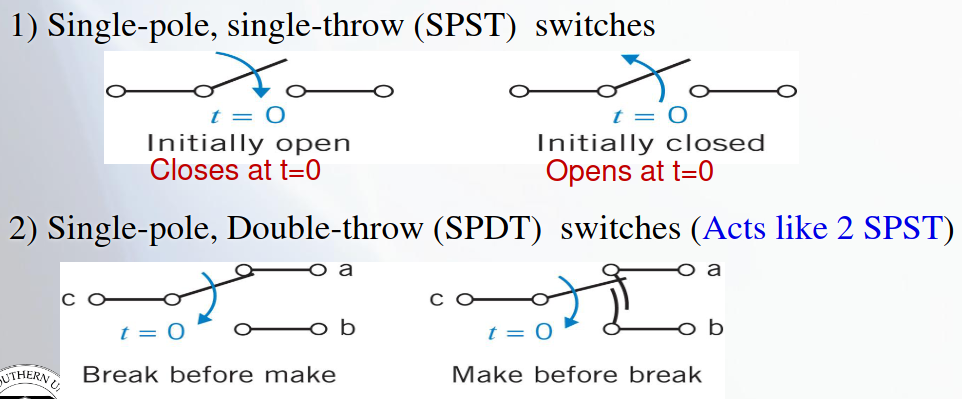
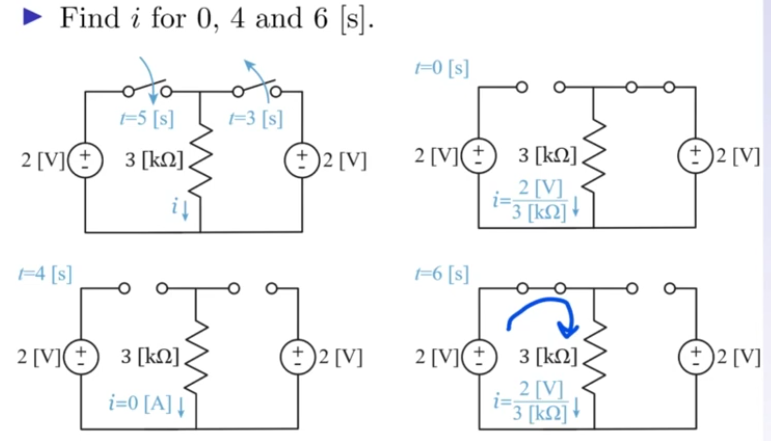
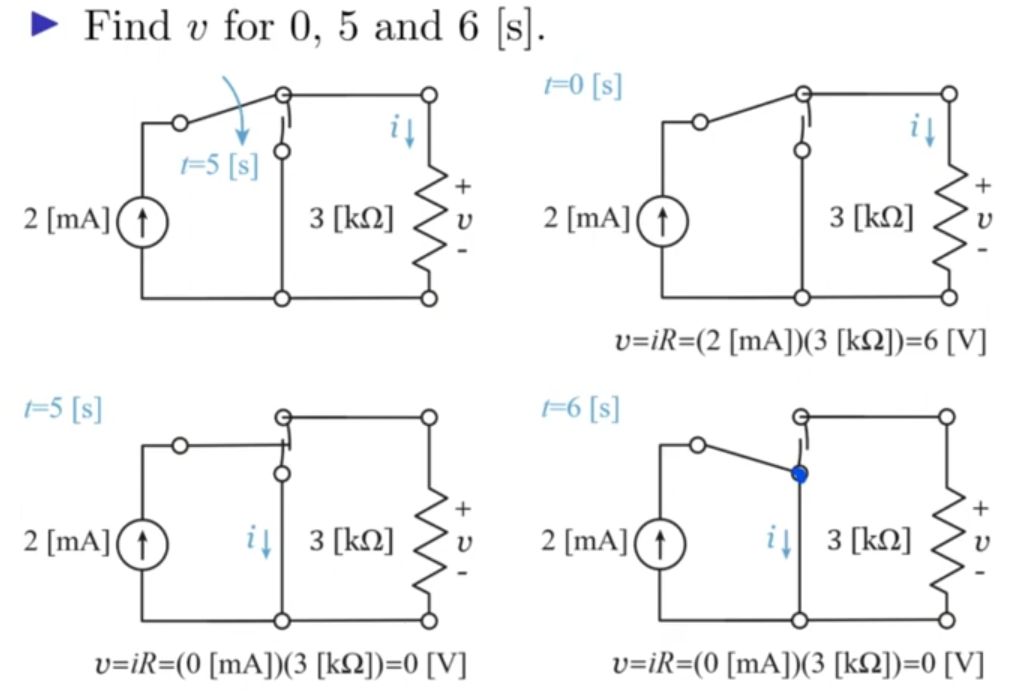
Switches
- Single-Pole Single-Throw is like a light switch and can be used to prevent momentary connection of old and new circuit paths (break before make)
- Single-Pole Double-Throw switches between two branches without ever seeing an open circuit (make before break)
Examples
References
- Course slides, chapter 2: Circuit Elements
Sources
- Course slides, chapter 2: Circuit Elements