Notes › Fundamentals of Electric Circuits (Sadiku) Lecture 1
Basic Concepts
849 words 7 min Modified
Table of Contents
What is Circuit Analysis?
An interconnection of electrical elements
- Analyzing circuits is important to understand:
- How does it respond to a given input?
- How do the interconnected elements and devices interact?
Charge and Current
An electrical property of the atomic particles of which matter consists, measured in coulombs (C)
- The fundamental charge $e$ is equal to -1.602e-19 C
- In 1 C of charge there are 1/(1.602e-19) = 6.24e18 electrons
- Charge is quantized and conserved
The time rate of change of charge, measures in amperes (A) = 1 C/s
$$i = \frac{\mathrm{d}q}{\mathrm{d}t}$$$$Q = \int_{t_{0}}^{t} i \, \mathrm{d}t$$- Current that never reverses direction is direct current (DC)
- Current that changes direction is alternating current (AC)
- By convention, we take current to flow in the direction of positive charges
(Example 1.1
[Alexander & Sadiku, Fundamentals of Electric Circuits, 7th ed., p. 34])
1In [1]: -1.602e-19*4.6e3
2Out[1]: -7.3692e-16(Practice Problem 1.1
[Alexander & Sadiku, Fundamentals of Electric Circuits, 7th ed., p. 34])
1In [2]: 1.602e-19*10e9
2Out[2]: 1.602e-09(Example 1.2
[Alexander & Sadiku, Fundamentals of Electric Circuits, 7th ed., p. 34])
1In [5]: diff(5*x*sin(4*pi*x))
2Out[5]: 20⋅π⋅x⋅cos(4⋅π⋅x) + 5⋅sin(4⋅π⋅x)
3In [18]: _.subs(x, 0.5)
4Out[18]: 10.0⋅π(Practice Problem 1.2
[Alexander & Sadiku, Fundamentals of Electric Circuits, 7th ed., p. 34])
1In [19]: diff(20-15*x-10*exp(-3*x)).subs(x, 1)
2Out[19]:-15 + 30*exp(-3)
3In [3]: N(_)
4Out[3]: -13.5063879489641(Example 1.3
[Alexander & Sadiku, Fundamentals of Electric Circuits, 7th ed., p. 34])
1In [4]: Q = Piecewise((8, (t<1)&(t>0)),(8*t**2, (t>1)))
2In [5]: integrate(Q, (t, 0, 2))
3Out[5]: 80/3
Voltage
- Moving a point charge requires work
- This work requires an external electromotive force (emf), typically a battery
- This emf is also known as voltage or potential difference
- The voltage $v_{ab}$ between two points $a$ and $b$ in a circuit is the work, in joules (J), needed to move a unit charge, in coulombs, from $b$ to $a$
- Measured in volts (V) = 1 J/C = 1 Nm/C
The energy required to move a unit charge from GND (-) to VCC (+), measured in volts (V).
- $v_{ab}$ can be interpreted in two ways:
- Point $a$ is at a potential $v_{ab}$ higher than point $b$ (the voltage drops from $a$ to $b$)
- The electric potential at point $a$ with respect to point $b$ is $v_{ab}$
- It follows that $v_{ab} = -v_{ba}$
Power and Energy
The time rate of expending/absorbing energy, measured in watts (W)
$$p = \frac{\mathrm{d}w}{\mathrm{d}t}$$- It follows that $p = \frac{\mathrm{d}w}{\mathrm{d}t} = \frac{\mathrm{d}w}{\mathrm{d}q} \frac{\mathrm{d}q}{\mathrm{d}t} = vi$
- If $p > 0$, power is delivered/absorbed by the element
- If $p < 0$, power is being delivered by the element
- The voltage polarity and current direction must conform to the passive sign convention to be positive
Satisfied when the current enters through the positive terminal of an element and $p = +vi$. If the current enters through the negative terminal, $p = -vi$.
- By the law of conservation of energy, the sum of power in a circuit must always be zero
The capacity to do work, measured in joules (J).
- The energy absorbed/supplied by an element from time $t_0$ to time $t$ is
- Power utility companies measure energy in watt-hours (Wh):
(Example 1.5
[Alexander & Sadiku, Fundamentals of Electric Circuits, 7th ed., p. 38])
 1In [6]: i_t = 5*cos(60*pi*t)
 2
 3In [7]: v1 = 3*i_t
 4
 5In [8]: v2 = 3*diff(i_t)
 6
 7In [9]: (i_t * v1).subs(t, 3e-3)
 8Out[9]: 75*cos(0.18*pi)**2
 9
10In [10]: N(_)
11Out[10]: 53.4667234336902
12
13In [11]: (i_t * v2).subs(t, 3e-3)
14Out[11]: -4500*pi*sin(0.18*pi)*cos(0.18*pi)
15
16In [12]: N(_)
17Out[12]: -6395.84554679224(Practice Problem 1.5
[Alexander & Sadiku, Fundamentals of Electric Circuits, 7th ed., p. 39])
 1In [6]: i_t = 5*cos(60*pi*t)
 2
 3In [13]: v1 = 6*i_t
 4
 5In [14]: v2 = 6 + 10 * integrate(i_t, (t, 0, t))
 6
 7In [15]: N((i_t * v1).subs(t, 5e-3))
 8Out[15]: 51.8237254218789
 9
10In [16]: N((i_t * v2).subs(t, 5e-3))
11Out[16]: 18.2642465093081(Practice Problem 1.6
[Alexander & Sadiku, Fundamentals of Electric Circuits, 7th ed., p. 40])
Answer is interpreted as 33.12 kilowatt-hours
1In [18]: p = 12 * 115
2
3In [19]: p * 24
4Out[19]: 33120
Circuit Elements
- Active elements generate energy, do not
- There are two kinds of voltage/current sources: independent and dependent sources
An active element that provides a specified voltage or current that is completely independent of other circuit elements.
- Ideal independent voltage source delivers whatever current is necessary to maintain its terminal voltage
- And vice versa for ideal independent current source
An active element in which the source quantity is controlled by another voltage or current.
(Practice Problem 1.7
[Alexander & Sadiku, Fundamentals of Electric Circuits, 7th ed., p. 42])
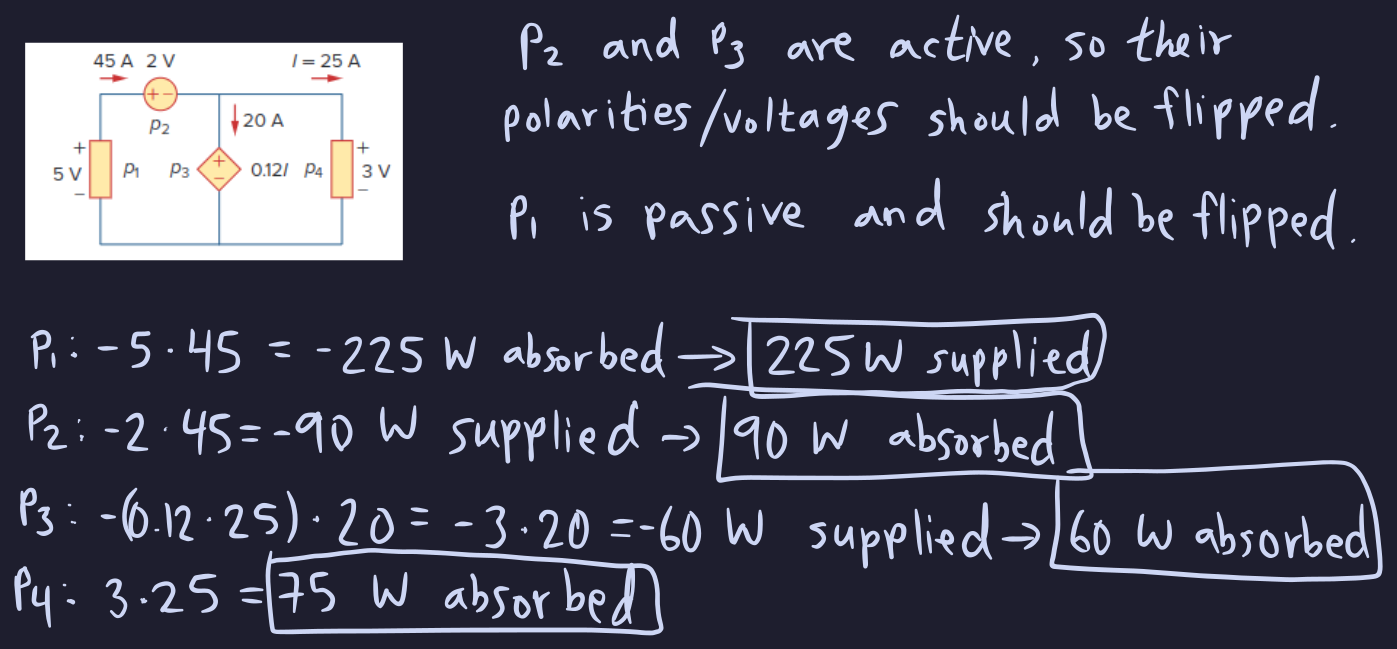
Sources
- Alexander & Sadiku, Fundamentals of Electric Circuits