Notes › EENG 3345: AC Circuit Analysis Lecture 2
Sinusoidal Signals and Phasor Representation
254 words 2 min Modified
Table of Contents
Time Domain vs. Phasor Domain
-
Time Domain Signal:
$$ v(t) = V_m \cos(\omega t + \phi) $$- Represents instantaneous voltage as a function of time.
- Harder to manipulate analytically for AC circuit analysis.
-
Phasor Domain:
$$ V = V_m e^{j\phi} \quad \text{or} \quad V = V_m (\cos(\phi) + j \sin(\phi)) $$- Represents a complex number encoding amplitude and phase.
- Omits time dependency (only valid for steady-state sinusoidal signals).
- Based on Euler’s formula: $$ e^{j\phi} = \cos(\phi) + j \sin(\phi) $$
- Shorthand notation is $V_m \angle \phi$
Conversion Between Phasor and Time Domain
-
From Phasor to Time Domain: Multiply phasor $V$ by $e^{j\omega t}$, then take the real part
$$ v(t) = \Re\{ V e^{j\omega t} \} = V_m \cos(\omega t + \phi) $$ -
From Time Domain to Phasor Domain: Drop the time-dependent $e^{j\omega t}$ and keep only the amplitude and phase
$$ v(t) = V_m \cos(\omega t + \phi) \quad \Rightarrow \quad V = V_m e^{j\phi} $$
Phasor Arithmetic
Let $V_1 = A e^{j\theta_1}$, $V_2 = B e^{j\theta_2}$:
-
Addition/Subtraction:
- Convert to rectangular form and add real/imaginary parts separately $$ V = V_{m1}(\cos\phi_1 + j\sin\phi_1) \pm V_{m2}(\cos\phi_2 + j\sin\phi_2) $$
-
Multiplication: Multiply magnitudes, add angles
$$ V_1 \cdot V_2 = AB e^{j(\theta_1 + \theta_2)} $$ -
Division: Divide magnitudes, subtract angles
$$ \frac{V_1}{V_2} = \frac{A}{B} e^{j(\theta_1 - \theta_2)} $$
Sinusoidal Steady State Analysis
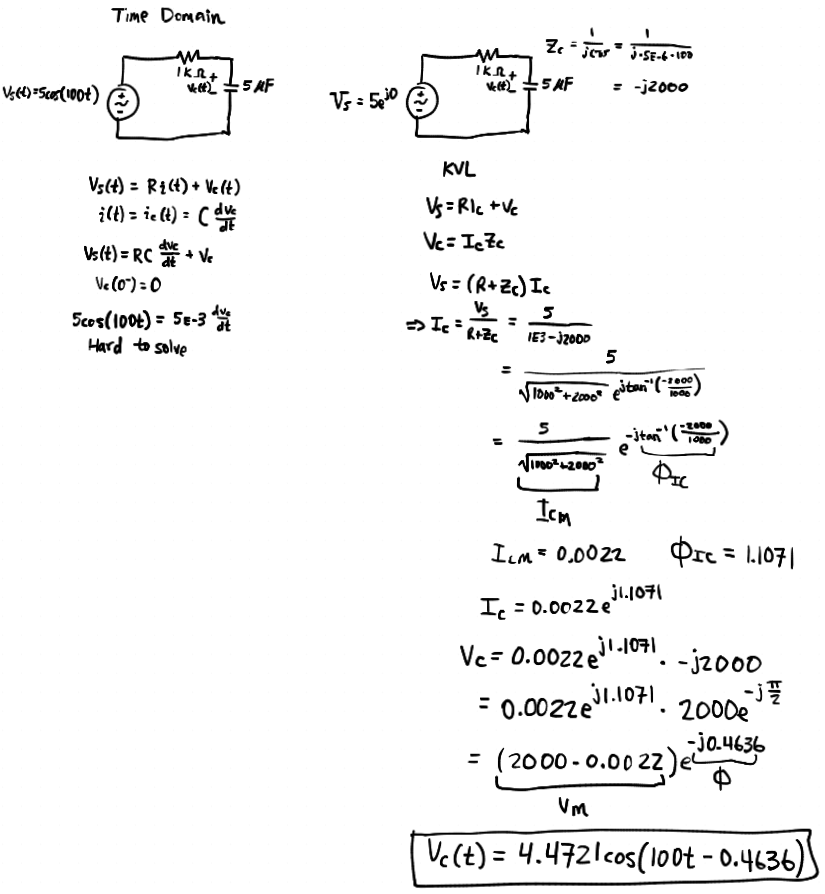
RC Circuit Example
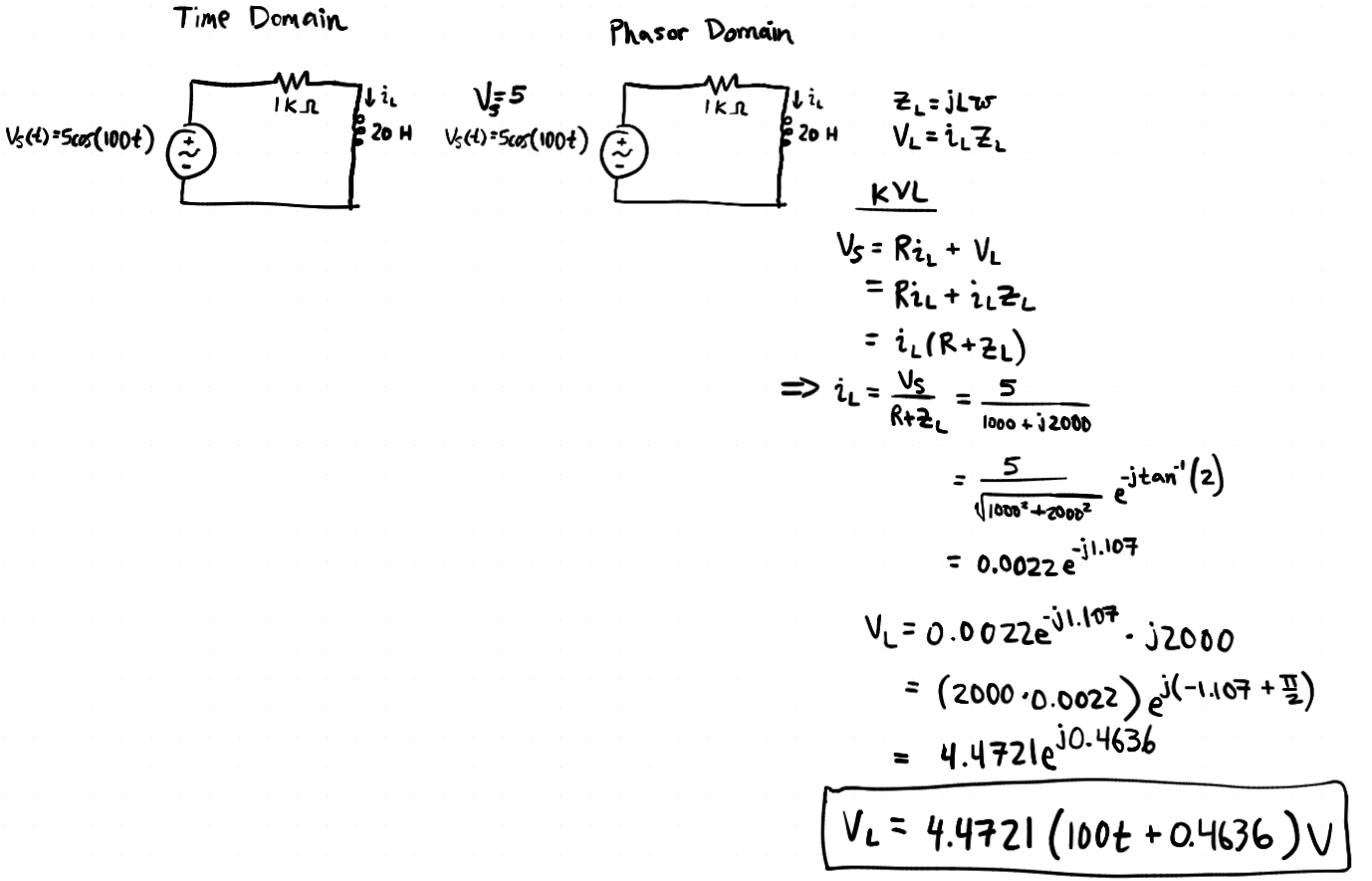
RL Circuit Example
- Should have $\cos$ at the end
Phasor Arithmetic with Multiple Frequencies
- Cannot be done, have to use Superposition instead
References
- Course handout 2: phasor and time domains
Sources
- Course handout 2: phasor and time domains