Notes › Fundamentals of Photonics (Saleh & Teich) Concept
Prism
145 words 1 min Modified
Table of Contents
Characterization
- Characterized by the apical angle $\alpha$, refractive index $n$, and incident angle $\theta_{i,1}$
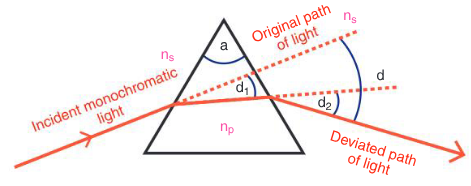
- Derived values: first refracted ray $\theta_{r,1}$, first angle of deviation $\theta_{d,1}$, second incident ray $\theta_{i,2}$, second refracted ray $\theta_{r,2}$, second angle of deviation $\theta_{d,2}$, and total deviation $\theta_{d}$
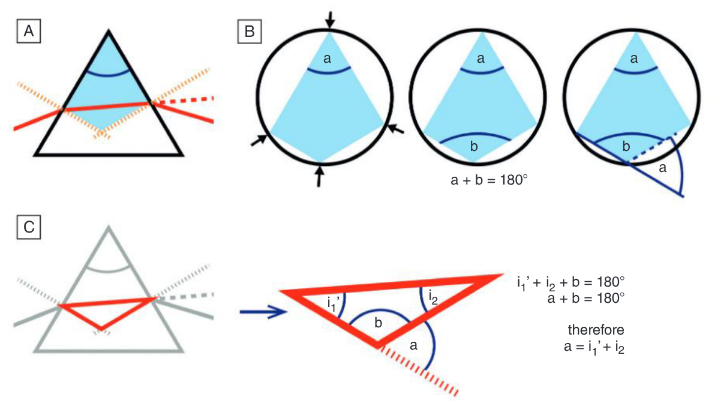
- Apex-interior relation (if you are solely working with first refracted/second incident rays—requires drawing normal lines): $\alpha = \theta_{r,1} + \theta_{i,2}$
- Calculated using
cyclic quadrilaterals
[Course handout, Introduction to Visual Optics: A Light Approach, p. 102] (more on them here [Course handout, Cyclic Quadrilaterals])
- Calculated using
- Total deviation relation (easier imo—extend the path light takes, and calculate each deviation angle individually, then sum): $\theta_{d} = \theta_{d,1} + \theta_{d,2}$
- Apex-interior relation (if you are solely working with first refracted/second incident rays—requires drawing normal lines): $\alpha = \theta_{r,1} + \theta_{i,2}$
Prism Equation
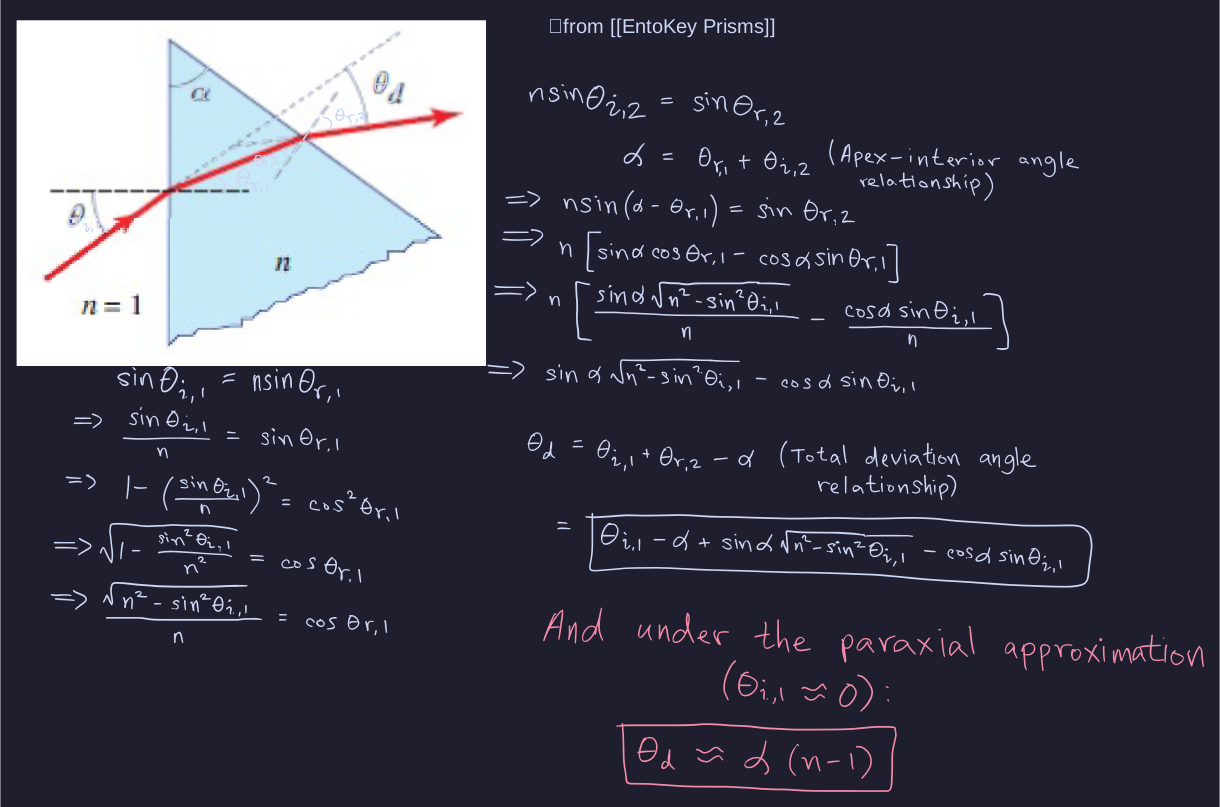
$$\begin{align} \theta_{d} &= \theta-\alpha + \sin^{-1}\left[ \sqrt{ n^2 \sin^2 \theta} \sin \alpha - \sin \theta \cos \alpha \right] \\ &\approx (n-1)\alpha \text{ (if $\theta \ll 1$)} \end{align}$$Derivation
[Saleh & Teich, Fundamentals of Photonics, p. 172]
Sources
- Course handout, Cyclic Quadrilaterals
- Course handout, Introduction to Visual Optics: A Light Approach
- Saleh & Teich, Fundamentals of Photonics