Notes › Operating System Concepts Essentials (Silberschatz) Lecture 6
CPU Scheduling
1355 words 8 min Modified
Table of Contents
Basic Concepts
- We want max CPU utilization when doing multiprogramming
- This is achieved via the CPU-I/O Burst Cycle: processes execute by alternating a cycle of CPU burst and I/O wait
- I/O wait is because peripheral devices have slower access time than the CPU
- The distribution of the CPU burst is important, since you don’t want the cores to be too spread out (there will be too much overhead)
CPU Scheduler
- Short-term scheduler: select from processes in ready queue and allocate CPU to one
- Queue is handled with several algorithms
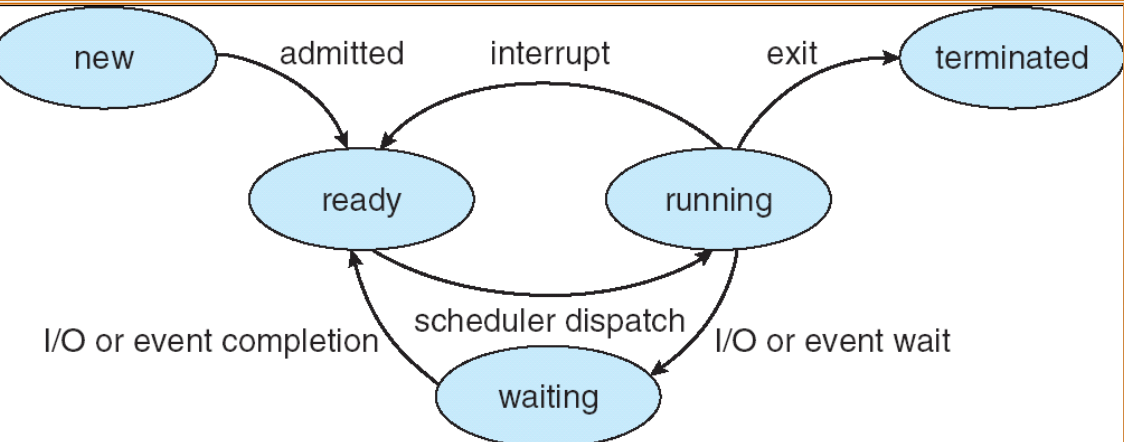
- CPU scheduling decisions can occur only when a process is switching states:
- Running -> Wait
- Running -> Ready
- Waiting -> Ready
- Running -> Terminated
- Circumstances 1 and 4 is nonpreemptive/cooperative, since the process decides when it gives up the CPU
- Circumstances 2 and 3 are preemptive, since the OS is forcibly taking away the CPU from the process
- A ready program must run before it can wait (it has to be dispatched by the scheduler first)
- A waiting program must become ready before it can run (it has to wait for I/O or event completion first)
- For $n$ states, you have $n(n-1)$ possible edges
Dispatcher
- Component of the scheduler that switches the CPU from one process to another
- Saves address space of process (suspend)
- Switch to user mode
- Jump to proper location in user program and resume that program
- Dispatch latency: time for dispatcher to stop a process and start another; this is pure overhead
- You don’t want to dispatch processes too often; too frequent means the overhead of switching is not doing any useful work from any user POV, and too infrequent will cause programs to hang (usually its a few ms)
Scheduling Criteria
- CPU utilization: % of time CPU is busy; keep the CPU as busy as possible
- Throughput: number of processes completing execution per time unit
- Turnaround time: time for a process to fully execute, from instantiation to termination
- Waiting time: time a process spends in ready queue (not to be confused with the waiting state)
- Total waiting time would be the sum of the I/O burst times
- The waiting time for a particular process would be the sum of the waiting times for all the processes before that one
- Response time: time from when a request is submitted until the first response is produced (new -> ready and in queue -> running)
- Includes the waiting time
- The period that the process actually spends waiting to run (from launch to run)
- The goal with CPU scheduling algorithms is to max cpu utilization/throughput and min turnaround time/waiting time/response time
Scheduling Algorithms
- A Gantt Chart is a diagram that puts processes in a block for their execution time
- Generally, we assume that all the processes arrive at time 0
- And all the process time blocks are contiguous in the Gantt chart, since we are assuming negligible context switching overhead
First-Come-First Served
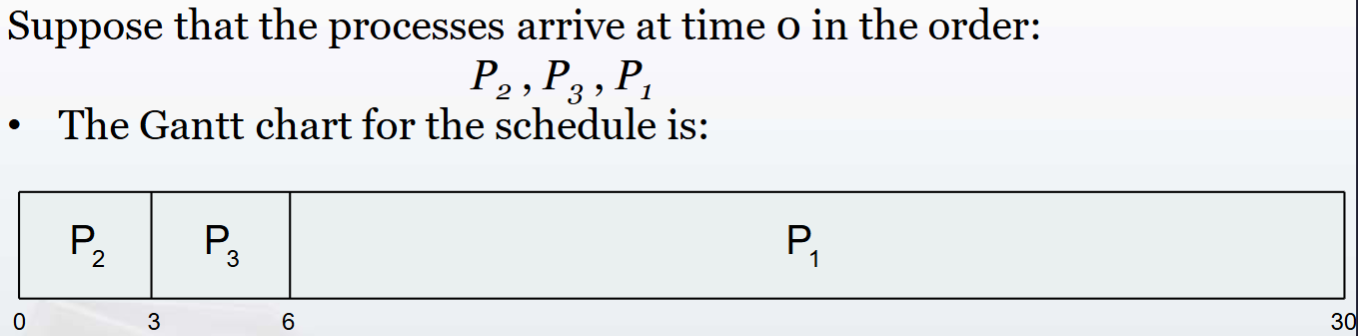
- Processes are scheduled in the order that they arrive
- When the shorter burst time processes go later than long burst process, the average waiting time is much higher due to the Convoy effect
- This is undesirable since you don’t want to schedule long process first
Shortest-Job-First
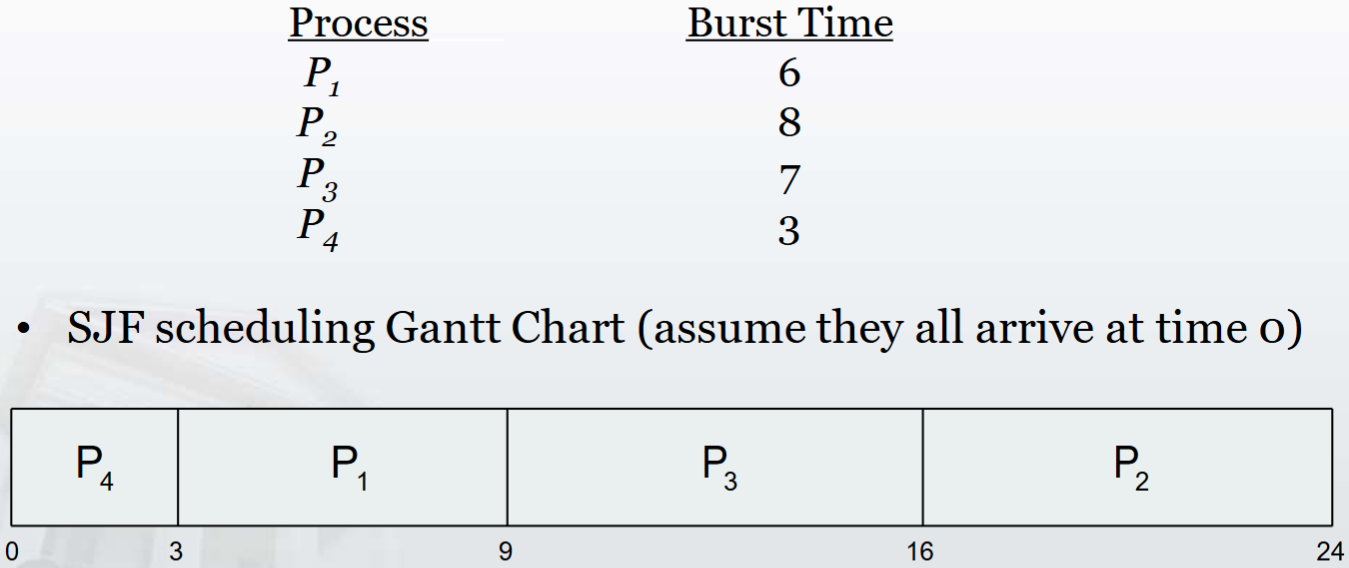
- Associate with each process the length of its next CPU burst, and schedule the process with the shortest CPU burst time first
- Optimal because is gives the minimum average waiting time for a given set of process
- Difficulty: how to know the length of next CPU burst?
- Maybe we can ask the user?
Shortest-Remaining-Time-First (Preemptive SJF)
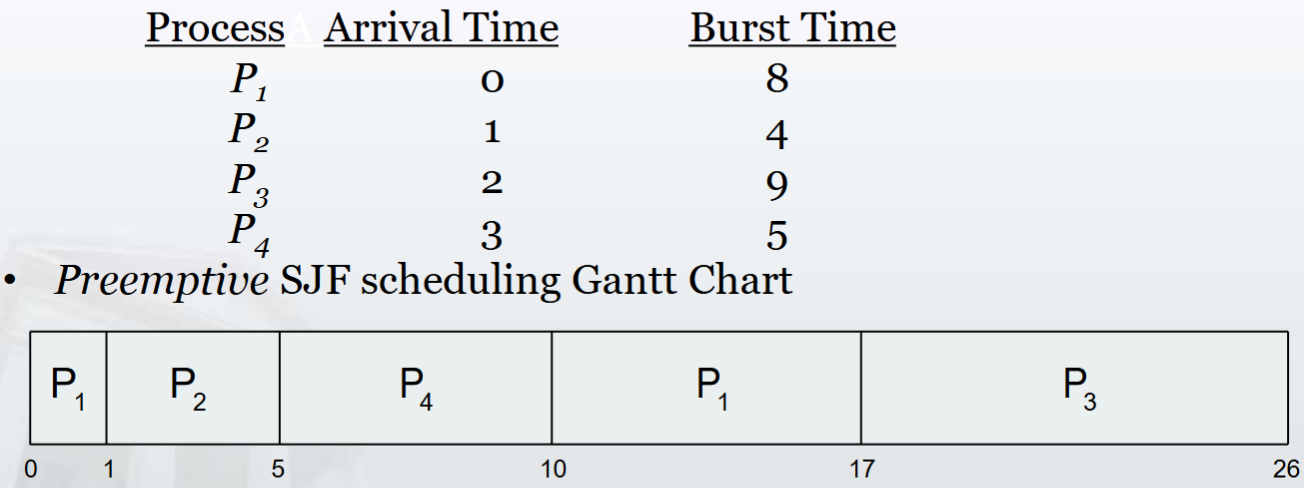
- Still finding the process with the shortest burst time, but now you have to account for processes that are not arriving at the same time
- Instead of comparing total burst time, we compute remaining burst time
- It’s called “Preemptive SJF” because you’re preemptively pausing and resuming the process via the kernel
- We assume the process’ creation time is equal to its arrival time
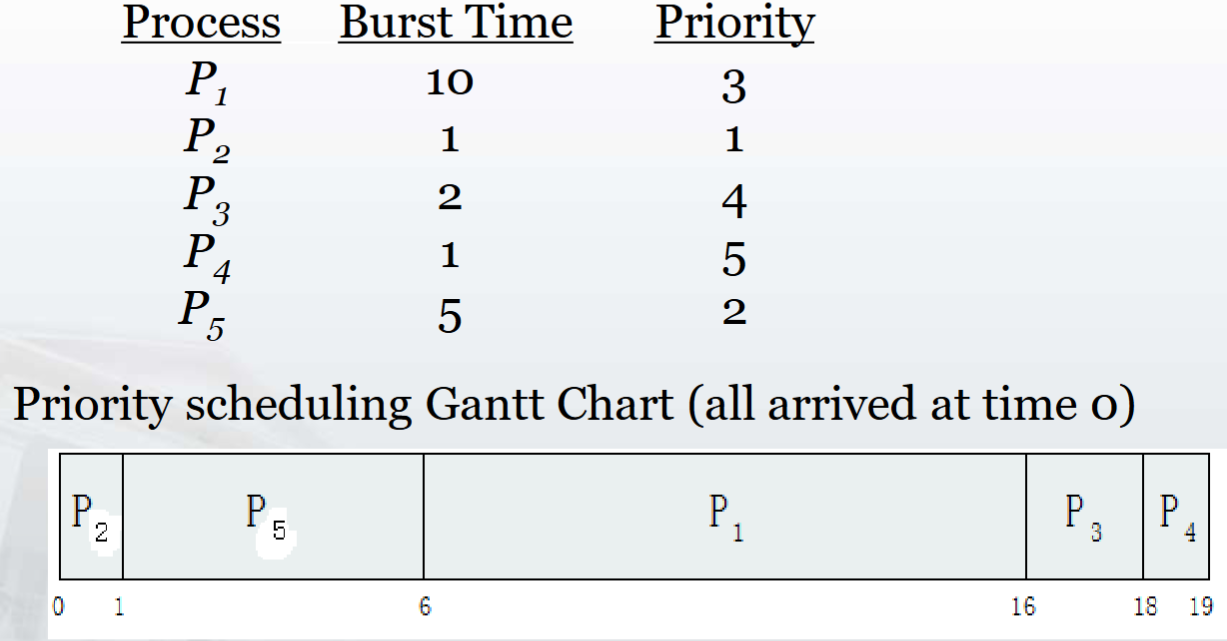
Priority Scheduling
- A priority number is associated with each process
- Smallest integer is highest priority
- The CPU is allocated to the process with the highest priority
- Preemptive approach: unfinished low priority processes may be preempted by newly arrived high priority processes
- Nonpreemptive: just let the process finish first
- Starvation problem: Low priotiy processes may never execute
- Solution: Process aging; increase the priority of waiting processes as time progresses
Round Robin
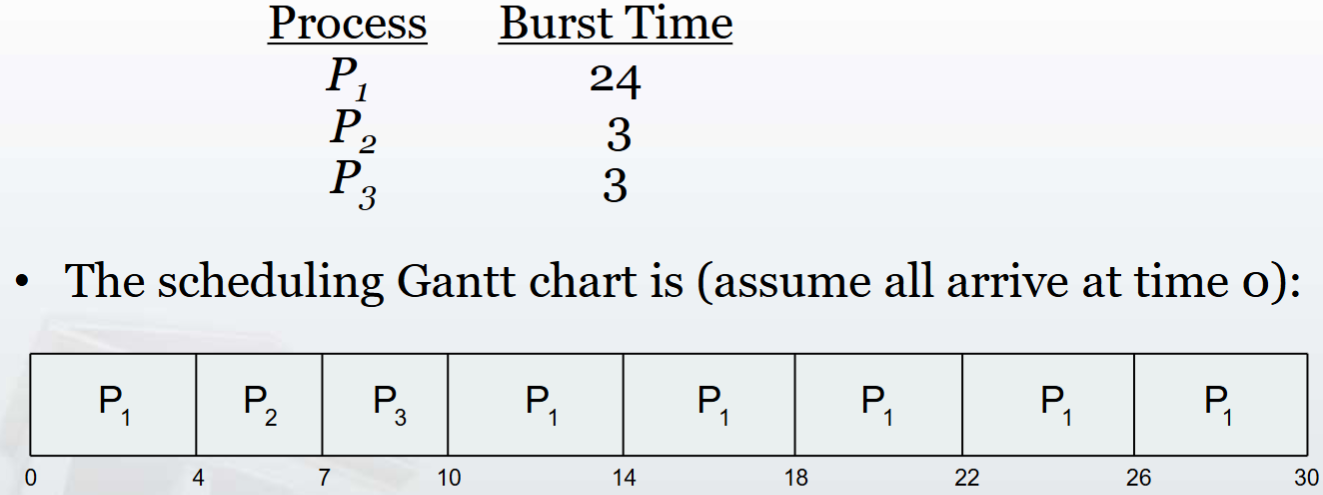
- The waiting time for each process is quantized by the fundamental unit, a quantum, which has a fixed time length
- Each process gets one quantum of time of CPU burst
- If the process has not finished execution within that time, it must wait $(n-1)q$ time units before it is scheduled again
- The timer will interrupt at the end of every quantum to schedule the next process
- Performance:
- $q$ very large: essentially becomes FCFS or FIFO
- $q$ very small: very inefficient, since the quantum time is small with regard to the context switch time
- The best heuristics keep $q$ small but not too small
- Typically higher turnaround time than SJF, but better response time overall
Time Formulas
- Notation: $A_i$ arrival time, $C_i$ completion time, $B_i$ burst time, $S_i$ start time, $n$ total number of processes
- All times can be read directly from the Gantt chart
Turnaround Time
- Time from process arrival to completion
- Per process: $TAT_i = C_i - A_i$
- If all processes arrive at $t = 0$, this simplifies to $TAT_i = C_i$
- Average turnaround time:
Waiting Time
- Total time spent in the ready queue (not running)
- Per process: $WT_i = TAT_i - B_i$
- If the zeroth process finishes execution in a single burst, it has a waiting time of zero
- This could apply to the other processes as well, but only if they begin execution at their arrival time
- Average waiting time:
Response Time
- Time from arrival until the process first gets the CPU
- Per process: $RT_i = S_i - A_i$
- For all processes arriving at $t = 0$, $RT_i = S_i$
- For nonpreemptive algorithms (such as FCFS, SJF, and Priority), the response time equals the waiting time, since the processes do not stop between execution once they have started
- Average response time:
Multilevel Queue
- Ready queue is split into separate queues, each with its own scheduling policy
- Foreground queue: interactive processes (use Round Robin)
- Background queue: batch processes (use FCFS)
- Each process is permanently assigned to one queue
- Scheduling between queues:
- Fixed priority scheduling: one queue always runs before the other (may cause starvation)
- Time slicing: each queue gets a portion of CPU time (e.g. 80% to foreground, 20% to background)
- Advantage: separates short, interactive tasks from long batch tasks for better responsiveness
- Disadvantage: inflexible; once assigned, a process cannot move to another queue
Multilevel Feedback Queue
- Processes can move between queues based on their behavior
- For example, a CPU-bound process moves to a lower-priority queue
- An I/O-bound or newly arriving process may move to a higher-priority queue
- Parameters of the scheduler:
- Number of queues
- Scheduling algorithm for each queue
- Rules for entering and moving between queues
- Upgrade policy: determines when to move a process to a higher queue
- Demotion policy: determines when to move a process to a lower queue
- Aging is implemented by moving long-waiting processes up the queues
- Used by general-purpose OS kernels to balance throughput and responsiveness
Multiple-Processor Scheduling
- Scheduling is more complex when multiple CPUs are available
- Asymmetric multiprocessing:
- One processor handles all scheduling and system data structures
- Simpler design but may cause a bottleneck
- Symmetric multiprocessing (SMP):
- Each processor is self-scheduling
- Either a common ready queue or a private queue per processor
- Most modern OS use SMP
- Processor affinity:
- Processes tend to run on the same CPU to maximize cache reuse
- Soft affinity: OS tries to keep process on the same CPU
- Hard affinity: process is bound to a specific CPU
- Processor sets allow grouping CPUs for load distribution
- Processes tend to run on the same CPU to maximize cache reuse
- Load balancing is necessary to avoid idle processors while others are overloaded
- SMP improves throughput but introduces synchronization and data consistency challenges
References
- Course slides: CPU Scheduling
- Practice 6 solutions
Sources
- Course slides: CPU Scheduling
- Practice 6 solutions
- Silberschatz, Galvin & Gagne, Operating System Concepts Essentials