Notes › MATH 4890: Fourier Analysis Concept
The Genesis of Fourier Analysis
1605 words 9 min Modified
Table of Contents
Simple Harmonic Motion
- Describes the behavior of basic oscillatory systems
- A mass that is displaced from its initial equilibrium position and released undergoes simple harmonic motion.
SHM Derivation
The restoring force of an ideal spring is $F_s = -ky(t)$. By Newton’s 2nd Law:
$$-ky(t) = my''(t)$$Since $c = \sqrt{\frac{k}{m}}$, the second order ODE becomes:
$$y''(t)+c^2y(t)=0$$with a general solution of:
$$y(t)=a\cos{ct} + b\sin{ct}$$If we are given initial position and velocity ($y(0)$ and $y'(0)$), the unique solution is given by:
$$y(t) = y(0)\cos{ct} + \frac{y'(0)}{c}\sin{ct}$$And there are constants $A > 0$ and $\gamma \in \mathbb{R}$ such that:
$$y(t) = a\cos{ct}+b\sin{ct} = A\cos({ct-\phi})$$where:
- $A = \sqrt{a^2 + b^2}$ and is the amplitude
- $c$ is the frequency
- $\phi$ is the phase
- $\frac{2\pi}{c}$ is the period
Waves
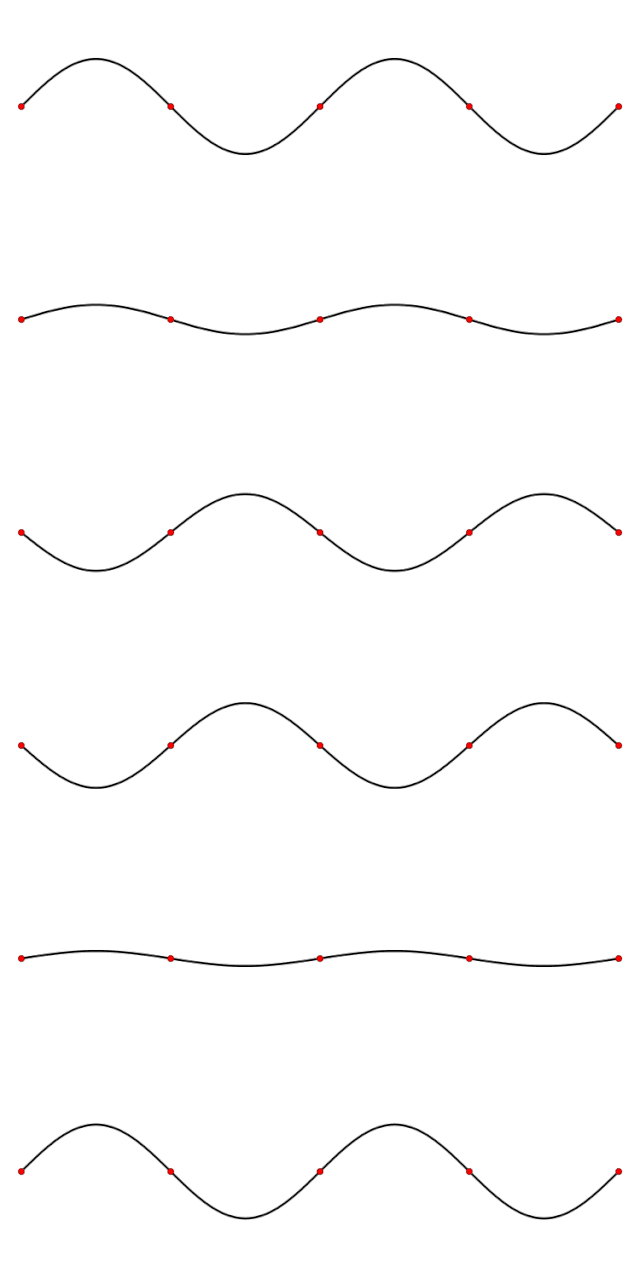
Standing Wave
- Oscillate up and down
- Described by $y=u(x, t)=\phi(x)\psi(t)$, where:
- $\phi(x)$ is the initial configuration of the wave
- $\psi(t)$ is the amplifying factor of the wave, dependent on $t$
- Suggests separation of variables, since it’s a product of two functions
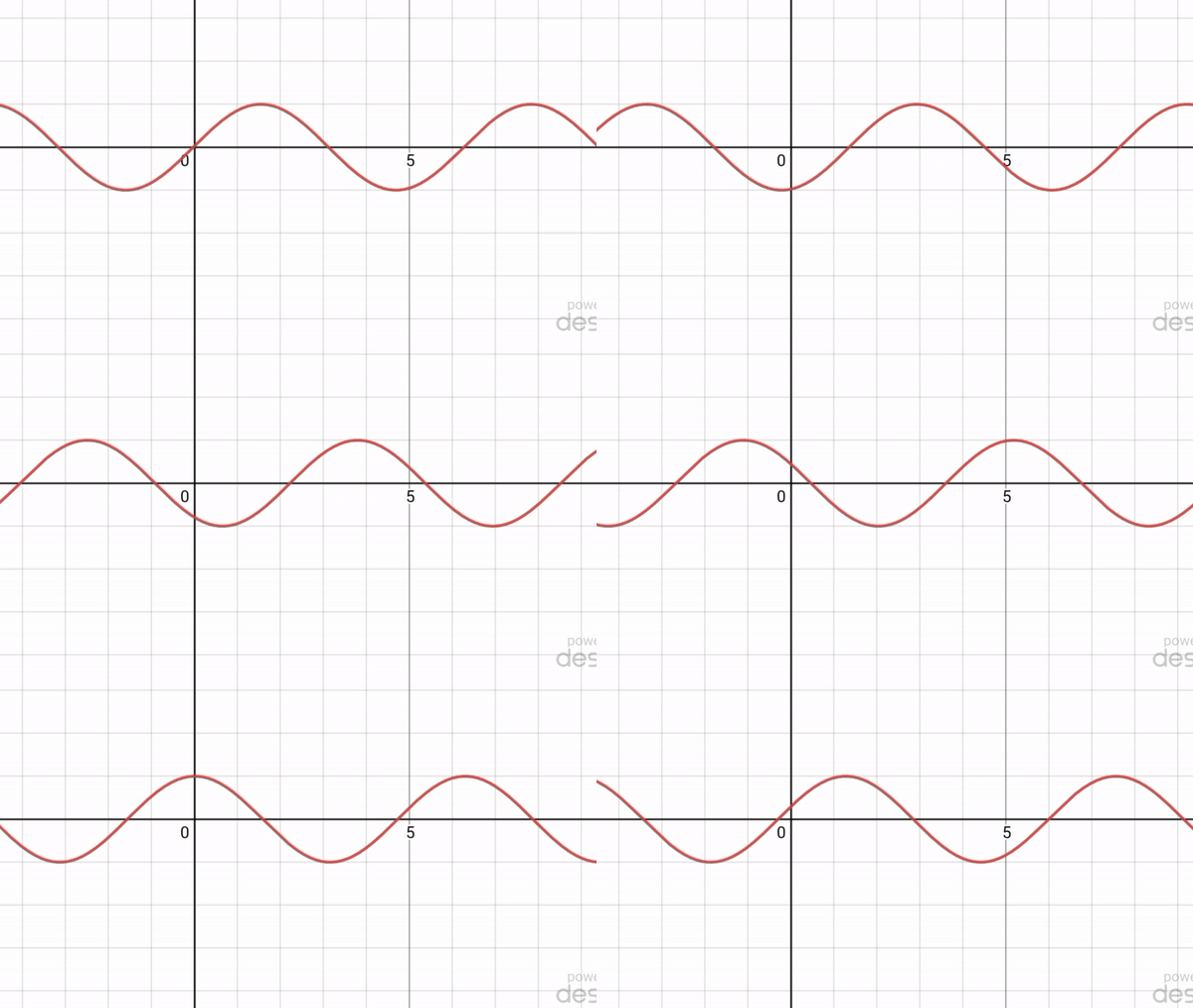
Traveling Wave
- Waves that move at a constant velocity, $c$, in a particular direction
- Represented by an initial profile $F(x)$ that is displaced by $ct$ units as $t$ grows
- $u(x, t) = F(x-ct)$
The Vibrating String Problem
Background
Consider a vibrating string stretched from $x = 0$ to $x = L$ with a vertical displacement given by the function $y=u(x, t)$. The string has a tension coefficient $\tau$ and density coefficient $\rho$. Derive the differential equation that governs this function.
Deriving the Wave Equation
Divide the string into $N$ uniformly distributed particle masses. The $n^{th}$ particle has its $x$-coordinate at $x_{n} = \frac{nL}{N}$. The distance $h$ between particles is $\frac{L}{N}$. Each mass is connected to its neighbors by tension, linking their oscillations.
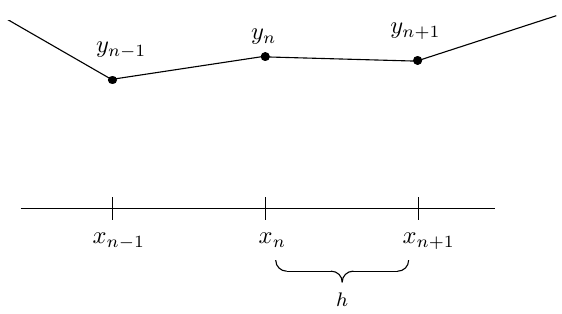
The mass of each particle is $\rho h$. By Newton’s 2nd Law:
$$\Sigma F_{n} = \rho h y''_{n}(t)$$where $\Sigma F_n$ is the vector sum of $F_{T, x+1}$ and $F_{T, x-1}$
Since $F_{T, x+1}$ is proportional to $\frac{(y_{n+1} - y_n)}{h}$, the slope, we may write it as:
$$F_{T, x+1} = \left(\frac{\tau}{h}\right)(y_{n+1}-y_{n})$$Similarly, we may write $F_{T, x-1}$ as:
$$F_{T, x-1} = \left(\frac{\tau}{h}\right)(y_{n-1}-y_{n})$$Therefore:
$$\rho h y''_{n}(t) = \frac{\tau}{h}(y_{n+1}(t)+y_{n-1}(t)-2y_{n}(t))$$We can convert the functions of $y$ into functions of $u$:
$$\rho h y''_{n}(t) = \frac{\tau}{h}(u(x_{n}+h, t)+u(x_{n}-h, t)-2u(x_{n}, t))$$The limit definition of the second derivative states that:
$$f''(x) = \lim_{ h \to 0 } \frac{f(x+h) + f(x-h) - 2f(x)}{h^2}$$If we divide by $h$:
$$\rho y''_{n}(t) = \tau \frac{u(x_{n}+h, t)+u(x_{n}-h, t)-2u(x_{n}, t)}{h^2}$$And let $h$ tend to $0$ (which means having infinite point masses):
$$\rho y''_{n}(t) = \tau \frac{\partial^2 u}{\partial x^2}$$Since $N \to \infty$, the discrete second time derivative $y''_n(t)$ becomes the continuous second time derivative of the function $u(x,t)$:
$$\rho \frac{\partial^2 u}{\partial t^2} = \tau \frac{\partial^2 u}{\partial x^2}$$And since $c = \sqrt{\frac{\tau}{\rho}}$:
$$\frac{1}{c^2}\frac{\partial^2 u}{\partial t^2} = \frac{\partial^2 u}{\partial x^2}$$This is known as the one-dimensional wave equation, more simply the wave equation, where $c$ is the velocity of the motion.
Scaling
We can incorporate scaling to simplify the wave equation further:
- We can replace $x$ with $x=aX$, changing the interval from $x \in [0, L]$ to $X \in \left[0, \frac{L}{a}\right]$, and replace $t$ with $bT$.
- If we set $U(X, T) = u(x, t)$ then $\frac{\partial^2 U}{\partial X^2} = a^2 \frac{\partial^2 u}{\partial x^2}$ and $\frac{\partial^2 U}{\partial T^2} = b^2 \frac{\partial^2 u}{\partial t^2}$.
Therefore, there exist an $a$ and $b$ such that:
$$\frac{\partial^2 U}{\partial T^2} = \frac{\partial^2 U}{\partial X^2}$$which is effectively setting $c = 1$.
Now, we can transform the interval from $x \in [0, L]$ to $X \in [0, \pi]$ (choosing $\pi$ for $L$ is usually a convenient substitution). This is accomplished by making $a = \frac{L}{\pi}$ and $b = \frac{L}{c\pi}$. Once the new equation is solved, we can return to the original equation by making the inverse change of variables.
Solutions to the Wave Equation
Two ways to solve the wave equation:
- using traveling waves
- using the superposition of standing waves
Using Traveling Waves
If we assume $c = 1$ and $L = \pi$, the wave equation becomes:
$$\frac{\partial^2 u}{\partial t^2} = \frac{\partial^2 u}{\partial x^2}$$If a traveling wave $F$ is continuous, then $F(x\pm t)$ are solutions to the wave equation.
Additionally, the wave equation is linear. This means that all linear combinations of particular solutions $u(x, t)$ and $v(x, t)$ are also particular solutions. Therefore:
$$u(x, t) = F(x + t) + G(x-t)$$where $G$ is a continuous traveling wave in the opposite direction as $F$. All solutions take this form.
Applying Traveling Waves to Vibrating String Problem
If we extend the initial shape of the string to all of $\mathbb{R}$ by making it odd and periodic, then $u(x, 0) = f(x) \ \forall \ x \in \mathbb{R}$, and:
$$f(x) = F(x) + G(x)$$Since there are infinite choices of $F$ and $G$ that satisfy this condition, we must impose another initial condition on $u$: the initial velocity of the string, $g(x)$:
$$\frac{\partial u}{\partial t}(x, 0) = g(x),$$where $g(0) = g(\pi) = 0$. We similarly extend $g$ to $\mathbb{R}$. The two initial conditions of position and velocity create this system:
$$ \begin{cases} F(x) + G(x) = f(x) \\ F'(x) - G'(x) = g(x) \end{cases} $$Differentiate $f(x)$ and add/subtract $g(x)$ to obtain:
$$ \begin{align*} 2 F'(x) = f'(x) + g(x) \\ 2 G'(x) = f'(x) - g(x) \end{align*} $$Hence, there are constants $C_1$ and $C_2$ such that
$$F(x) = \frac{1}{2}\left[f(x) + \int_0^x g(y) \ \mathrm{d}y \right] + C_1$$and
$$G(x) = \frac{1}{2}\left[f(x) - \int_0^x g(y) \ \mathrm{d}y \right] + C_2$$Since $F(x) + G(x) = f(x)$, $C_1 + C_2 = 0$, and our final solution takes the form
$$u(x, t) = \frac{1}{2}[f(x+t) + f(x-t)] + \frac{1}{2}\int_{x-t}^{x+t}g(y) \ \mathrm{d}y$$This is known as d'Alembert's formula.
There also exists a negative time solution $u^-$ to the wave equation by setting $u^-(x, t) = u(x, -t)$.
Using Superposition of Standing Waves
We can use separation of variables to express the general solution of the wave equation as a sum of particular solutions in the form $u(x, t) = \phi(x)\psi(t)$.
In the case of the wave equation, we have:
$$\phi(x)\psi''(t) = \phi''(x)\psi(t)$$and therefore
$$\frac{\psi''(t)}{\psi(t)} = \frac{\phi''(x)}{\phi(x)}$$Since the LHS only depends on $t$ and the RHS only depends on $x$, both sides must equal a constant, $\lambda$:
$$ \begin{cases} \psi''(t) - \lambda\psi(t) = 0 \\ \phi''(x) - \lambda\phi(x) = 0 \end{cases} $$For $\psi$ to oscillate with time, $\lambda \ge 0$. Therefore, we can write $\lambda = -m^2$ with the solution of the equation given by:
$$\psi(t) = A\cos{mt} + B\sin{mt}$$The solution to the second solution is:
$$\phi(x) = \tilde{A}\cos{mx} + \tilde{B}\sin{mx}$$Since the string is attached at $x=0$ and $x=\pi$, $\phi(0) = \phi(\pi) = 0$ and $\tilde{A} = 0$. If $\tilde{B} \ne 0$, then $m$ must be an integer. For each $m \ge 1$ the function
$$u_{m}(x, t) = (A_{m}\cos{mt} + B_{m}\sin{mt})\sin{mx}$$is a solution to the wave equation and is a standing wave. You have to double check that $u_m$ solves the equation, since $\phi$ and $\psi$ sometimes vanish when being divided.
Harmonics
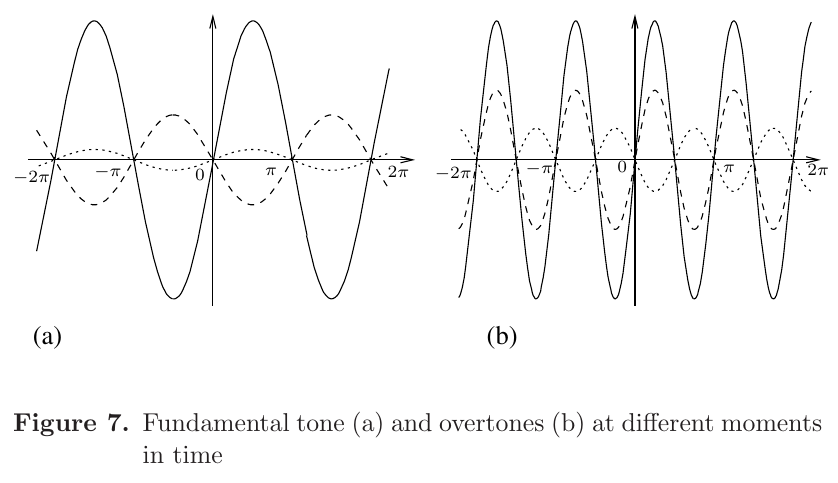
Consider the wave function $u(x, t) = \cos{t}\sin{x}$ for a vibrating string.
The case $m = 1$ for a standing wave is the first harmonic of a vibrating string. This is also called the fundamental tone of the string.
When $m = 2$, $u(x, t) = \cos{2t}\sin{2x}$. This is the first overtone or second harmonic. This generalizes for all $m$. As $m$ increases, the frequency increases and the period $\frac{2\pi}{m}$ goes down.
Superposition
Since all solutions to the wave equation are linear, we can construct more solutions by taking linear combinations of the standing waves $u_m$. This is known as superposition:
$$u(x, t) = \sum_{m=1}^\infty(A_{m}\cos{mt}+B_{m}\sin{mt})\sin{mx}$$with the initial shape of the function $u(x, 0) = f(x)$ given by:
$$\sum_{m=1}^\infty A_{m}\sin{mx} = f(x)$$The fundamental question becomes whether it is possible to find coefficients $A_m$ to make the above true.
The Plucked String
Suppose we have a string from $[0, \pi]$ that satisfies the wave equation with $c = 1$. The string is plucked to height $h$ at $p$ between $0$ and $\pi$. The initial position of the string is given by the piecewise function
$$ f(x) = \begin{cases} \frac{xh}{p} & 0 \le x \le p \\ \frac{h(\pi - x)}{\pi - p} & p \le x \le \pi \end{cases} $$If we let $g(x) = 0$, we can compute $A_m$, the Fourier coefficients of $f$:
$$ \begin{align} A_m &= \frac{2h}{\pi p} \int_{0}^{p} x \sin(mx) \,dx + \frac{2h}{\pi (\pi - p)} \int_{p}^{\pi} (\pi - x) \sin(mx) \,dx \\[10pt] &= \frac{2h}{\pi p} \left( -\frac{p \cos(mp)}{m} + \frac{\sin(mp)}{m^2} \right) + \frac{2h}{\pi (\pi - p)} \left( \frac{(\pi - p) \cos(mp)}{m} + \frac{\sin(mp)}{m^2} \right) \\[10pt] &= -\frac{2h \cos(mp)}{\pi m} + \frac{2h \sin(mp)}{\pi m^2 p} + \frac{2h \cos(mp)}{\pi m} + \frac{2h \sin(mp)}{\pi m^2 (\pi - p)} \\[10pt] &= \frac{2h \sin(mp)}{\pi m^2 p} + \frac{2h \sin(mp)}{\pi m^2 (\pi - p)} \\[10pt] &= \frac{2h \sin(mp)}{\pi m^2} \left( \frac{1}{p} + \frac{1}{\pi - p} \right) \\[10pt] &= \frac{2h \sin(mp)}{\pi m^2} \cdot \frac{\pi}{p (\pi - p)} \\[10pt] &= \frac{2h}{m^2} \frac{\sin(mp)}{p (\pi - p)}. \end{align} $$When we put this into
$$ f(x) = \sum_{m=1}^\infty A_{m}\sin(mx) $$we get
$$ u(x, t) = \sum_{m}^\infty A_{m} \cos(mt) \sin(mx) $$which matches the solution obtained by d'Alembert's formula
The Heat Equation
Derivation
Consider a square plate $S$ in $\mathbb{R}^2$ centered at $(x_0, y_0)$ and side length $h$ with an initial heat profile at $t = 0$. Let the temperature at $(x, y)$ at $t$ be denoted by $u(x, y, t)$. The amount of heat energy in $S$ at $t$ is given by
$$ H(t) = \sigma \int \int_{S}u(x,y,t) \ \mathrm{d}x \mathrm{d}y $$where $\sigma$ is the specific heat of $S$. Therefore, the heat flow is
$$ \frac{\partial H}{\partial t} = \sigma \int \int_{s} \frac{\partial u}{\partial t} \ \mathrm{d}x \mathrm{d}y $$which is approximately equal to
$$ \sigma h^2 \frac{\partial u}{\partial t}(x_{0}, y_{0}, t) $$since the area of $S$ is $h^2$