Notes › ENGR 2341: Signals and Systems Lecture 10
Frequency Response
236 words 1 min Modified
Table of Contents
Continuous-time Systems
- Represented by:
- Differential equation
- Impulse response (convolution integral)
- Frequency response
- Transfer function
- Impulse response, $h(t)$, is the system response to $\delta$
- LTI system is BIBO stable if its impulse response is absolutely integrable
Frequency Response
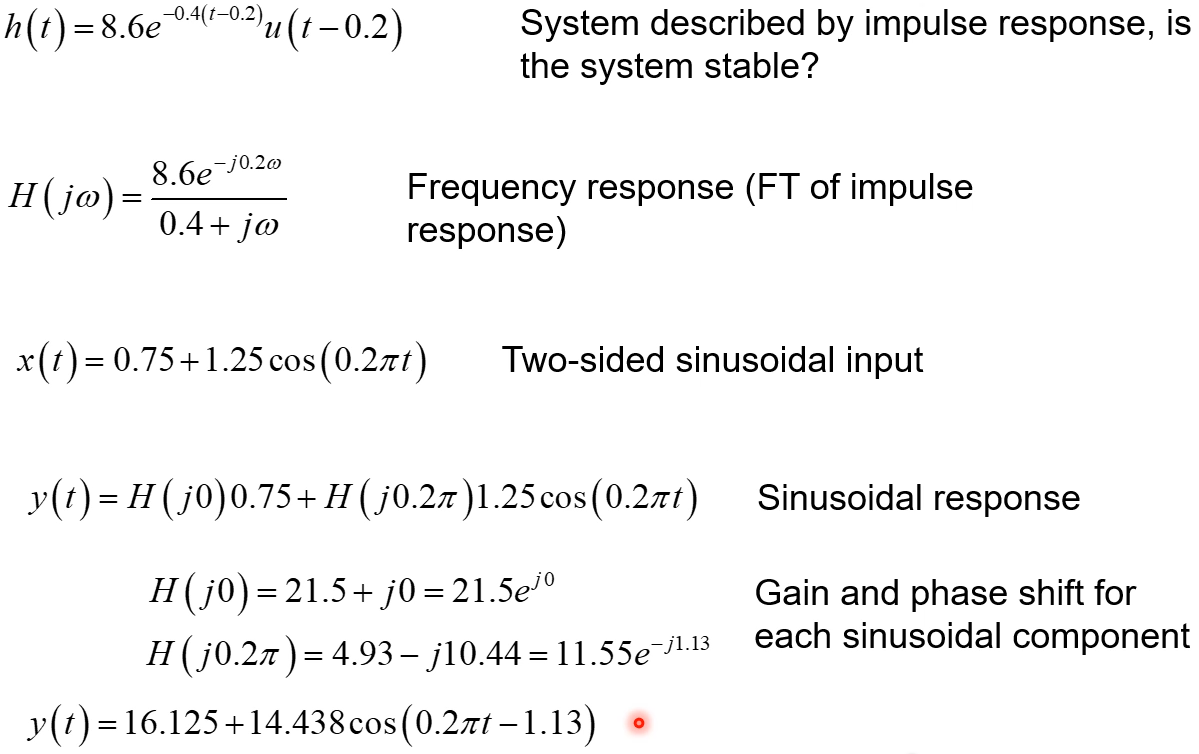
- Describes what the system does to sinusoidal inputs
- Broken down into magnitude and phase components
- Determined using the Fourier transform of $h(t)$
Analysis of $H(j\omega)$
Let $H(j\omega)$ be a general frequency response function of the form $H(jω)= \frac{N(j\omega)}{D(j\omega)}$. Then:
- $|H(j\omega)| = \frac{|N(j\omega)|}{|D(j\omega)|}$
- $H(j\omega) = \angle N(j\omega) - \angle D(j\omega)$
Magnitude Calculation
- If $M(j\omega) = A e^{j\phi(\omega)}$, $|M(j\omega)| = A$
- If $M(j\omega) = a + j b(\omega)$, $|M(j\omega)| = \sqrt{a^2 + b(\omega)^2}$
Phase Calculation
- If $M(j\omega) = A e^{j\phi(\omega)}$, $\angle M(j\omega) = \phi(\omega)$
- If $M(j\omega) = a + j b(\omega)$, $\angle M(j\omega) = \tan^{-1}\left(\frac{b(\omega)}{a}\right)$
Sinusoidal Response
- Response to sinusoids for an LTI system is a sinusoid of the same frequency with a shifted amplitude (gain) and phase, dependent on $H(j\omega)$
- Frequencies of the sinusoidal components cannot change and it must be two-sided
- Input format $x(t)$:
- Output format $y(t)$:
References
- Frequency response (course handout)
Sources
- Frequency response