Notes › ENGR 2341: Signals and Systems Lecture 24
Digital Filter Design
254 words 2 min Modified
Table of Contents
Digital Filters
- Designed to have certain characteristics in the frequency domain
- Advantages over analog filters:
- Linear phase response
- Robust to environmental changes (temperature)
- Can be modified if implemented with a microprocessor or digitized
- Disadvantages over analog filters:
- Speed limitation at high RF frequencies
- Noise generated from sampling and quantization
FIR Vs IIR Filters
- Can find more at FIR and IIR Filters
FIR
- Linear phase
- Always BIBO stable
- More robust to quantization of filter coefficients
- Difficult to design without CAD tools
IIR
- Nonlinear phase, especially at the edges of bands
- Not guaranteed to be BIBO stable
- Can be designed from analog filters (less difficult to design)
- Can process signals more quickly to meet higher frequency specifications
Recommended Use Cases
- FIR is recommended when you have a small number of filter coefficients and the phase distortion needs to be minimized
- IIR is recommended when sharp band edges are needed and the frequency is very high
Filter Design Steps
- Specify filter requirements
- Frequency domain specs
- Processing time
- Implementation method
- Cost of filter
- Calculate filter coefficients
- FIR coefficients determined using windowing, frequency sampling, or Parks-McClellan optimization method
- IIR coefficients determined by transforming analog filters or using zero-pole placement
- Verify the design meets specifications
- Realize the design using a computer
- Analyze the effect of finite word length on the performance
- Check that the specifications met with filter coefficient quantization
- Implement the filter in hardware/software
- Need memory to store filter coefficients and present/past inputs/outputs, multipliers, and adders
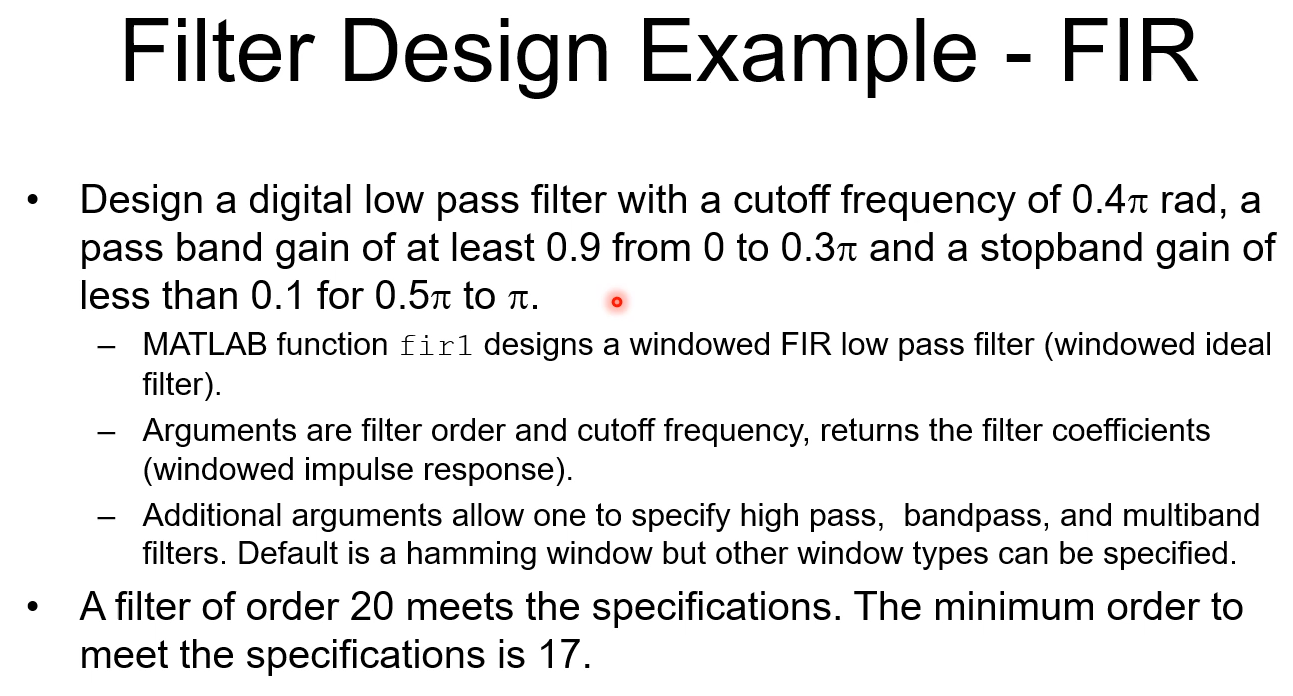
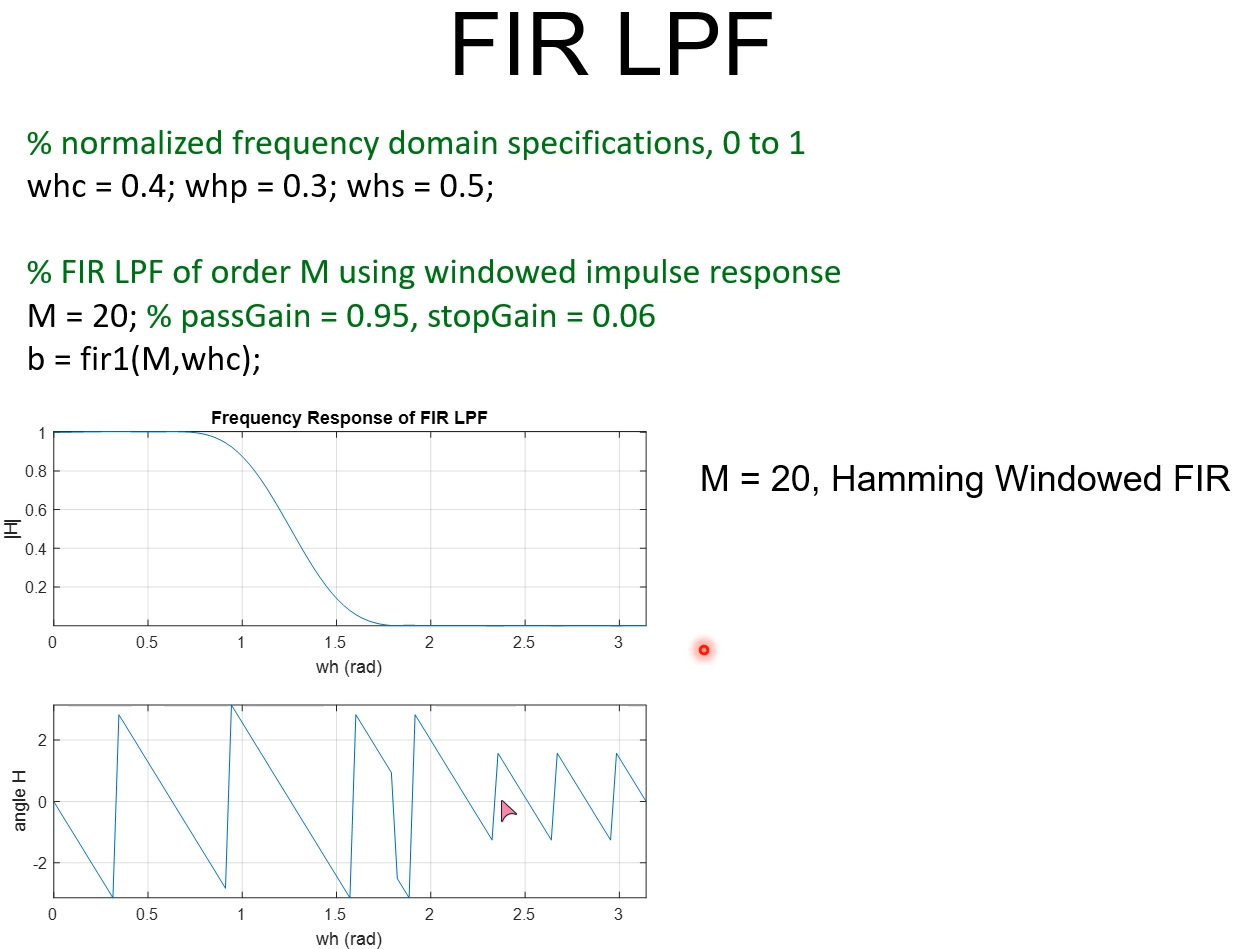
FIR Low Pass Filter Design Example
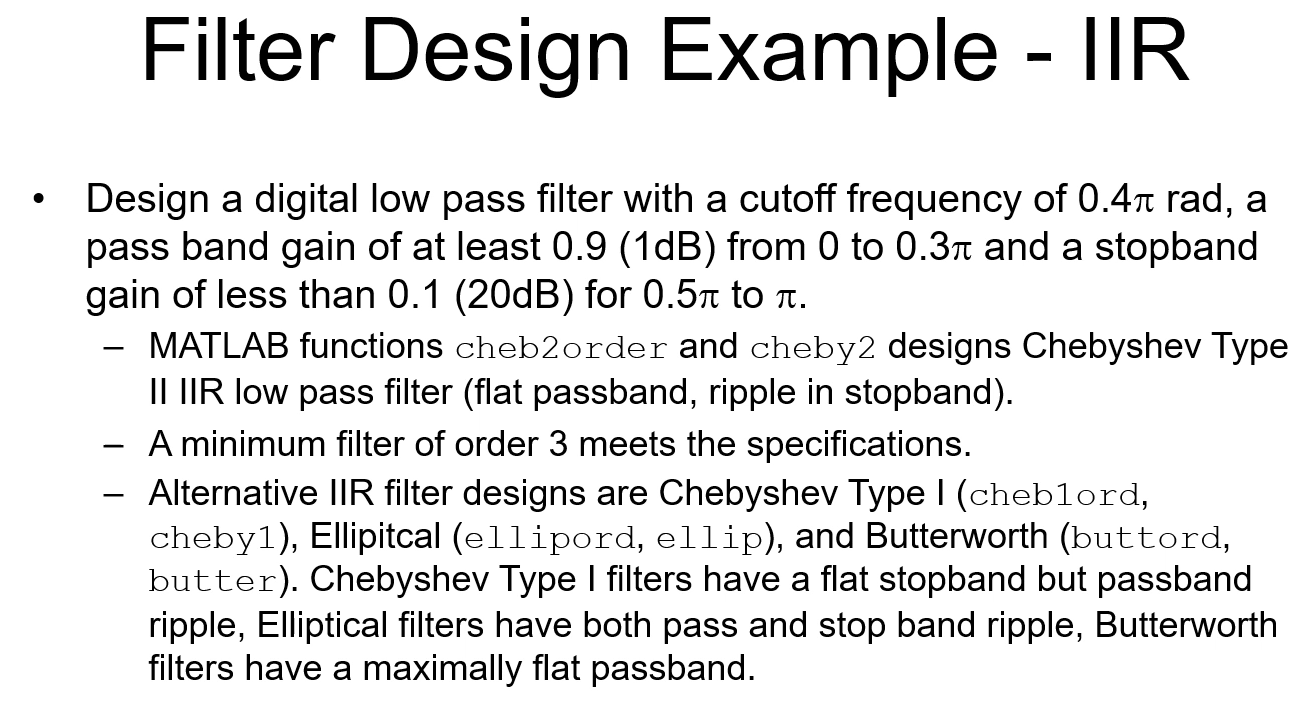
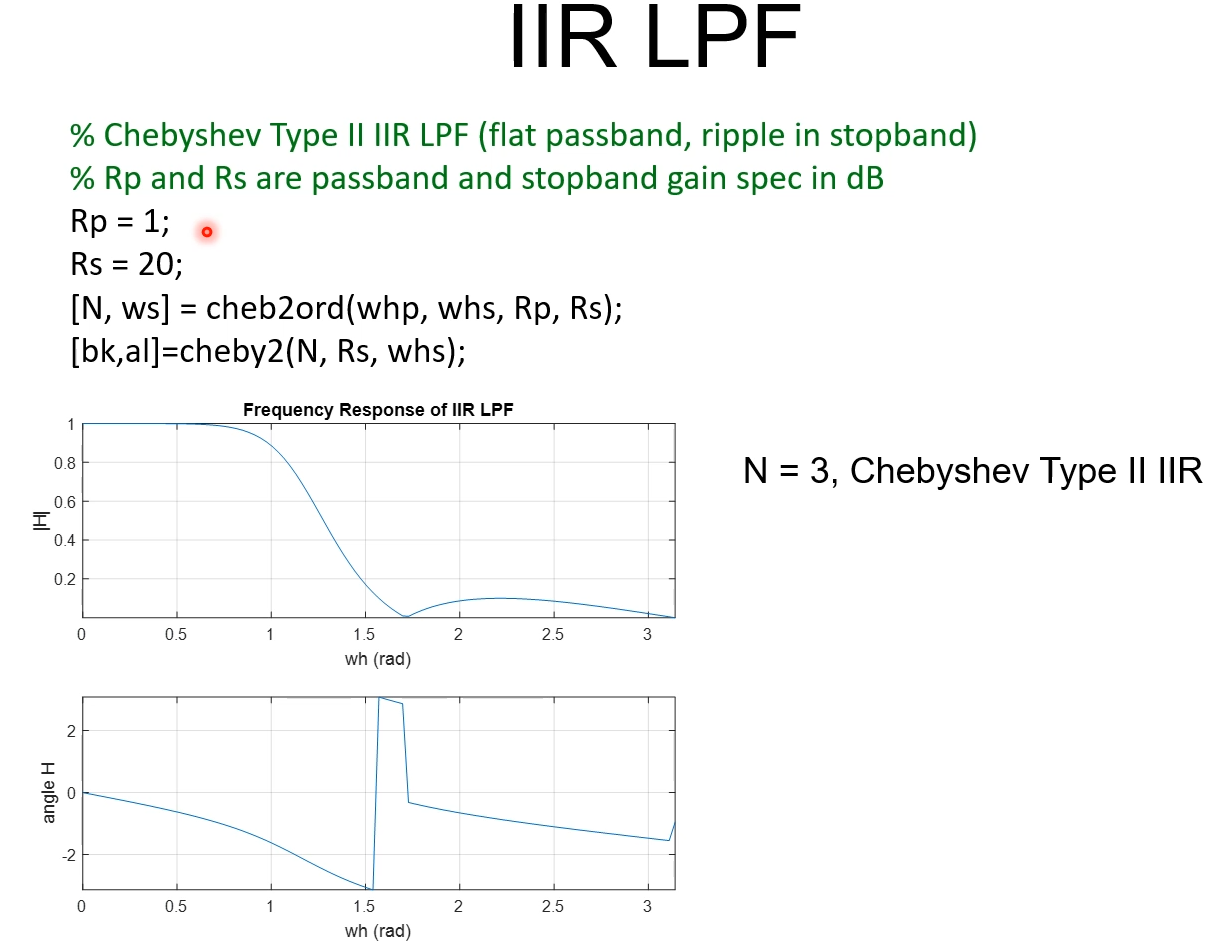
IIR Low Pass Filter Design Example