Notes › ENGR 2341: Signals and Systems Lecture 5
Continuous Time System Response
166 words 1 min Modified
Table of Contents
Convolution
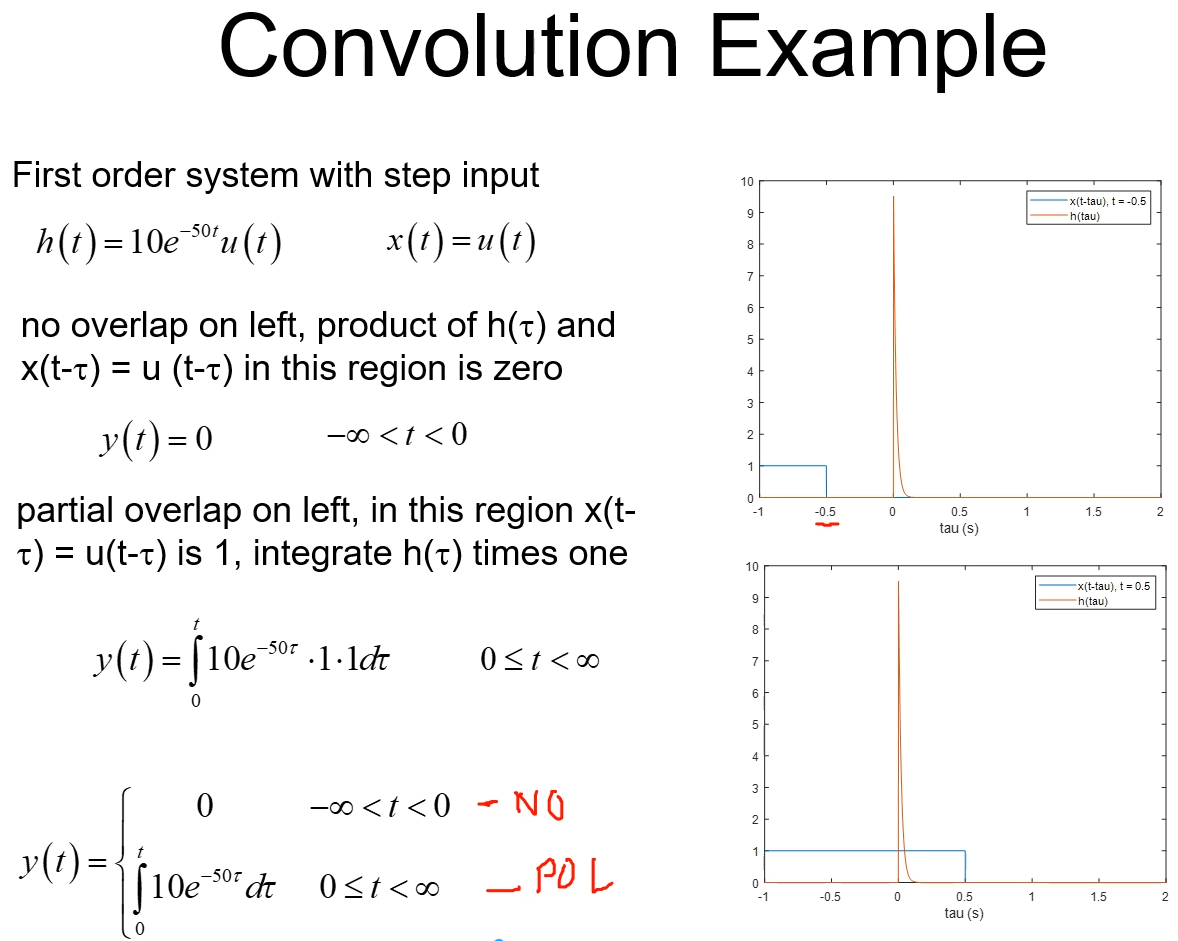
- An operator that takes a kernel $h(t)$ and a signal $x(t)$ and accumulates the interactions between both
- For each $\tau$, the reflected kernel $h(-τ)$ is shifted by $t$ to become $h(t−τ)$. This shifted kernel is then multiplied with the signal $x(τ)$
- Fancy multiplication; the kernel acts as a weight/filter that determines how much influence different parts of the signal have on the output
- Linear, distributive, associative, and commutative
LTI System Responses
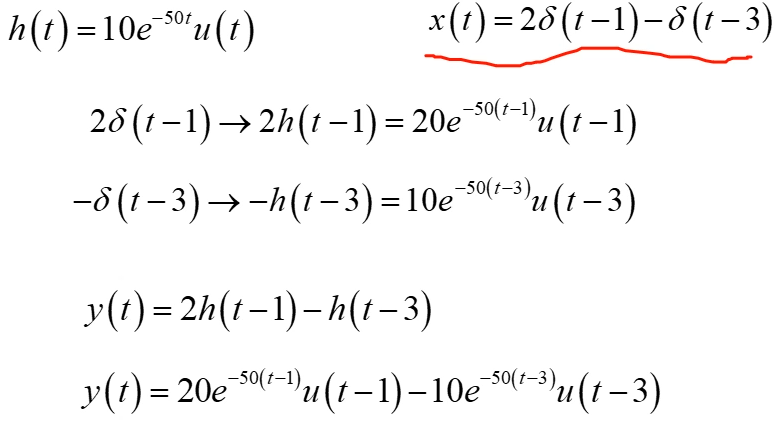
- If fed a weighted sum of impulses and the impulse response is known, the output is the corresponding weighted sum of response output
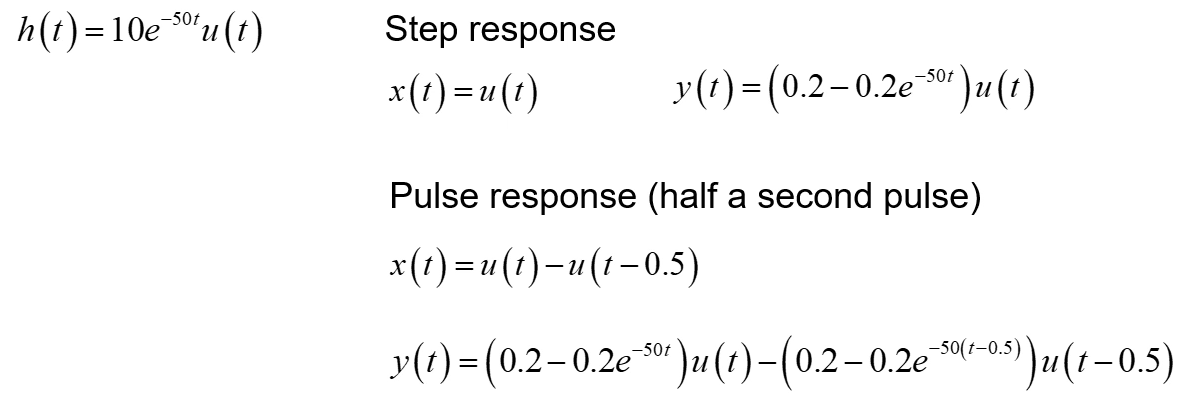
- If fed a weighted sum of functions and the response for each of those functions is known, the output is the corresponding weighted sum
Numerical Convolution
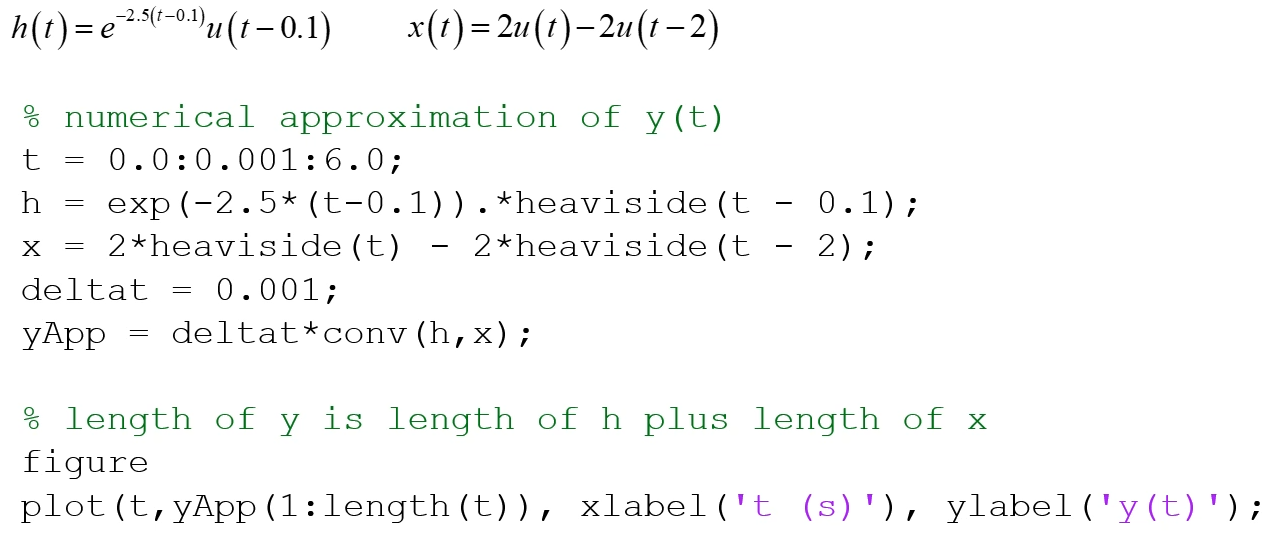
- Responses can be approximated when integral convolution is not practical
- MATLAB uses
convto approximate convolution integrals with midpoint method
MATLAB Code
References
- Continuous-time system response (course handout)
- https://betterexplained.com/articles/intuitive-convolution/
Sources
- Continuous-time system response